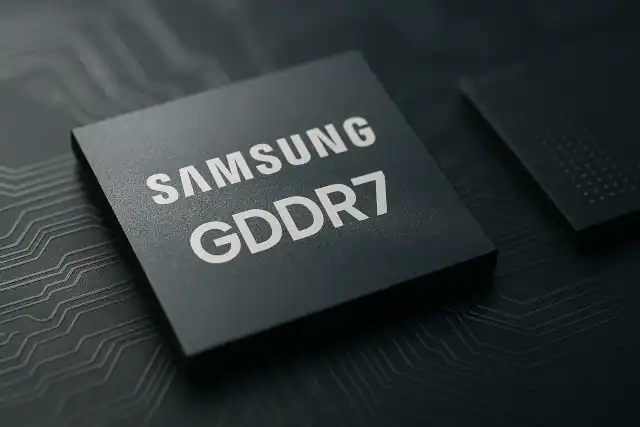
Samsung Samples 24Gb GDDR7 DRAM with Blazing 36Gbps Speeds
Samsung Samples 24Gb GDDR7 DRAM with Blazing 36Gbps Speeds
- 60% of MD5 Password Hashes Can Be Cracked in Under an Hour with a Single GPU
- Dirty Frag: Root Access on Every Major Linux Distribution — No Patch, No Warning
- Ubuntu 26.04 LTS (Resolute Raccoon): The Most Ambitious Ubuntu LTS in a Decade
- Proton Mail: Data Transferred to FBI Again!
- How Close Are Quantum Computers to Breaking RSA-2048?
- How to Prevent Ransomware Infection Risks?
- What is the best alternative to Microsoft Office?
Samsung Samples 24Gb GDDR7 DRAM with Blazing 36Gbps Speeds
Tech giant ramps up memory performance with new high-speed variants for next-generation graphics cards
Samsung Electronics has expanded its GDDR7 memory lineup with faster sample variants reaching speeds up to 36Gbps, marking a significant leap in graphics memory performance.
The South Korean semiconductor manufacturer recently added 32Gbps and 36Gbps versions to its product catalog, building on last month’s announcement of the industry’s first 24Gb GDDR7 DRAM.
The new samples, designated as K4vcf325zc-sc32 (32Gbps) and K4vcf325zc-sc36 (36Gbps), join the previously announced 28Gbps variant (K4vcf325zc-sc28).
This progression gives graphics card manufacturers multiple speed options to choose from when designing next-generation products, potentially including NVIDIA’s rumored GeForce RTX 50 SUPER series, which is expected to utilize 3GB memory modules.
Advanced Manufacturing and Efficiency
Samsung’s 24Gb GDDR7 memory leverages the company’s fifth-generation 10-nanometer class DRAM manufacturing process. Despite maintaining the same physical package dimensions as previous generations, the chips achieve a remarkable 50% increase in storage density, allowing 3GB of memory per chip compared to 2GB in GDDR6 configurations.
A key innovation distinguishes GDDR7 from its predecessors: the implementation of PAM3 (Pulse Amplitude Modulation 3-level) signal encoding. This represents a departure from the NRZ/PAM2 encoding used in GDDR6 and the PAM4 mechanism employed in GDDR6X, offering improved data transmission efficiency at higher speeds.
Power Efficiency Gains
Samsung has incorporated several power-saving technologies originally developed for mobile products into its graphics memory lineup. The GDDR7 chips feature clock control management and dual-voltage design, which work together to reduce unnecessary power consumption during operation. These optimizations contribute to an overall energy efficiency improvement exceeding 30% compared to GDDR6.
To ensure stability during high-frequency operation, Samsung has implemented power gating design, which effectively suppresses current leakage that can occur at elevated clock speeds. This is particularly important as memory speeds push toward the 40Gbps threshold that industry experts predict will become the next benchmark.
Market Implications
The availability of multiple speed grades provides graphics card manufacturers with flexibility in product positioning and performance tiers. While NVIDIA has not officially confirmed which memory speeds it will adopt for upcoming products, the existence of 36Gbps samples suggests that premium graphics cards could see substantial bandwidth improvements in the near future.
For context, a graphics card using twelve 24Gb GDDR7 chips running at 36Gbps across a 384-bit memory interface would achieve a theoretical memory bandwidth of 1,728 GB/s, representing a significant increase over current high-end solutions.
Samsung’s rapid progression from 28Gbps to 36Gbps samples within weeks demonstrates the company’s commitment to maintaining its leadership position in the graphics memory market. As artificial intelligence workloads and high-resolution gaming continue to demand greater memory bandwidth, these advances in GDDR7 technology position Samsung to meet the evolving needs of GPU manufacturers and end users alike.
The samples are currently available to Samsung’s partners for evaluation and integration into upcoming product designs, with mass production expected to ramp up as customer demand materializes in 2025.