Low-Cost SSDs Vanish as Korean Memory Giants Refuse Production Increases Despite Shortages
Low-Cost SSDs Vanish as Korean Memory Giants Refuse Production Increases Despite Shortages
- 60% of MD5 Password Hashes Can Be Cracked in Under an Hour with a Single GPU
- Dirty Frag: Root Access on Every Major Linux Distribution — No Patch, No Warning
- Ubuntu 26.04 LTS (Resolute Raccoon): The Most Ambitious Ubuntu LTS in a Decade
- Proton Mail: Data Transferred to FBI Again!
- How Close Are Quantum Computers to Breaking RSA-2048?
- How to Prevent Ransomware Infection Risks?
- What is the best alternative to Microsoft Office?
Low-Cost SSDs Vanish as Korean Memory Giants Refuse Production Increases Despite Shortages
Major NAND manufacturers shift focus to more profitable DRAM, leaving consumers facing sustained price hikes through 2027
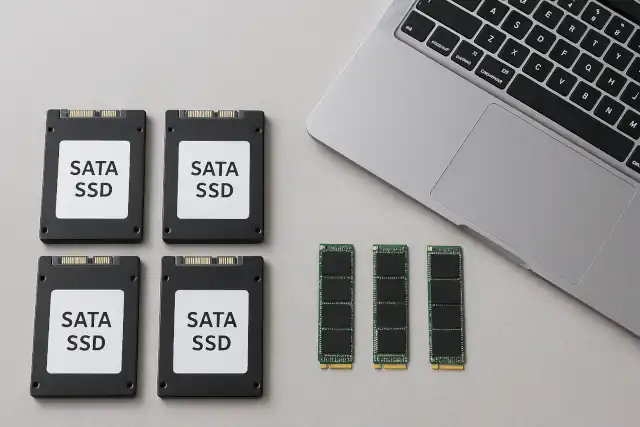
The storage market is experiencing a dramatic transformation as consumers face a harsh new reality: affordable SSDs are becoming a thing of the past, with industry experts warning that budget-friendly solid-state drives may remain scarce for at least the next year.
As of December 1, 2024, the ongoing shortage of NAND flash chips has driven SSD prices to levels not seen in years.
What once bought a 2TB drive now barely covers a 1TB model, with prices effectively doubling across the board.
The situation mirrors the concurrent crisis in DRAM pricing, where upgrading to 32GB or 48GB of memory has become prohibitively expensive for many consumers.
World’s First Self-Destructing SSD: T-CREATE EXPERT P35S Enables One-Button Data Destruction
Strategic Shift by Industry Leaders
The heart of the problem lies in a calculated decision by the world’s dominant memory manufacturers. SK Hynix and Samsung, which together control a significant portion of global NAND and DRAM production, have made a strategic pivot that prioritizes short-term profitability over market supply.
SK Hynix is redirecting manufacturing capacity from NAND flash to the more lucrative DRAM market, a move that reflects broader industry trends. Samsung has adopted a similar strategy, with both companies showing little interest in expanding overall production capacity despite soaring demand.
Is It True That Your SSD Only Keeps Data Safe for One Year?
Enterprise Market Drives Shortage
The shortage has become particularly acute in the enterprise segment, where data center operators are competing for limited supplies. High-capacity SSDs ranging from 8TB to 30TB have seen price increases of 25% to 40%, yet these premium products remain in short supply. Major tech companies investing billions in data center infrastructure cannot afford delays, making them willing to pay premium prices regardless of cost.
This willingness to pay has created a two-tier market where enterprise customers absorb available inventory at inflated prices, leaving consumer-grade products even more constrained.
Why Enterprise Data Centers Still Rely Heavily on Hard Disk Drives Despite SSD Advancements?
Industry-Wide Production Restraint
The calculated approach extends beyond the Korean giants. Western Digital’s SanDisk division, Micron Technology, and Kioxia (formerly Toshiba Memory) have all adopted similar strategies, creating what amounts to an industry-wide production slowdown.
This coordinated restraint stems from recent history. The previous two years saw overproduction that led to a supply glut and collapsing prices, which severely impacted profit margins across the sector. Having endured that painful period, manufacturers are now prioritizing profitability over market share growth.
Should You Upgrade to PCIe 5.0 SSD?
Long Road to Recovery
The outlook for consumers remains bleak in the near term. Building new semiconductor fabrication capacity typically requires 18 to 24 months, meaning any decision to expand production today wouldn’t yield results until late 2026 at the earliest. Industry analysts don’t expect price stabilization until 2027.
The current situation creates a perfect storm for sustained high prices: strong demand from AI and data center expansion, manufacturers reluctant to risk overproduction, and the long lead times required for capacity expansion. For consumers planning storage upgrades, the message is clear: the era of cheap, abundant SSDs has ended, at least for the foreseeable future.
As the market adjusts to this new reality, buyers may need to reconsider their storage strategies, whether that means making purchases now before prices climb further, accepting smaller capacities, or delaying upgrades until the market eventually rebalances in the years ahead.