Industries Disrupted by the iPhone: A Tech Revolution
Industries Disrupted by the iPhone: A Tech Revolution
- 60% of MD5 Password Hashes Can Be Cracked in Under an Hour with a Single GPU
- Dirty Frag: Root Access on Every Major Linux Distribution — No Patch, No Warning
- Ubuntu 26.04 LTS (Resolute Raccoon): The Most Ambitious Ubuntu LTS in a Decade
- Proton Mail: Data Transferred to FBI Again!
- How Close Are Quantum Computers to Breaking RSA-2048?
- How to Prevent Ransomware Infection Risks?
- What is the best alternative to Microsoft Office?
Industries Disrupted by the iPhone: A Tech Revolution
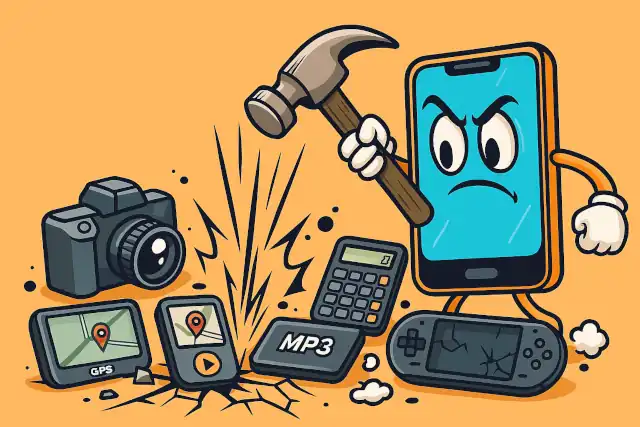
Since its launch in 2007, the iPhone has fundamentally transformed the consumer electronics landscape, rendering entire product categories obsolete.
Here’s a look at the industries that fell victim to the smartphone revolution.
Portable Digital Cameras
The iPhone’s increasingly sophisticated camera technology decimated the point-and-shoot camera market. With computational photography, multiple lenses, and instant sharing capabilities, smartphones eliminated the need for casual photographers to carry separate devices. The compact camera industry collapsed, with shipments dropping over 90% from their 2010 peak.
GPS Navigation Devices
Standalone GPS units from companies like Garmin and TomTom once dominated car dashboards. The iPhone’s integrated mapping and turn-by-turn navigation made these dedicated devices redundant. The convenience of always having updated maps in your pocket, without purchasing expensive map updates, spelled doom for portable navigation systems.
MP3 and MP4 Players
The iPod’s own successor became its killer. The iPhone combined music playback with phone functionality, making dedicated media players unnecessary. The portable media player market, once valued in billions, virtually disappeared as streaming services and smartphone storage made standalone devices obsolete.
Pocket Calculators
Scientific and basic calculators, once essential for students and professionals, became unnecessary when the iPhone offered built-in calculator apps with advanced functions. Third-party apps even provided graphing calculator capabilities that rivaled expensive dedicated devices.
Digital Voice Recorders
Journalists, students, and professionals once relied on dedicated voice recorders. The iPhone’s high-quality microphones and recording apps eliminated this market almost entirely, offering better organization, instant sharing, and cloud backup that standalone recorders couldn’t match.
Electronic Dictionaries and Translators
Devices like electronic translators and pocket dictionaries were popular among travelers and language learners. The iPhone’s instant internet access, translation apps, and digital dictionaries made these single-purpose devices completely obsolete.
Alarm Clocks and Timers
Bedside alarm clocks became redundant as smartphones took over wake-up duties. The iPhone’s customizable alarms, multiple timer functions, and stopwatch capabilities eliminated the need for separate devices, fundamentally changing bedroom nightstands worldwide.
Paper Maps and Atlases
While not an electronic device, paper map sales plummeted as iPhone navigation became ubiquitous. Gas stations and bookstores that once sold road atlases saw this revenue stream dry up, and map publishers struggled to remain relevant in a digital-first world.
Portable Gaming Consoles
While not entirely eliminated, devices like the Nintendo DS and PlayStation Portable faced enormous pressure from iPhone gaming. The App Store’s massive library of games, many free or cheap, significantly eroded the handheld gaming console market.
Flashlights
Simple but significant: the iPhone’s LED flash became a universal flashlight, devastating sales of small portable flashlights. What was once a common household purchase became unnecessary for most consumers.
The Convergence Effect
The iPhone’s impact demonstrates the power of device convergence. By integrating dozens of functions into one pocket-sized device, Apple didn’t just compete with these industries—it made them largely irrelevant.
This consolidation continues today, with each iPhone generation absorbing more functionality that once required dedicated devices.
The lesson is clear: in the smartphone era, specialized single-purpose devices face an existential threat unless they offer capabilities that significantly exceed what an integrated smartphone can provide.
Major Related Bankruptcies:
- Eastman Kodak (2012) – Lost its camera dominance
- Motorola Mobile (2006-2009) – Market share collapsed from 21% to 5%
- BlackBerry/RIM (exited 2016) – Failed to adapt to touchscreens
- Nokia (sold 2013) – Lost 60% market share
- Palm (2010) – Couldn’t compete with iPhone UX
- BenQ-Siemens (2006) – $1 billion loss
- Gionee (2018) – Chinese manufacturer
- Sagem/MobiWire (2011) – Budget phone maker