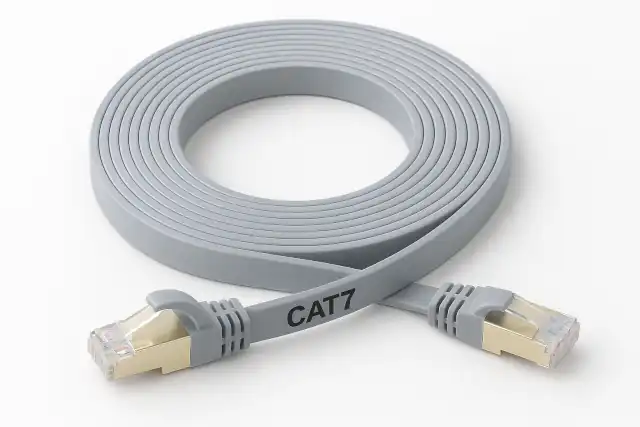
Flat CAT7 Cables vs. Traditional Twisted Pair: Can They Match the Performance?
Flat CAT7 Cables vs. Traditional Twisted Pair: Can They Match the Performance?
- Apple’s Native Linux Container Tool Has Arrived — But Can It Really Replace Docker?
- 60% of MD5 Password Hashes Can Be Cracked in Under an Hour with a Single GPU
- Dirty Frag: Root Access on Every Major Linux Distribution — No Patch, No Warning
- Proton Mail: Data Transferred to FBI Again!
- How Close Are Quantum Computers to Breaking RSA-2048?
- What is the best alternative to Microsoft Office?
Flat CAT7 Cables vs. Traditional Twisted Pair: Can They Match the Performance?
In the networking world, a question frequently arises among consumers and IT professionals: can flat CAT7 Ethernet cables deliver the same transmission speeds as traditional round, twisted-pair CAT7 cables?
As flat cables gain popularity for their space-saving design and aesthetic appeal, understanding their performance limitations compared to conventional cables has become increasingly important.
CAT5e CAT6 CAT6a CAT7 Comparison
Understanding CAT7 Cable Standards
CAT7 cables are specified under the ISO/IEC 11801:2002 standard, also known as Class F cabling, and were ratified in 2002 to support 10 Gigabit Ethernet over 100 meters of copper cabling.
The specification mandates several critical requirements:
- Frequency support: 600 MHz bandwidth over 100 meters
- Data transmission: 10 Gbps standard speed, with laboratory tests showing capabilities up to 40 Gbps at 50 meters and 100 Gbps at 15 meters
- Construction: Four individually shielded twisted copper pairs plus an overall cable shield
- Shielding: S/FTP (Shielded Foil Twisted Pair) configuration with dual shielding design
However, there’s an important caveat: CAT7 is not an IEEE standard and lacks approval from TIA/EIA, using proprietary connectors rather than standard RJ-45. This has limited its widespread adoption despite impressive specifications.
Why CAT7 Shielded Cables Are Unnecessary for Most Home and Office Networks?
The Fundamental Design Difference
The performance gap between flat and round CAT7 cables stems from their internal construction:
Traditional Round CAT7 Cables:
- Feature tightly twisted copper pairs that naturally cancel electromagnetic interference
- Include multiple protective layers with fillers maintaining circular shape
- Mandate S/FTP construction with a braided shield mesh and individual foil wrapping for each twisted pair
Flat CAT7 Cables:
- Arrange twisted pairs side by side rather than in a square configuration, making overall shielding more difficult
- Modern versions claim to use twisted pairs, but the geometry differs significantly
- Generally feature thinner profiles with minimal filler material
Can Wi-Fi 8 Handle Thousands of Devices Without Slowing Down?
Performance Reality: The Speed Question
The short answer is: flat CAT7 cables can theoretically achieve similar speeds to round cables, but with significant caveats.
When Flat Cables Perform Well:
Recent developments have improved flat cable technology. Modern flat twisted pair cables meet ISO/IEC 11801 Ea Class and ANSI/EIA/TIA-568 Cat 6A Channel standards, and some testing shows flat cables can outperform round cables in NEXT crosstalk measurements. Contemporary flat CAT7 products feature foiled twisted pair (FTP) construction with oxygen-free copper and individual pair shielding.
For short runs in low-interference environments, quality flat CAT7 cables can deliver:
- Full 10 Gbps transmission speeds
- 600 MHz bandwidth performance
- Adequate EMI/RFI protection
Where Flat Cables Fall Short:
However, several inherent limitations exist:
-
Distance limitations: Flat cables suffer from greater signal loss and are best for runs under 15 meters to avoid performance degradation, while round cables reliably maintain signal integrity up to 100 meters
-
Interference susceptibility: Despite twisted pairs, flat cables lack the optimal twist rates and copper volume of round cables, affecting performance against crosstalk
-
Physical durability: Flat cables have less shielding and are more vulnerable to EMI, making round cables preferable for scenarios requiring optimal EMI protection and signal reliability
-
Conductor gauge: Flat cables often use 32AWG or smaller conductors compared to 24AWG or larger in round cables, reducing overall copper content and insulation
Why You Should Still Turn Off WiFi When You’re Not Using It?
The Connector Compatibility Problem
An often-overlooked issue affects all CAT7 cables, flat or round: CAT7 uses proprietary GG45 or TERA connectors, but terminating with standard RJ45 physically bottlenecks performance back to roughly Cat6A standards due to connector pin spacing.
This means that regardless of cable design, most real-world CAT7 implementations cannot fully realize the standard’s theoretical capabilities.
The Inevitable Transition: Why 4G LTE Must Give Way to 5G-SA Standalone Soon
Expert Recommendations
Industry consensus suggests:
Choose Flat CAT7 When:
- Cable runs are under 50 feet
- Aesthetic and space considerations are priorities
- Installation requires routing under carpets or along walls
- Environment has minimal electromagnetic interference
- You purchase from reputable manufacturers with proper certifications
Choose Round CAT7 When:
- Runs exceed 50 feet or approach 100 meters
- Installation is in high-interference environments
- Long-term reliability is critical
- Cables will be subject to physical stress
- Professional data center or industrial applications
For most home and gaming setups under 50 feet, high-quality flat CAT7 cables can deliver comparable speeds, but round CAT7 cables always provide superior interference protection as mandated by the standard.
LiFi Promised Gigabit Speeds a Decade Ago—So Why Are We Still Using WiFi?
The Bigger Picture: Is CAT7 Even Necessary?
CAT7 cables face limited adoption, with CAT6A proving more popular, cost-effective, and future-proof for most applications. Since CAT6A and CAT7 offer identical 10 Gigabit performance, and most users employ 1 Gigabit equipment, purchasing CAT7 often wastes money.
For consumers deciding between flat and round designs, the question may be less about flat versus round CAT7 and more about whether CAT7 is needed at all. CAT7 remains overkill for personal or residential applications without delivering tangible performance benefits over mature CAT6A alternatives.
Speed Latency and Capacity: A Comprehensive Comparative Analysis of Wi-Fi 7 and Wi-Fi 6E
Conclusion
Flat CAT7 cables can approach the transmission speeds of traditional round CAT7 cables under optimal conditions—short distances, quality construction, and low-interference environments. However, they cannot consistently match the performance, durability, and reliability of properly constructed round cables, especially over longer distances or in challenging electromagnetic environments.
The fundamental physics of twisted pair technology favors the traditional round design. While modern manufacturing has significantly improved flat cable performance, the compromises inherent in the flat form factor mean that for mission-critical applications, professional installations, or maximum future-proofing, round CAT7 cables remain the superior choice.
For most home users, the practical advice is simple: if aesthetics and concealment matter and your runs are short, quality flat CAT7 cables will likely suffice. But if you’re building infrastructure meant to last or need guaranteed performance under all conditions, invest in traditional round construction—or better yet, consider whether CAT6A might meet your needs at lower cost and with better industry support.