Samsung Bets on Unmanned Wafer Facility by 2030 to Weaken Union Bargaining Power
- Apple’s Native Linux Container Tool Has Arrived — But Can It Really Replace Docker?
- 60% of MD5 Password Hashes Can Be Cracked in Under an Hour with a Single GPU
- Dirty Frag: Root Access on Every Major Linux Distribution — No Patch, No Warning
- Proton Mail: Data Transferred to FBI Again!
- How Close Are Quantum Computers to Breaking RSA-2048?
- What is the best alternative to Microsoft Office?
TECH & INDUSTRY — SEMICONDUCTOR REPORT
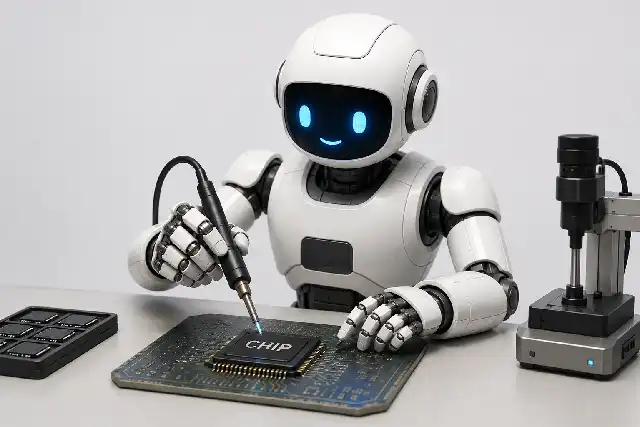
Samsung Bets on Unmanned Wafer Facility by 2030 to Weaken Union Bargaining Power
After a bruising bonus standoff that nearly halted global chip supply, Samsung is accelerating a lights-out factory push through its new Data Sharing Eco Platform — a move analysts say could redraw the balance of power between the conglomerate and its 48,000-member union.
Samsung Electronics is pushing hard toward a fully unmanned semiconductor factory by the end of the decade, accelerating automation and data-sharing infrastructure that analysts say is designed to reduce its reliance on unionized frontline workers and engineers. The effort gained urgency following a high-stakes labor confrontation this spring that brought South Korea’s most important company to the brink of an 18-day nationwide strike.
At the center of Samsung’s strategy is the Data Sharing Eco Platform (DSEP), a new multimodal system the company recently unveiled. Reported first by South Korean technology publication ET News, DSEP shares real-time semiconductor process data with external partners — primarily equipment suppliers — and feeds the aggregated information into Samsung’s proprietary AI models. The goal: autonomous detection of equipment failures, yield drift, and quality irregularities, without a human ever setting foot on the factory floor.
More than 60 partner companies have already joined the platform, with that number expected to grow. Crucially, DSEP enables something previously considered impossible for security reasons: remote diagnosis and repair of equipment that had historically required on-site visits by vendor technicians. By sharing live process data, both Samsung and its suppliers can now identify root causes of malfunctions jointly and quickly, reducing production disruption without a specialist physically entering the fab.
To underpin DSEP’s data demands, Samsung’s semiconductor division (DS) has also established a High-Performance Computing (HPC) center within the division, providing the raw computational backbone for processing the vast volume of sensor and process data that a modern chip factory generates around the clock.
Samsung has already piloted unmanned operation on portions of its chip packaging lines — a segment less sensitive than full wafer fabrication. The results are striking: manufacturing headcount in those areas fell by approximately 85%, equipment failures dropped by roughly 90%, and overall equipment efficiency more than doubled. Samsung and industry observers are careful to note these figures reflect packaging lines, not full wafer fabs, and represent the ceiling of the automation opportunity rather than its current state.
The push also runs parallel to Samsung’s collaboration with Nvidia on Omniverse-based digital twins of its fabs, used for anomaly detection and predictive maintenance — a second track toward what the companies describe as a fully autonomous fab, and part of a broader industry race in which rivals such as TSMC and SK Hynix are pursuing similar 2030 horizons.
The timing of Samsung’s automation acceleration is not coincidental. In May 2026, the company’s largest union — representing roughly 48,000 workers, the majority in the chip division — threatened an 18-day general strike over performance bonuses. South Korean Prime Minister Kim Min-seok warned that direct losses from such a walkout could reach 1 trillion won, with cascading damage potentially reaching 100 trillion won if wafers already in production had to be scrapped. Samsung accounts for approximately 12.5% of South Korea’s GDP and 22.8% of its total exports.
A deal was reached within an hour of the strike deadline, brokered by Labor Minister Kim Young-hoon. Under the government-mediated agreement — approved by 73.7% of union members in a subsequent ballot — Samsung’s semiconductor employees will receive a special performance bonus equal to 10.5% of the DS division’s annual operating profit, paid out in company stock over at least 10 years. An additional 1.5% is disbursed in cash. The arrangement is contingent on profit thresholds: the chip division must generate more than 200 trillion won in annual operating profit from 2026 to 2028, with the bar lowering to 100 trillion won from 2029 to 2035.
Based on current market projections — Bloomberg forecasts Samsung’s 2026 operating profit at approximately 330 trillion won, fueled by explosive demand for high-bandwidth memory and AI-related chips — the numbers are staggering. Employees in the profitable memory unit could receive bonuses of up to 600 million won (approximately $400,000) this year alone, roughly three times their annual salary. Workers in loss-making foundry and System LSI units would receive substantially less, though the distribution formula for those divisions was deferred for one year under the agreement.
Industry insiders are quick to point out that the bonus arrangement and the automation drive are not separate stories — they are two moves in the same strategic contest. The high-cost performance-based bonus structure won by the union is precisely what makes Samsung more motivated to reduce its long-term dependence on human labor in wafer fabs. With the full rollout of DSEP and related automation projects, analysts widely expect that the company’s manpower requirements in at least some production lines will be substantially reassessed before the decade is out, potentially weakening the union’s negotiating position in future wage and bonus rounds.
For now, Samsung’s semiconductor workers have secured one of the most valuable bonus packages in South Korean corporate history. Whether that arrangement endures into the 2030s may depend on how quickly Samsung can make the factory floor itself obsolete.