Netmaker vs WireGuard vs OpenVPN
Netmaker vs WireGuard vs OpenVPN
- 60% of MD5 Password Hashes Can Be Cracked in Under an Hour with a Single GPU
- Dirty Frag: Root Access on Every Major Linux Distribution — No Patch, No Warning
- Ubuntu 26.04 LTS (Resolute Raccoon): The Most Ambitious Ubuntu LTS in a Decade
- Proton Mail: Data Transferred to FBI Again!
- How Close Are Quantum Computers to Breaking RSA-2048?
- How to Prevent Ransomware Infection Risks?
- What is the best alternative to Microsoft Office?
Netmaker vs WireGuard vs OpenVPN
Performance · Security · Scalability · Use Cases — A Data-Driven Comparison
01 What Are They?
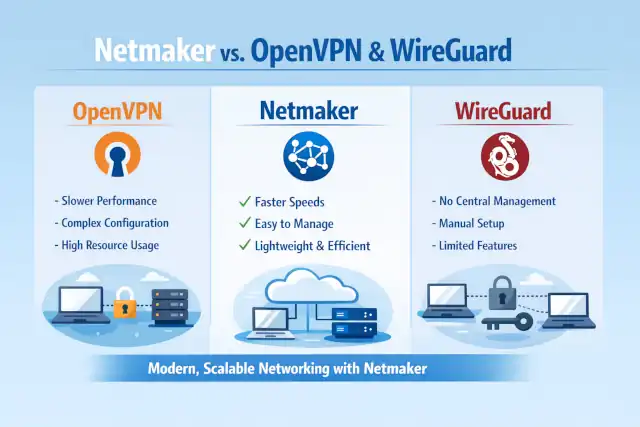
Before comparing numbers, it’s critical to understand that these three tools are not direct equivalents. WireGuard and OpenVPN are VPN protocols — the raw tunneling engines. Netmaker is an orchestration platform that sits on top of WireGuard, automating everything a bare WireGuard deployment requires you to do manually. Comparing them is like comparing a car engine to a fully-built vehicle — one powers the other.
An open-source (SSPL-licensed) control plane that automates creation and management of distributed WireGuard mesh networks at scale. Built for DevOps, multi-cloud, and enterprise teams.
A lean, modern VPN protocol embedded in the Linux kernel with ~4,000 lines of code. State-of-the-art cryptography, blazing speed, and minimal attack surface — but zero management tooling.
A battle-tested TLS-based VPN with 20+ years of production use, ~70,000 lines of code, and deep flexibility. The legacy standard for enterprise remote access.
02 Performance Benchmarks
Performance is where the gap between these tools is most measurable. In independent cross-cloud tests run between AWS regions (using identical t3.medium Ubuntu 22.04 instances), WireGuard and Netmaker comprehensively outperformed OpenVPN.
A key nuance: WireGuard’s MTU setting matters enormously. In AWS tests, using wg-quick’s default MTU produced poor results, but after manual tuning, WireGuard (and Netmaker, which handles this automatically) actually exceeded direct connection speeds — a behaviour researchers believe relates to how WireGuard bypasses certain AWS bandwidth-limiting mechanisms.
03 Security Architecture
All three tools provide strong encryption, but their cryptographic philosophies differ substantially. WireGuard and Netmaker use a fixed, opinionated modern stack; OpenVPN offers broad configurability — which is both a strength and a potential liability.
| Dimension | Netmaker | WireGuard | OpenVPN |
|---|---|---|---|
| Key Exchange | Curve25519 (via WireGuard) | Curve25519 | TLS/SSL (RSA or ECDSA) |
| Encryption | ChaCha20 (via WireGuard) | ChaCha20-Poly1305 | AES-256-GCM (configurable) |
| Hashing | BLAKE2 (via WireGuard) | BLAKE2 | SHA-256 / SHA-512 |
| Crypto Flexibility | Fixed (opinionated) | Fixed (opinionated) | Highly configurable |
| Auth Methods | Keys + OAuth 2.0 + OIDC | Pre-shared keys only | Certificates, LDAP, MFA |
| Access Control | Full ACLs + Zero Trust | None (manual) | Moderate (cert-based) |
| Audit Surface | Medium | Minimal (safest) | Large |
| Security Audits | Inherited from WireGuard | Multiple independent audits | Multiple independent audits |
| DNS Leaks | Private DNS included | Manual configuration | Configurable DNS push |
OpenVPN’s configurability is its double-edged sword. While it supports a wide range of authentication integrations (LDAP, RADIUS, certificates), that same flexibility can lead to misconfigurations and potential security vulnerabilities in real deployments. WireGuard sidesteps this by using a single, modern, expertly chosen cipher suite — eliminating the risk of accidentally picking weak algorithms. Netmaker inherits this discipline and layers enterprise identity management on top.
04 Scalability & Management
This is where the tools diverge most sharply. Raw WireGuard requires manually editing config files on every single node whenever anything changes — a peer IP shifts, a new device joins, or a node leaves the network. At 10 nodes this is manageable; at 100+ nodes it becomes operational chaos.
Topology Support
Netmaker supports full mesh, partial mesh, hub-and-spoke, site-to-site, and remote access gateway topologies — all configurable from a web UI without touching config files. OpenVPN primarily excels at client-server (hub-and-spoke) architectures. Raw WireGuard can technically support any topology but requires manual implementation of every routing rule.
05 Side-by-Side Comparison
| Feature | Netmaker | WireGuard | OpenVPN |
|---|---|---|---|
| Type | Network Orchestrator | VPN Protocol | VPN Protocol + Software |
| Speed | Very Fast (WG-native) | Fastest | Moderate |
| Latency Overhead | 1–3ms | 1–3ms | 8–12ms |
| CPU Usage | 8–15% | 8–15% | 45–60% |
| Ease of Setup | Web UI, automated | Manual CLI config | Complex (PKI required) |
| Mesh Networking | Built-in, automated | Manual only | Not native |
| Web Dashboard | Yes | No | Paid (Access Server) |
| User Management | Full (OAuth, OIDC, roles) | None | Certificate-based |
| ACLs / Zero Trust | Built-in | None | Limited |
| Private DNS | Built-in | Manual | Configurable |
| Self-Hosted Option | Yes | Yes (native) | Yes |
| SaaS Option | Yes | No | CloudConnexa |
| OS Support | Linux, Docker, Win, Mac | Linux, Win, Mac, iOS, Android | All major platforms |
| Mobile Clients | Via WireGuard app | Native iOS + Android | Native clients |
| Kubernetes Integration | Native support | Manual | Possible, complex |
| License | SSPL (source-available) | GPL-2.0 (open source) | GPL-2.0 (open source) |
| Scalability | Thousands of nodes | Limited (manual) | Moderate |
| Ideal Team Size | 10 → Enterprise | 1 → ~20 nodes | 5 → Mid-enterprise |
06 Best Tool for Each Use Case
Simple, zero overhead, no server needed. Fastest setup for 2–5 static devices.
User management, session expiry, and ACLs make it purpose-built for distributed teams.
Connect AWS, GCP, Azure, and on-prem under one encrypted mesh network effortlessly.
Mature certificate-based auth, broad compliance coverage, and deep LDAP/AD integration.
Native Kubernetes support with dynamic pod networking across regions and providers.
Centrally deploy, monitor, and secure thousands of edge devices from one dashboard.
Kernel-level processing with no management overhead delivers peak throughput.
20+ years of audits, FIPS-compatible configs, and broad compliance tool integrations.
07 Honest Caveats
Netmaker
While Netmaker’s features are compelling, two caveats matter. First, its license is SSPL (Server Side Public License) — not a true OSI-approved open-source license. This restricts how the software can be used commercially as a hosted service. Second, the Windows and macOS client experiences are notably less polished than competitors like Tailscale, and there is currently no native iOS or Android client — mobile users must use the standard WireGuard app.
WireGuard
WireGuard’s minimalism is both its greatest asset and its limitation at scale. It has no built-in key distribution, no dynamic peer discovery, no user management, and no web interface. Every operational change requires manual CLI intervention on every affected node. It is also worth noting that WireGuard does not hide the fact that you are using a VPN — its traffic patterns are identifiable, which matters in restrictive network environments.
OpenVPN
OpenVPN’s performance gap is real and growing. In modern benchmarks it consistently uses 3–4× more CPU than WireGuard and introduces 6–9× more latency. Its 70,000-line codebase creates a substantially larger attack surface compared to WireGuard’s ~4,000 lines. That said, OpenVPN’s flexibility in running over both TCP and UDP, and its ability to traverse restrictive firewalls by running on port 443 (TCP), remains a genuine operational advantage in certain enterprise environments.
08 Final Verdict
🔵 Choose Netmaker if…
You are managing 10+ nodes across clouds, data centers, or offices. You need user management, ACLs, and zero-trust networking without building it yourself. You want WireGuard’s speed with enterprise management tooling.
🟢 Choose WireGuard if…
You need a fast, simple, and fully open-source tunnel for a small number of static devices. You have the technical expertise to manage configs manually. You want zero dependencies and minimal operational overhead.
🟡 Choose OpenVPN if…
You are in a high-compliance environment requiring audited, certificate-based auth. You need deep integration with existing corporate identity infrastructure (LDAP, AD, RADIUS). You need to traverse firewalls on port 443 TCP.
Performance data: AWS EC2 t3.medium cross-region benchmarks (Netmaker Engineering, 2022–2025); broexperts.com OpenVPN vs WireGuard 2025 benchmark suite.
Feature data: netmaker.io official documentation (2025); WireGuard.com; OpenVPN official documentation.
User testimonials: netmaker.io customer stories.
License analysis: SSPL vs OSI-approved licenses — Software Freedom Conservancy guidance.
Article prepared: March 2025 · Data reflects tools as of Q1 2025.