Are Soaring Memory Prices About to Bring Back the microSD Slot on Smart Phones?
Are Soaring Memory Prices About to Bring Back the microSD Slot on Smart Phones?
- 60% of MD5 Password Hashes Can Be Cracked in Under an Hour with a Single GPU
- Dirty Frag: Root Access on Every Major Linux Distribution — No Patch, No Warning
- Ubuntu 26.04 LTS (Resolute Raccoon): The Most Ambitious Ubuntu LTS in a Decade
- Proton Mail: Data Transferred to FBI Again!
- How Close Are Quantum Computers to Breaking RSA-2048?
- How to Prevent Ransomware Infection Risks?
- What is the best alternative to Microsoft Office?
Are Soaring Memory Prices About to Bring Back the microSD Slot on Smart Phones?
AI’s insatiable hunger for DRAM is crushing smartphone budgets. Chinese suppliers are whispering about reviving the humble microSD slot — but a closer look reveals why expandable storage can never be a true substitute for the blazing flash memory built into modern phones.
The Memory Crunch Behind the Headlines
The global memory market is in the grip of what analysts have taken to calling “RAMmageddon.” The trigger is structural: every wafer that Samsung, SK Hynix, or Micron dedicates to producing High Bandwidth Memory for an Nvidia AI accelerator is a wafer withheld from the LPDDR chips inside your next smartphone. The result has been severe. DRAM prices soared roughly 172% through 2025, and research firm TrendForce reported in early 2026 that contract prices for a mainstream 8 GB + 256 GB smartphone memory configuration had surged nearly 200% year-on-year — roughly tripling from the same period in 2025.
The ripple effects are now visible at the retail level. Chinese brands Oppo and OnePlus announced price hikes on March 10, followed by Vivo and iQOO on March 16, with increases of 500–1,000 yuan (roughly US$70–140) on select models. Xiaomi’s president Lu Weibing publicly warned that cost pressures are likely to persist “for some time.” TrendForce forecasts global smartphone production to fall 10% year-on-year in 2026 to approximately 1.135 billion units — with a bear-case scenario of a 15% or steeper contraction.
“Memory is increasingly accounting for a larger share of the BOM costs in consumer devices. Even for Apple, the memory component in the total BOM for iPhones is expected to significantly increase in Q1 2026.” — TrendForce, December 2025
Chinese brands are especially exposed. Xiaomi and Transsion rely heavily on entry-level and mid-range models, where memory can represent 15–20% of the total bill of materials. Their price-sensitive customers leave little room to pass higher costs on. It is precisely this pressure that gave rise to the microSD card slot rumour.
So, Is the Rumour True?
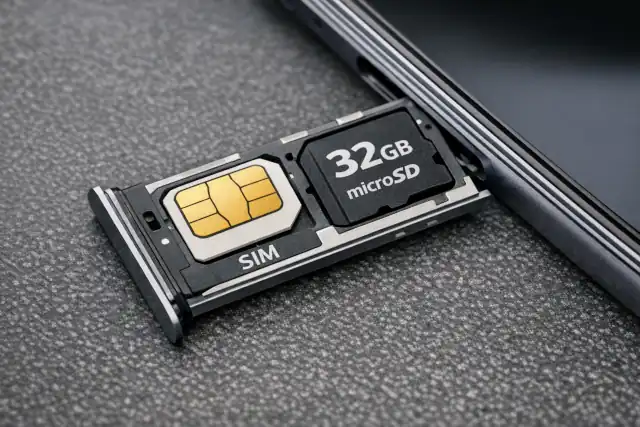
Partially — but with important caveats. In December 2025, a Weibo leaker known as Repeater 002 posted that chatter was circulating among Chinese component suppliers about reviving the microSD card slot. The leaker did not name any specific smartphone brand, and no manufacturer has made a formal announcement. Industry observers noted that smartphones already in the supply pipeline are not expected to undergo a complete redesign; the change, if it materialises, would most likely appear in devices planned for the second half of 2026 onwards.
The economic logic is sound enough. A microSD card slot adds negligible hardware cost and gives buyers a low-cost path to expanding storage capacity, reducing the pressure on manufacturers to include larger (and now very expensive) onboard NAND. But whether the slot will actually help — or is merely a cosmetic remedy that cannot address the deeper performance demands of modern smartphones — is a very different question.
The Speed Wall: Why microSD Cannot Replace UFS 4.1
Modern flagship smartphones ship with UFS (Universal Flash Storage) 4.0 or 4.1 internal memory — a full-duplex, high-throughput standard designed from the ground up for the multitasking demands of mobile computing. The figures are striking. UFS 4.1 delivers a theoretical interface speed of up to 4,200 MB/s sequential read and 2,800 MB/s sequential write. JEDEC finalised the even faster UFS 5.0 specification in February 2026, promising sequential read/write speeds of up to 10,800 MB/s — putting phone storage on par with high-end desktop PCIe Gen 4 SSDs.
By contrast, the fastest consumer microSD cards available today — high-end SD Express cards — top out at around 900 MB/s sequential read under optimal conditions. Standard UHS-II professional cards peak at approximately 156 MB/s read, and the ubiquitous UHS-I cards manage roughly 90–170 MB/s. These figures are not close; they exist in entirely different performance leagues.
The gap is not merely numerical. UFS operates as a full-duplex interface — it reads and writes simultaneously, enabling deep command queuing and low latency that smartphone processors expect. Standard microSD uses a half-duplex architecture: it can only read or write at one time, not both together. This architectural difference means that even at the same clock rate, microSD would deliver inferior real-world performance for the random, small-block I/O operations that dominate smartphone workloads: loading apps, writing camera buffers, streaming game assets.
What microSD Can and Cannot Do
There is a legitimate role for a microSD slot — and it is the one it has always had. Storing photos, videos, music, podcasts, and downloaded documents on a microSD card is perfectly sensible. For bulk media that is read sequentially and infrequently, the speed gap is tolerable. Consumers who shoot a lot of video or store large libraries of offline content would genuinely benefit from affordable expandable storage at a time when onboard storage configurations are being downgraded to cut costs.
What microSD cannot meaningfully do is serve as a substitute for internal flash memory in the context of app storage and execution. This brings us to the second major structural problem: Android’s own app installation policy.
The App Installation Problem
Android historically allowed apps to be installed to or moved to external storage, but this capability has been progressively curtailed. Beginning with Android 6.0 Marshmallow, Google introduced “Adoptable Storage,” which allowed a microSD card to be formatted and encrypted as internal storage — but many manufacturers, including Samsung and LG, chose to disable the feature entirely on their devices. As of current Android versions, apps are installed to internal storage by default, and the “move to SD card” option is absent from most modern devices, with no path to restore it without rooting.
Even where the option technically exists, it is governed by individual app developers: an app must explicitly declare itself moveable to external storage in its manifest. Large, performance-sensitive apps — games in particular — typically do not support this. A game like Genshin Impact may deposit a small stub on external storage while keeping the majority of its data on internal storage regardless of user preference. The speed mismatch is one of the core reasons developers have resisted external storage support: running a complex app from a UHS-I microSD card would deliver perceptibly worse load times and stutter compared to internal UFS 4.1.
The UFS 5.0 Horizon
The long-term trajectory of internal storage technology makes the microSD’s limitations even more stark. In February 2026, JEDEC finalised the UFS 5.0 standard. Its maximum sequential read/write speed of 10,800 MB/s is roughly double that of UFS 4.1 and nearly twelve times the best-in-class SD Express card available today. Memory supplier Kioxia began shipping UFS 5.0-compatible samples to manufacturers in late February 2026, with consumer devices — likely beginning with the Samsung Galaxy S27 series — expected to arrive in early 2027.
In this context, the microSD slot’s revival is best understood as a cost-management measure, not a technology advancement. It is a pragmatic concession to extraordinary economic circumstances, not a sign that expandable storage can replace the relentless improvement of internal memory standards.
Verdict: Real Problem, Partial Solution
The underlying news is real and significant: AI-driven DRAM inflation is causing genuine pain for Chinese smartphone makers, forcing price hikes, spec downgrades, and a search for cost-cutting alternatives. The possibility that some manufacturers may revive the microSD card slot in second-half 2026 devices is plausible and sourced from credible supplier-level chatter.
However, the microSD slot is a partial and limited remedy. It can offer affordable expansion of media storage at a time when onboard NAND is expensive — a genuine benefit for many users. But it cannot replace UFS 4.1 or 4.1 internal flash memory for app performance: the speed gap is enormous (up to 46× for sequential reads, worse for random I/O), the half-duplex architecture is fundamentally inferior, and Android’s app ecosystem has progressively closed the door on running software from external storage.
If the slot returns, think of it as extra shelf space — not as a faster hard drive. For consumers facing higher phone prices in 2026, it may still be a welcome return. Just temper expectations about what it can actually do.
Key Sources
| Source | Finding |
|---|---|
| TrendForce (Feb 2026) | Smartphone production forecast to fall 10% YoY in 2026; 8GB+256GB config prices up ~200% YoY |
| Counterpoint Research (Dec 2025) | Smartphone ASP expected to rise 6.9% in 2026; DRAM prices may climb another 40% through Q2 2026 |
| IDC (Feb 2026) | Global smartphone shipments forecast to decline 8–9% in 2026 |
| TechNode (Mar 17, 2026) | Oppo, OnePlus, Vivo, iQOO raise prices 500–1,000 yuan amid memory cost pressure |
| Wccftech / AndroidHeadlines (Dec 2025) | Weibo leaker reports Chinese suppliers discussing microSD slot revival; no brand confirmed |
| JEDEC / MakeUseOf (Mar 2026) | UFS 5.0 finalised Feb 2026; up to 10,800 MB/s — nearly double UFS 4.1’s 5,800 MB/s |
| HowToGeek / Tom’s Guide | Android app-to-SD card support severely limited on modern devices; most OEMs removed Adoptable Storage |