The Quantum Threat to Elliptic Curve Cryptography: What the Science Actually Says
The Quantum Threat to Elliptic Curve Cryptography: What the Science Actually Says
- 60% of MD5 Password Hashes Can Be Cracked in Under an Hour with a Single GPU
- Dirty Frag: Root Access on Every Major Linux Distribution — No Patch, No Warning
- Ubuntu 26.04 LTS (Resolute Raccoon): The Most Ambitious Ubuntu LTS in a Decade
- Proton Mail: Data Transferred to FBI Again!
- How Close Are Quantum Computers to Breaking RSA-2048?
- How to Prevent Ransomware Infection Risks?
- What is the best alternative to Microsoft Office?
Quantum Threat Report
The Quantum Threat to Elliptic Curve Cryptography: What the Science Actually Says
A fact-checked analysis of how Shor’s algorithm threatens ECC and RSA — and why one popular account gets the risk comparison exactly backwards.
Elliptic Curve Cryptography (ECC) quietly underpins much of modern digital life. It secures TLS connections, signs software updates, authenticates blockchain transactions, and protects communications on billions of mobile devices. Its appeal is simple: a 256-bit ECC key delivers roughly the same classical security as a 3,072-bit RSA key — with far less computational overhead. But quantum computing is set to change that calculus entirely. This article reviews the accurate science behind quantum attacks on ECC, corrects a key misconception circulating in recent technical writing, and surveys the global response now underway.
Background
How ECC Works — and Why It Was Thought Secure
An elliptic curve is defined over a finite field and forms what mathematicians call an Abelian group: a set of points where addition is closed, commutative, and associative, with a special “point at infinity” serving as the identity element. Two operations are central to ECC:
Point addition defines a geometric rule for combining two points on the curve into a third. Scalar multiplication — the core of ECC — repeatedly applies point addition to compute Q = k · G, where G is a publicly known base point and k is the private key. Given G and the public key Q, recovering k requires solving the Elliptic Curve Discrete Logarithm Problem (ECDLP).
For classical computers, the ECDLP is extraordinarily hard. The best known algorithms — such as Pollard’s rho — require roughly O(√p) operations, which for a 256-bit curve translates to approximately 2¹²⁸ operations. That is computationally infeasible today and for the foreseeable classical future. This hardness is ECC’s security guarantee — and it evaporates under quantum computation.
The Quantum Attack
How Shor’s Algorithm Breaks ECC
Peter Shor’s 1994 quantum algorithm is a period-finding machine. For RSA, it factors large integers by finding the period of the modular exponentiation function. For ECC, the approach is similar but adapted to the group structure of elliptic curves.
Rather than a one-dimensional period search, the quantum attack on ECDLP uses a two-dimensional function of the form f(a, b) = aG + bQ, where G is the base point and Q = kG is the public key. This function is periodic in two dimensions over the group, and quantum Fourier analysis over this two-dimensional lattice reveals the private key k.
The additional complexity, however, does not mean ECC is safer than RSA against quantum computers. A critical distinction must be drawn between complexity per operation and total resource cost — a distinction that recent popular accounts have confused, sometimes fatally.
Fact-Check
The Key Factual Error: ECC Falls Sooner, Not Later
Several recent analyses — including a widely shared article on quantum algorithms — claim that “breaking ECC using Shor’s algorithm is relatively more difficult” than breaking RSA, implying ECC is more quantum-resistant. This is the opposite of what current research shows. ECC is expected to be broken by a quantum computer substantially before RSA of equivalent classical security strength.
The confusion arises from mixing up two different questions: (1) Is the quantum circuit for attacking ECC more complex per bit? Yes. (2) Does attacking ECC require fewer total resources than attacking equivalently secure RSA? Also yes — because ECC keys are dramatically shorter.
The most rigorous published resource estimates make this concrete:
| Metric | 256-bit ECC | 2048-bit RSA |
|---|---|---|
| Classical security | ~128-bit equivalent | ~112-bit equivalent |
| Logical qubits needed | ~2,330 | ~4,098 |
| Toffoli gates needed | ~126 billion | ~5.2 trillion |
| Physical qubits (est.) | ~67.7 million | ~hundreds of millions |
| Quantum vulnerability | Higher (falls first) | Lower relative to ECC |
Source: Webber et al. (2022), “The impact of hardware specifications on reaching quantum advantage in the fault tolerant regime.” The data show that ECC requires far fewer quantum resources to break than comparably-deployed RSA — meaning ECC will likely be the first to fall when a cryptographically relevant quantum computer (CRQC) arrives.
“ECC is actually the more vulnerable of the two to quantum attacks — it will likely fall to quantum attack much earlier than RSA.”
— Research consensus, Webber et al. (2022) & supporting literature
This is counter-intuitive but logically consistent: ECC’s classical efficiency (short keys) becomes a quantum liability. The shorter the key, the less work a quantum computer needs to do — even if each quantum operation is more intricate.
Hardware Reality
Where Quantum Hardware Stands Today
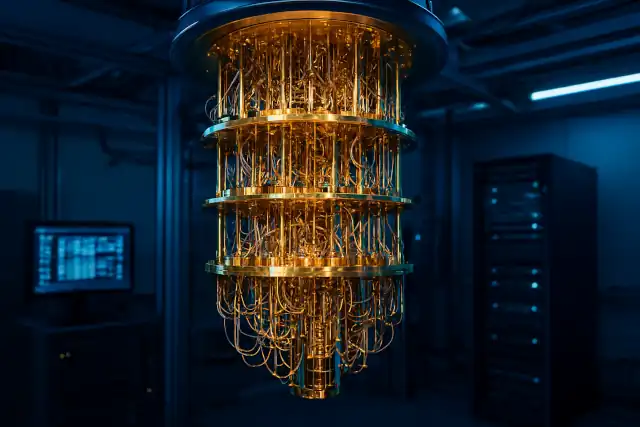
No quantum computer today is remotely close to breaking either ECC or RSA with real-world parameters. Current milestones, while impressive, remain in a completely different regime from what cryptographic attacks require.
Google’s Willow chip, announced in December 2024 with 105 qubits, achieved remarkable error-correction milestones — but confirmed that millions of additional qubits would still be needed to threaten RSA-2048. IBM’s Condor processor has exceeded 1,100 qubits, yet gap between noisy current qubits and the fault-tolerant logical qubits required for Shor’s algorithm is vast.
In October 2024, Chinese researchers using D-Wave’s quantum annealer factored a 22-bit RSA key, a result that generated headlines but remains many orders of magnitude removed from practical cryptographic threat. Breaking RSA-2048 with Shor’s algorithm — on a fault-tolerant quantum computer — would require roughly 4,000 logical qubits running billions of gates. Experts place the physical qubit requirement at 20 million or more under conservative error-correction assumptions, and as few as under one million under optimistic scenarios (Gidney & Ekerå, 2021).
The SANS Emerging Threats Summit 2025 summarized the position of leading practitioners: experts estimate that by the early 2030s, quantum systems could enable threat actors to bypass widely used public-key infrastructure algorithms like RSA and ECC. Most researchers agree the threat is not immediate — but the migration timeline is.
Immediate Risk
“Harvest Now, Decrypt Later”: Why the Threat Is Already Here
Even though a CRQC capable of breaking ECC does not yet exist, the quantum threat is not purely a future problem. Nation-state actors and sophisticated adversaries are believed to be conducting harvest now, decrypt later (HNDL) attacks: intercepting and storing encrypted communications today, intending to decrypt them once quantum capability arrives.
This tactic is particularly dangerous for data with long-term sensitivity — classified government communications, medical records, financial transactions, and intellectual property. Any information encrypted today under ECC or RSA and stored by an adversary may be readable within a decade or two. The Federal Reserve Board explicitly analyzed this risk in a September 2025 paper on post-quantum cryptography and distributed ledger networks.
The implication is stark: the migration to post-quantum cryptography cannot wait for Q-Day itself. The relevant deadline is now — organizations must begin transitioning before the CRQC arrives, because by then it will be too late for data already captured.
The Global Response
Post-Quantum Cryptography: The Standards Are Ready
The global cryptographic community has not been waiting. After nearly a decade of international competition, the U.S. National Institute of Standards and Technology (NIST) finalized its first three post-quantum cryptography standards on August 13, 2024 — a historic milestone representing the culmination of a process that began in 2016 with submissions from cryptographers worldwide.
NIST is urging organizations to begin transitioning to these standards immediately. Under NIST IR 8547, quantum-vulnerable algorithms will be deprecated and ultimately removed from NIST standards by 2035, with high-risk systems expected to migrate substantially earlier.
Primary standard for key encapsulation. Lattice-based, fast, with compact key sizes. Recommended default for TLS and VPN applications.
General-purpose digital signature algorithm. Balances security and efficiency; suitable for code signing, document authentication, and protocols.
Hash-based signature scheme. Slower and larger signatures, but relies on fundamentally different mathematics — valuable as a diversity backstop.
Code-based key encapsulation mechanism selected by NIST in March 2025 as a backup to ML-KEM. Final standard expected 2027. Based on different math to reduce correlated risk.
A fourth lattice-based signature standard — FN-DSA (FALCON), to be published as FIPS 206 — is progressing through the standardization pipeline. Two of the three principal standards were developed by IBM researchers in collaboration with academic and industry partners; a third was co-developed by a researcher who has since joined IBM.
Industry adoption is accelerating. Popular communication platforms including Apple iMessage, Signal, and Zoom already support post-quantum cryptography. Google Chrome began supporting hybrid post-quantum key exchange for most outbound connections in 2024. The U.S. government issued an executive order in January 2025 strengthening and promoting innovation in national cybersecurity, including quantum readiness mandates. The European Commission published a Coordinated Implementation Roadmap for post-quantum transition in June 2025.
Key Dates
A Timeline of the Post-Quantum Era
Peter Shor publishes his quantum algorithm for integer factorization and discrete logarithm, immediately implying that RSA and ECC would be broken by a sufficiently powerful quantum computer.
NIST launches its post-quantum cryptography standardization project, inviting submissions from cryptographers worldwide.
NIST announces four finalist algorithms: CRYSTALS-Kyber, CRYSTALS-Dilithium, SPHINCS+, and FALCON. Google’s Gidney & Ekerå publish revised estimates showing RSA-2048 could be broken with fewer than one million noisy qubits — dramatically lower than previous 20-million estimates.
NIST publishes the first three finalized post-quantum cryptography standards: FIPS 203 (ML-KEM), FIPS 204 (ML-DSA), and FIPS 205 (SLH-DSA). Organizations are urged to begin migration immediately.
Chinese researchers using D-Wave’s quantum annealer factor a 22-bit RSA key — significant as a demonstration but far from threatening real-world encryption. Google debuts its Willow 105-qubit chip with landmark error-correction results.
U.S. Executive Order on national cybersecurity issued, reinforcing quantum readiness mandates for federal agencies and suppliers.
NIST selects HQC as a fifth post-quantum algorithm — a code-based backup KEM to complement ML-KEM. Final standard expected 2027.
European Commission publishes its Coordinated Implementation Roadmap for post-quantum transition. McKinsey’s Quantum Technology Monitor notes quantum-tech investment grew nearly 50% in 2024, reaching approximately $2 billion.
NIST’s planned deadline for deprecating quantum-vulnerable algorithms from federal standards. High-risk systems are expected to complete migration significantly earlier.
Action
What Organizations Must Do — Now
The migration to post-quantum cryptography is estimated to take seven to fifteen years across most industries, depending on legacy dependencies, regulatory requirements, and system complexity. Given that Q-Day may arrive as early as the early 2030s, organizations that have not yet started are already behind schedule.
Priority actions recommended by NIST, CISA, and NSA include conducting a cryptographic inventory to identify all assets relying on RSA, ECC, or Diffie-Hellman; classifying data by sensitivity and longevity to assess HNDL exposure; piloting ML-KEM and ML-DSA in lower-risk systems; and building crypto-agility — the architectural capacity to swap cryptographic algorithms quickly as standards evolve. Hybrid approaches that layer classical and post-quantum algorithms are recommended as a transitional measure while full migration is underway.
The financial sector is moving with particular urgency. Europol’s Centre created the Quantum Safe Financial Forum in 2024 to coordinate post-quantum migration across European financial institutions. The Bank of Israel published banking system preparedness guidance in January 2025. Mastercard, Citigroup, and major central banks have published detailed transition white papers.
Accuracy Summary
Fact-Check Summary: What Recent ECC Articles Get Right and Wrong
| Claim | Verdict |
|---|---|
| ECC relies on the ECDLP for security | ✅ Correct |
| ECC forms an Abelian group over a finite field | ✅ Correct |
| Classical algorithms like Pollard-Rho require exponential time for ECDLP | ✅ Correct |
| Shor’s algorithm can solve ECDLP via 2D period-finding | ✅ Correct |
| ECC quantum circuits are more complex than RSA circuits per bit | ✅ Correct |
| “Breaking ECC is relatively more difficult [than RSA]” for a quantum computer | ❌ Wrong — ECC requires fewer total qubits and gates to break than equivalent RSA |
| Breaking 256-bit ECC needs thousands of logical qubits | ✅ Broadly correct (~2,330 per Webber et al.) |
| Millions of physical qubits needed due to error correction | ✅ Correct |
| Current quantum computers cannot break real-world ECC or RSA | ✅ Correct |