China Bets Big on Hybrids.Will Tesla Follow?
China Bets Big on Hybrids. Will Tesla Follow?
- 60% of MD5 Password Hashes Can Be Cracked in Under an Hour with a Single GPU
- Dirty Frag: Root Access on Every Major Linux Distribution — No Patch, No Warning
- Ubuntu 26.04 LTS (Resolute Raccoon): The Most Ambitious Ubuntu LTS in a Decade
- Proton Mail: Data Transferred to FBI Again!
- How Close Are Quantum Computers to Breaking RSA-2048?
- How to Prevent Ransomware Infection Risks?
- What is the best alternative to Microsoft Office?
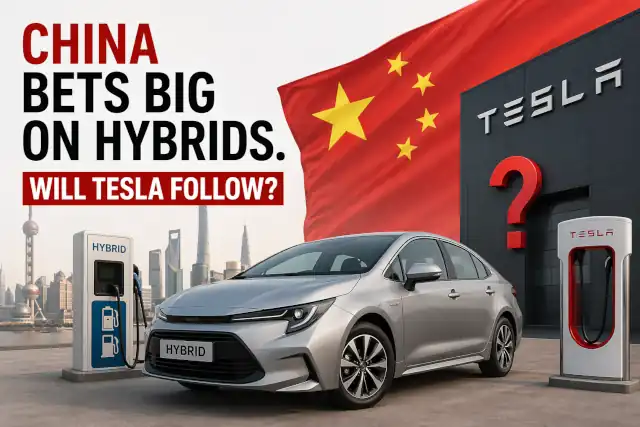
China Bets Big on Hybrids.
Will Tesla Follow?
As Chinese automakers flood global markets with HEVs and PHEVs to sidestep tariffs and capture mainstream buyers, the world watches to see whether Tesla will abandon its all-electric identity — or double down on it.
No One Asked Tesla
The global automobile market is fracturing along a fault line that few predicted just three years ago. Chinese electric vehicle manufacturers — BYD, SAIC, Geely, Chery, and Changan among them — have pivoted hard toward hybrid electric vehicles (HEVs) and plug-in hybrids (PHEVs), flooding European and Asian markets with affordable dual-powertrain models that carry neither the range anxiety of a pure EV nor the fuel thirst of a conventional gasoline car. The strategic trigger: steep EU tariffs enacted in late 2024 on Chinese battery-electric vehicles, which do not apply to hybrids.
The result has been a staggering acceleration. China exported 214,000 passenger cars to Europe in just the first two months of 2026 alone — up 62% year-on-year — with hybrids now making up a rapidly growing share of that volume. Meanwhile, in California, Tesla’s first-quarter 2026 registrations dropped 24% compared to the prior year as hybrid models displaced EV sales even in America’s most EV-friendly market.
Against this backdrop, a pointed question has resurfaced in boardrooms, analyst notes, and automotive forums alike: Will Tesla develop a hybrid vehicle? The short answer, supported by every piece of available evidence in April 2026, is a resolute no. But understanding why requires examining both Tesla’s strategic identity and the genuine merits of the hybrid technology it has so persistently rejected.
China’s Hybrid Offensive
The pivot by Chinese automakers to hybrids is no retreat from electrification — it is a calculated geopolitical and commercial maneuver. When the European Union imposed elevated tariffs on Chinese BEVs in 2024, citing concerns about state subsidies distorting competition, manufacturers like BYD, SAIC, and Geely found a legal workaround: hybrids were exempt. The result was a tripling of Chinese hybrid exports to Europe between July and October 2024 compared to the same period the previous year, and the momentum has not slowed since.
BYD’s approach is perhaps the most instructive. The company now operates a genuine dual-strategy: many of its flagship models, including the Great Tang DM-i SUV launched in the first half of 2026, are available in both hybrid and pure-electric variants. The Great Tang DM-i integrates a 1.5-litre turbocharged engine alongside a 200 kW electric motor, delivering a CLTC-rated pure electric range of 342 kilometres before the combustion engine engages — effectively combining the best of both technologies in a single chassis.
SAIC offers an even broader portfolio, with hybrid products spanning the MG3 HEV, MG6 PHEV, and the Roewe Erx5 Super Hybrid Edition SUV. Geely fields the Galaxy Starship 7 PHEV alongside mild-hybrid variants under the Geely Azkarra nameplate. These are not niche offerings; they are now the primary growth vehicles for Chinese brands in tariff-affected markets.
“Long-term, really the only vehicle we would make is autonomous vehicles — with the exception of the next-generation Roadster.”
— Elon Musk, Tesla Q4 2025 Earnings Call, January 28, 2026Tesla’s Unambiguous Position
Tesla has never manufactured a hybrid vehicle, and its publicly stated roadmap for 2026 and beyond contains no provision for one. The company’s current product pipeline centres on the Cybercab — a fully autonomous, fully electric robotaxi that began mass production in April 2026 at Giga Texas — alongside the Robovan (internally dubbed the Robus), the next-generation Roadster, and the ongoing expansion of the Model Y and Model 3 family. All are battery-electric.
Elon Musk’s remarks at Tesla’s Q4 2025 earnings call in January 2026 left little ambiguity about the long-term strategic direction. His vision is one where autonomous, pure-electric vehicles replace virtually every other powertrain configuration, not one in which Tesla hedges with a combustion fallback. The company’s “Master Plan Part 4” — focused on autonomous mobility, affordable EVs, energy storage, and humanoid robotics — makes no mention of hybrid development.
This is not merely ideological stubbornness. Tesla has built its entire manufacturing, supply chain, and software architecture around the absence of an internal combustion engine. Its factories contain no engine assembly lines, no transmission machining, no exhaust system manufacturing. Introducing a conventional hybrid would require not just engineering a new powertrain but rebuilding portions of an industrial infrastructure that spans multiple continents. The cost, complexity, and brand-identity risk would be substantial.
That said, the commercial pressure Tesla faces is real. The 24% decline in California registrations during Q1 2026 is a sobering data point for a company whose home state has historically been its strongest market. Tesla’s response, however, has been to accelerate its autonomous vehicle strategy rather than reach for a gasoline engine.
HEV Advantages: Where Hybrids Genuinely Win
To understand why hybrids have captured so much consumer and manufacturer attention, it is necessary to examine where they hold measurable, practical advantages over both conventional gasoline vehicles and pure battery-electric vehicles. The picture that emerges is nuanced: hybrids do not win everything, but in several critical dimensions they represent a genuinely superior solution for tens of millions of drivers worldwide in 2026.
Powertrain Comparison — HEV vs. Gasoline vs. BEV
| Category | HEV / PHEV | Gasoline (ICE) | Battery EV (BEV) |
|---|---|---|---|
| Fuel Economy | Advantage Regenerative braking and electric assist can cut fuel use 25–50% vs ICE equivalents. PHEVs achieve near-zero fuel consumption on short trips. | Weakest No energy recovery; full fuel burn at all times. Urban driving is especially inefficient. | Best No petrol consumption at all; ~4–5¢ per mile on grid power vs ~16¢ per mile for gasoline. |
| Range & Refuelling | Advantage Gasoline range extender eliminates anxiety. PHEVs handle daily EV driving; long trips revert to gasoline. No charging infrastructure required. | Best Unlimited range with three-minute refuelling. Dense global station network. | Constrained Long-range BEVs can exceed 400 miles, but fast-charging stops are required on extended trips and charging access varies widely. |
| Running Cost | Strong 50–60% cheaper per mile than gasoline. PHEVs approach BEV economics for short daily commutes. | Most Expensive Highest per-mile fuel costs. More frequent oil changes, belt replacements, and exhaust servicing. | Cheapest Up to 70% cheaper per mile than gasoline. Fewer moving parts mean lower maintenance costs. |
| Upfront Cost | Mid-range Generally more expensive than equivalent ICE but less than comparable BEVs, especially for longer-range variants. | Lowest Established manufacturing scale keeps purchase prices lower than electrified alternatives at most vehicle segments. | Highest Battery costs are falling but premium BEVs carry significant price premiums. Entry-level BEVs are closing the gap. |
| Charging / Infrastructure | None Required HEVs self-charge via regeneration and the engine. PHEVs can charge at any outlet. No dependency on public charging networks. | Ubiquitous Petrol stations exist almost everywhere on Earth. | Variable Fast-charging networks are expanding but remain uneven globally. Home charging solves the daily use case; road trips require planning. |
| Emissions | Strong Significantly lower CO₂ than ICE, especially in city driving. PHEVs with regular charging can approach BEV lifecycle emissions depending on grid mix. | Highest Full tailpipe emissions at all times. No mechanism to recover braking energy. | Best Tailpipe Zero direct emissions. Lifecycle emissions depend on the electricity grid — improving annually as grids decarbonise. |
| Mechanical Complexity | Most Complex Two complete powertrains must coexist, be managed by sophisticated control software, and be maintained separately. More potential failure points. | Established Well-understood engineering with a global repair network, but many moving parts relative to EVs. | Simplest Fewer moving parts than any combustion-based powertrain. No oil changes, fewer brake services due to regeneration. |
| Cold Weather Performance | Robust Gasoline engine provides cabin heat independently of the battery. Range is less affected by extreme cold than pure EVs. | Best Internal combustion generates ample heat. Minimal performance degradation in cold conditions. | Vulnerable Cold temperatures can reduce range 20–40%. Heating the cabin draws from the main battery pack. |
| Tariff / Regulatory Fit (2026) | Strategic Edge EU tariffs on Chinese BEVs do not apply to hybrids, making HEVs and PHEVs a commercially attractive export vehicle for Chinese manufacturers in 2026. | Declining Increasingly subject to tightening CO₂ fleet regulations in the EU, UK, and China. | Tariff Risk Chinese BEVs face significant EU tariff exposure introduced in 2024, reshaping the competitive landscape. |
The Strategic Divergence
The contrast between China’s hybrid pivot and Tesla’s pure-EV commitment reflects a deeper divergence in what each set of manufacturers believes the automobile market of the late 2020s will actually look like. Chinese automakers, operating in markets where charging infrastructure remains uneven and consumer range anxiety is acute — particularly in rural areas and in export markets across Southeast Asia, Latin America, and parts of Europe — see the hybrid as a permanent product tier, not a transitional technology.
Tesla, by contrast, is betting that its vertical integration in battery manufacturing, its global Supercharger network, and its autonomous driving software will make range anxiety an obsolete concern within the decade. The Cybercab, priced to achieve operating costs as low as 25–30 cents per mile, is Tesla’s answer to the hybrid value proposition: not a compromise between two powertrains, but a different kind of vehicle entirely — one that is cheaper to run precisely because it carries no combustion engine.
Whether that bet pays off depends on several variables Tesla cannot fully control: the pace of charging infrastructure expansion globally, the progress of its autonomous driving regulatory approvals, and the degree to which hybrid economics continue to improve. BYD’s Flash Charging technology, which claims a 342-kilometre EV range replenished in minutes, is already blurring the line between what a hybrid and a long-range BEV can offer.
For consumers making purchasing decisions in 2026, the honest assessment is that neither technology is universally superior. Hybrids remain the pragmatic choice for drivers without reliable home charging, those making frequent long-distance trips, and those in climates where battery performance degrades significantly. Pure EVs win on running costs, simplicity, and tailpipe emissions for drivers whose usage patterns align with the technology’s strengths. Hybrids occupy the middle ground that tens of millions of real-world drivers actually inhabit.
Bottom Line: Two Diverging Roads
Tesla will not build a hybrid vehicle in 2026 — and almost certainly not in the next several years. Its entire industrial, software, and brand architecture is oriented around battery-electric vehicles and autonomous driving. The competitive pressure from Chinese HEV exports is real and measurable, as California’s Q1 registration data confirms, but Tesla’s response is to accelerate robotaxi deployment rather than add a combustion engine to its lineup.
Chinese manufacturers, meanwhile, have demonstrated that hybrids are not a concession to gasoline — they are an aggressive tool for market expansion, tariff navigation, and customer acquisition in charging-infrastructure-limited markets. BYD’s dual-strategy, offering both hybrid and BEV variants of flagship models, may well prove to be the more flexible approach in a fragmented global market.
The broader lesson of 2026 is that there is no single correct powertrain. The winner will not be the technology that is theoretically superior but the one that best matches the infrastructure, economics, and usage patterns of the specific markets it serves — a reality that Chinese automakers appear to have grasped earlier, and more pragmatically, than their American counterpart.