End of an Era: The ThinkPad’s 20-Year Roll Cage Is Gone
End of an Era: The ThinkPad’s 20-Year Roll Cage Is Gone
- 60% of MD5 Password Hashes Can Be Cracked in Under an Hour with a Single GPU
- Dirty Frag: Root Access on Every Major Linux Distribution — No Patch, No Warning
- Ubuntu 26.04 LTS (Resolute Raccoon): The Most Ambitious Ubuntu LTS in a Decade
- Proton Mail: Data Transferred to FBI Again!
- How Close Are Quantum Computers to Breaking RSA-2048?
- How to Prevent Ransomware Infection Risks?
- What is the best alternative to Microsoft Office?
End of an Era:
The ThinkPad’s
20-Year Roll Cage Is Gone
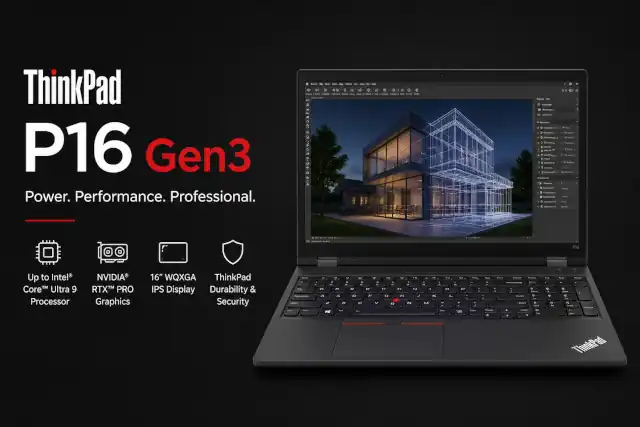
With the ThinkPad P16 Gen 3, Lenovo quietly discontinues the independent magnesium structural frame that has defined its mobile workstation line since 2006 — leaving the industry asking why.
The ThinkPad brand has long been synonymous with durability, and nothing embodied that reputation quite like the internal magnesium roll cage — a dedicated structural frame separate from the outer chassis, engineered to protect the laptop’s internals from the kind of physical stress that would cripple lesser machines. With the release of the ThinkPad P16 Gen 3, that design is gone.
The change, first spotted by Notebookcheck and confirmed by Tom’s Hardware, marks the end of a 20-year design lineage. The ThinkPad P16 Gen 2 was the final model to carry the classic construction. In its successor, Lenovo has transitioned to an integrated frame approach — the same strategy it adopted for its thinner T-series ultrabooks back in 2016 — where magnesium is used as part of the outer shell rather than as a discrete internal skeleton.
A Legacy Born in 2006
The roll cage concept was introduced with the ThinkPad T60 in 2006 — Lenovo’s first T-series laptop following its acquisition of IBM’s PC division in 2005. While the T60 was notable for being the last ThinkPad to ship with a 15-inch 4:3 display and the first to introduce a widescreen option, it was the roll cage that proved to be its most enduring legacy.
- 2005 Lenovo completes acquisition of IBM’s PC business and ThinkPad brand
- 2006 ThinkPad T60 launches — first Lenovo ThinkPad and first to feature the dedicated magnesium roll cage
- 2016 Lenovo transitions the T-series to integrated magnesium frames as the lineup moves toward thinner ultrabook designs
- 2006–2025 ThinkPad P-series (P50, P15, P16 Gen 1 & 2) carries on the roll cage tradition as Lenovo’s flagship mobile workstation line
- 2026 ThinkPad P16 Gen 3 becomes the first P-series to drop the independent roll cage in favor of an integrated frame design
The roll cage worked by sitting as a separate structural layer at the base of the chassis, providing rigidity around stress-prone areas — particularly corners and the palm-rest zone — that absorb significant mechanical force during everyday handling. Older P-series models additionally featured a magnesium subframe mounted behind the display panel.
It adds a millimeter or two to the X, Y, and Z dimensions, but it’s one of those things that’s not worth compromising on, because its value to the customer is so high.
— Sam Patterson, Lenovo Industrial Designer, speaking to AEC Magazine (prior P-series generation)What Changed — and What Remains
It is important to note that Lenovo has not abandoned magnesium as a material. The P16 Gen 3 still uses magnesium alloy for its outer casing. What has changed is the architecture: rather than a discrete internal frame, the magnesium is now integrated directly into the chassis structure — the same approach used in mainstream ThinkPad T-series models. The practical result is a laptop that is thinner and lighter than its predecessors, though Lenovo has not specified by exactly how much the dimensions have changed overall.
The tradeoff, at least in principle, is structural redundancy. The independent roll cage was designed specifically to handle the stresses that a powerful, heavy workstation accumulates over years of field use. Whether the integrated design achieves equivalent rigidity remains to be independently tested over time.
ThinkPad P16 Gen 3 — Key Specifications
Motivations — Cost, Slimness, or Both?
Lenovo has not issued a formal statement explaining the design change. Industry observers and reviewers have floated two plausible motivations: competitive pressure to slim down the P-series to better match rivals, and component cost pressures driven by the ongoing memory chip shortage, which has pushed up prices across the PC industry.
The P16 Gen 3 is already an expensive machine. The entry-level configuration — equipped with a Core Ultra 5 245HX, an NVIDIA RTX Pro 1000 Blackwell GPU, 16GB of DDR5-4400 RAM, and a 512GB PCIe 4.0 SSD — starts at nearly $3,000. Fully specced configurations with a Core Ultra 9 275HX, RTX Pro 5000, 128GB of RAM, a 4TB SSD, and the 3.2K Tandem OLED display approach $9,000–$10,000. Removing a structural component that requires dedicated manufacturing tooling may offer meaningful cost relief at the component level.
People will hold their machines in one corner of the keyboard, or the palm rest area, and that becomes a stress area. So we have to understand how that area is flexing, what it’s in contact with on the motherboard, whether it will stress components.
— Al Makley, Lenovo Executive Director of Workstation Development, to AEC MagazineAt the same time, the older P-series laptops had developed a reputation for being noticeably heavier and thicker than competing professional workstations. Making the P16 Gen 3 slimmer is a legitimate product goal — but for a platform positioned as a heavy-duty tool for engineers, architects, and scientists, the question of whether the integrated design truly maintains equivalent structural integrity is the one that matters most to buyers.
Why It Matters to the Workstation Market
The ThinkPad P-series occupies an unusual niche: it is one of the few commercially available laptop lines that was engineered from the ground up for extreme durability rather than for thinness. Its buyers — ranging from field engineers and CAD specialists to defense contractors and scientific researchers — have historically valued the extra physical robustness over portability. The roll cage was not merely a marketing talking point; it was a tangible, structurally meaningful feature backed by decades of engineering refinement.
The concern, expressed clearly across ThinkPad enthusiast communities, is that Lenovo may be chasing mainstream aesthetics at the expense of the very identity that justified the P-series’ premium price point. The T-series — which shed its roll cage in 2016 — competes on a different set of priorities. Whether the P-series can maintain its workstation credibility with an integrated frame approach is an open question that will take real-world deployments, rather than lab benchmarks, to truly answer.
The Verdict on a Design Decision Still Being Debated
The removal of the independent magnesium roll cage is the kind of change that rarely draws headlines in the broader consumer press, but that resonates deeply within the professional and enterprise communities that have relied on ThinkPad workstations for decades. It closes a chapter that began with IBM’s design philosophy and survived the transition to Lenovo ownership largely intact — until now.
Whether this is an act of pragmatic modernization or an unnecessary compromise remains to be seen. Lenovo has shown it is capable of maintaining high chassis strength through integrated designs — the X1 Carbon being a case in point. What’s different here is the weight class. The P16 is not an ultrabook. It is a mobile workstation, and its buyers will watch this change closely over the months and years ahead.
For now, the ThinkPad P16 Gen 2 stands as the last of a line. For those who specifically value the independent roll cage, the secondary market for its predecessors may become more attractive than it has been in years.