Nissan’s Solid-State Battery Reaches a Pivotal Milestone — And Could Cost Less Than You Think
Nissan’s Solid-State Battery Reaches a Pivotal Milestone — And Could Cost Less Than You Think
- 60% of MD5 Password Hashes Can Be Cracked in Under an Hour with a Single GPU
- Dirty Frag: Root Access on Every Major Linux Distribution — No Patch, No Warning
- Ubuntu 26.04 LTS (Resolute Raccoon): The Most Ambitious Ubuntu LTS in a Decade
- Proton Mail: Data Transferred to FBI Again!
- How Close Are Quantum Computers to Breaking RSA-2048?
- How to Prevent Ransomware Infection Risks?
- What is the best alternative to Microsoft Office?
Nissan’s Solid-State Battery Reaches a Pivotal Milestone — And Could Cost Less Than You Think
A 23-layer prototype pack has met real-world performance targets at the Yokohama pilot line. But unlike the breathless headlines, the cost story is more nuanced — and more optimistic.
Key Figures at a Glance
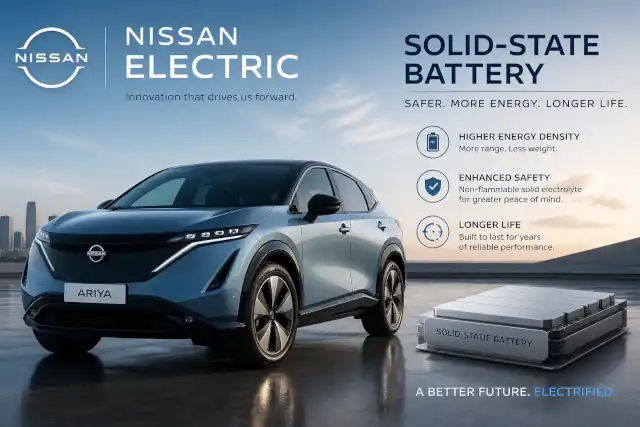
Nissan has achieved what engineers call a “scaling milestone” for its all-solid-state battery (ASSB) program — one that moves the technology from single-cell laboratory tests into the realm of actual vehicle use. At a technical briefing held on April 20, 2026, the Japanese automaker confirmed that a prototype battery pack comprising 23 stacked cell layers has successfully met the charge and discharge performance benchmarks required for commercial deployment, keeping the company on track for a fiscal year 2028 electric vehicle launch.
The announcement, first reported by Nikkei Asia, marks a meaningful step forward in what has become a decade-long race among Japanese automakers to commercialise solid-state battery technology — widely regarded as the most significant leap available to electric vehicles since the transition away from nickel-metal hydride cells.
From Lab Cells to a Vehicle-Grade Pack
The distinction between single-cell prototype tests and a multi-layer pack is not merely semantic. Manufacturing a single solid-state cell in a laboratory is a chemistry challenge; assembling 23 layers into a structurally integrated pack that can survive the thermal cycles, vibrations, and load demands of real-world driving is an engineering challenge of an entirely different order.
Nissan’s Yokohama pilot production line, which commenced operations in January 2025, provides the industrial infrastructure to study and refine these manufacturing processes at scale — a critical step between laboratory curiosity and factory reality. The April 2026 briefing confirmed that the prototype produced on that line has met its performance targets for both charging and discharging, validating the production methodology as much as the chemistry.
“Our all-solid-state battery technology is a game-changer for making EV sales grow explosively.”
— Nissan VP Shunichi InamijimaWhat the Technology Actually Promises
Some early reporting on Nissan’s milestone overstated the battery’s specifications. Circulating claims of energy density reaching “400–500 kWh/kg” are physically implausible — current lithium-ion cells achieve roughly 250–300 Wh/kg (note: watt-hours per kilogram, not kilowatt-hours). Nissan’s own published data describes energy density approximately double that of conventional lithium-ion cells — a figure that aligns with broader industry expectations for solid-state technology and would translate to a real-world driving range of over 620 miles (1,000 km) on the WLTP cycle for a car equivalent to the current Nissan Ariya long-range.
On charging speed, Nissan has stated that solid-state’s superior charge and discharge performance could reduce charging times by as much as two-thirds compared to current lithium-ion. The specific claim of “80% charge in 10 minutes” that appeared in some outlets is not confirmed in Nissan’s official technical briefings and should be treated with caution until formally published.
⚠ A Note on Circulating Misinformation
Several articles have quoted an energy density of “400–500 kWh/kg” — a figure that is physically impossible with known battery chemistries. Nissan’s verified claim is approximately double the density of conventional lithium-ion, and published industry analysis suggests up to 450 Wh/kg is achievable. Similarly, claims that a solid-state battery pack would cost “100 million yen” per vehicle are unverified and contradict Nissan’s own published cost targets.
The Cost Story — More Optimistic Than Reported
Perhaps the most misleading aspect of recent coverage is the framing of solid-state batteries as permanently cost-prohibitive. Nissan’s actual roadmap tells a different story. The company has set a target cost of $75 per kilowatt-hour at the pack level by fiscal year 2028, with a further reduction to $65/kWh thereafter. For context, the projected global average battery pack price in 2024 was approximately $115/kWh — meaning Nissan’s solid-state target would represent a cost roughly 30% below that baseline.
The pathway to achieving this cost reduction runs through manufacturing innovation. In August 2025, Nissan announced a partnership with US-based LiCAP Technologies to develop a dry electrode production process for the battery’s cathode. LiCAP’s Activated Dry Electrode technology eliminates the need for solvent-based processing and drying steps — a significant source of cost and environmental impact in conventional electrode manufacturing. Nissan has confirmed that this collaboration was instrumental in enabling the prototype to meet its performance targets.
The Road to 2028: What Still Needs to Happen
Meeting performance targets in a prototype is a necessary condition for commercialisation — but not a sufficient one. Nissan still needs to finalise the precise number of cell layers for its production battery, stabilise the manufacturing processes across its pilot line, and demonstrate that performance and yield are reproducible at the volumes required for a vehicle launch. The company’s roadmap calls for these decisions to be locked in before the end of 2026.
Nissan ASSB Development Timeline
A Crowded Race to the Finish Line
Nissan is not alone in pursuing this technology, and the competitive dynamics matter for understanding the stakes. Toyota has targeted a solid-state EV launch as early as 2027, while China’s GAC Group has outlined mass-production ambitions between 2027 and 2030. Samsung has showcased solid-state prototypes claiming ranges of up to 600 miles. In China, semi-solid-state batteries have already entered limited customer deliveries, blurring the line between present and future technology.
| Manufacturer | Technology Stage | Target Launch |
|---|---|---|
| Nissan | 23-layer prototype meets performance targets; pilot line operational | FY 2028 |
| Toyota | Prototype development; targeting initial vehicle deployment | 2027 |
| GAC Group (China) | Advanced development | 2027–2030 |
| Honda | Demonstration line operational since Jan 2025 | Late 2020s |
| Samsung SDI | Prototype; 600-mile range claimed | TBD |
For Nissan, the solid-state battery program carries strategic weight beyond the EV market itself. The company has faced years of financial pressure, declining sales, and ongoing restructuring. Delivering a credible, first-to-market solid-state EV would represent both a commercial and reputational revival — the kind of technology leadership that defined Nissan’s early EV days with the original Leaf in 2010.
Verdict: Real Progress, Realistic Caution
April 2026’s announcement is genuinely significant. Moving from a single laboratory cell to a 23-layer vehicle-grade prototype that meets performance targets is not a routine update — it is the kind of milestone that separates programs with real industrial momentum from those that remain perpetually “two years away.” Nissan has demonstrated that its pilot line can produce something resembling a production battery.
What remains is the hardest part: scaling, cost control, and reliability across millions of charge cycles. The 2028 target is credible but not guaranteed. And when solid-state vehicles do arrive, if Nissan’s cost targets hold, they may be more affordable than today’s premium EVs — not a luxury curiosity, but a mainstream proposition. That possibility alone makes this milestone worth taking seriously.