What are advantages and disadvantages of different load balancing?
What are advantages and disadvantages of different load balancing?
- 60% of MD5 Password Hashes Can Be Cracked in Under an Hour with a Single GPU
- Dirty Frag: Root Access on Every Major Linux Distribution — No Patch, No Warning
- Ubuntu 26.04 LTS (Resolute Raccoon): The Most Ambitious Ubuntu LTS in a Decade
- Proton Mail: Data Transferred to FBI Again!
- How Close Are Quantum Computers to Breaking RSA-2048?
- How to Prevent Ransomware Infection Risks?
- What is the best alternative to Microsoft Office?
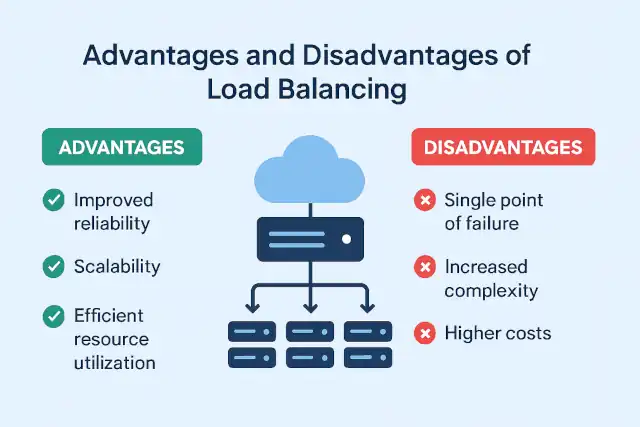
What are advantages and disadvantages of different load balancing?
As websites and applications grow from single-server setups to complex distributed systems, load balancing becomes essential for maintaining performance, reliability, and scalability.
Load balancing distributes incoming traffic across multiple servers, ensuring no single machine becomes overwhelmed while optimizing resource utilization.
However, different load balancing approaches come with distinct trade-offs that organizations must consider when architecting their systems.
Telegram Founder Launches Cocoon: A Decentralized Network Challenging Big Tech’s AI Monopoly
Understanding Load Balancing
Load balancing acts as a traffic manager for your infrastructure. When users access a website through a single domain like www.example.com, the load balancer sits at the entrance, intelligently routing requests to the most appropriate server in a cluster. This technology forms the backbone of modern cloud computing and distributed architectures, where backend servers function as pooled computing and storage resources managed transparently from the client’s perspective.
The two fundamental challenges that load balancing addresses are: selecting which server should handle a request, and forwarding that request efficiently. These decisions happen at different layers of the network stack, leading to various load balancing approaches.
Why Enterprises Should Replace VPN with Warpgate?
Types of Load Balancing: Layer-by-Layer Analysis
Layer 2 Load Balancing
How it works: Operates at the data link layer by maintaining a single virtual IP (VIP) while differentiating servers by MAC address. The load balancer rewrites the destination MAC address to forward requests.
Advantages:
- Extremely fast processing with minimal overhead
- Simple configuration for small deployments
- Servers appear unified to clients
Disadvantages:
- Limited to local network segments
- Poor scalability across geographic locations
- Difficult to implement advanced routing logic
- All servers must be on the same subnet
Best for: Small, geographically concentrated server clusters requiring maximum speed
Layer 3 Load Balancing
How it works: Functions at the network layer using IP addresses. The load balancer maintains a VIP but routes to servers with different IP addresses.
Advantages:
- Works across different subnets and network segments
- Better geographic distribution capabilities
- More flexible than Layer 2
Disadvantages:
- Still relatively basic routing capabilities
- Cannot make decisions based on application-level information
- Limited visibility into actual server load
Best for: Distributed infrastructure with servers across multiple network segments
Layer 4 Load Balancing
How it works: Operates at the transport layer using TCP/UDP protocols. Routes traffic by modifying IP addresses and port numbers in packet headers.
Advantages:
- Fast and efficient processing
- Protocol-agnostic for TCP/UDP traffic
- Lower computational overhead than Layer 7
- Good balance between speed and flexibility
- Can handle millions of requests per second
Disadvantages:
- Cannot inspect application-layer content
- No URL-based routing or header manipulation
- Limited ability to make intelligent routing decisions based on request content
- Cannot perform SSL termination with content inspection
Best for: High-throughput applications requiring speed over advanced routing logic, such as database clusters and game servers
Layer 7 Load Balancing
How it works: Functions at the application layer, understanding protocols like HTTP, HTTPS, and DNS. Makes routing decisions based on content including URLs, headers, cookies, and request methods.
Advantages:
- Intelligent routing based on application content
- URL-based routing for microservices architectures
- SSL termination and certificate management
- Content-based caching and compression
- Advanced health checks with application awareness
- Cookie-based session persistence
- Request rewriting and header manipulation
Disadvantages:
- Higher computational overhead
- More complex configuration and management
- Potential bottleneck under extreme load
- Requires more powerful hardware or more instances
Best for: Web applications, API gateways, microservices, and scenarios requiring content-based routing
Why Enterprises Are Replacing VPNs with Zscaler Private Access?
Popular Load Balancing Tools Compared
LVS (Linux Virtual Server)
Primary Use: Layer 4 load balancing
Architecture: Three-tier design with load balancer layer (Director Server), server array, and shared storage layer
Advantages:
- Exceptional performance for Layer 4 operations
- Native Linux kernel support since version 2.6
- Free and open-source
- Mature and battle-tested technology
- Supports multiple real server platforms (Linux, Windows, Solaris, AIX, BSD)
- Low resource overhead
Disadvantages:
- Complex initial configuration
- Limited to Linux/FreeBSD for Director Server
- Steeper learning curve than alternatives
- Less suitable for Layer 7 requirements
- Community documentation can be fragmented
Best for: Large-scale infrastructure requiring maximum Layer 4 performance, particularly for Chinese markets where it originated
Nginx
Primary Use: Layer 7 load balancing
Performance: Officially supports 50,000 concurrent connections; practical deployments typically handle 20,000-100,000 depending on optimization and workload
Advantages:
- Excellent reverse proxy capabilities
- Flexible load balancing strategies
- Modular design for easy extension
- Hot deployment without downtime
- Low memory footprint (2.5 MB per 10,000 keep-alive connections)
- Strong HTTP/HTTPS support with SSL termination
- Built-in caching and compression
- Extensive documentation and community
- Easy configuration syntax
Disadvantages:
- Primarily designed for HTTP/HTTPS traffic
- Configuration reloads require some planning
- Commercial features (Nginx Plus) require licensing
- Less efficient than LVS for pure Layer 4 tasks
Best for: Web applications, API gateways, microservices architectures, and general-purpose HTTP load balancing
HAProxy
Primary Use: Layer 7 load balancing (also supports Layer 4)
Advantages:
- High performance for both Layer 4 and Layer 7
- Rich feature set for HTTP load balancing
- Excellent health checking mechanisms
- Detailed statistics and monitoring
- Virtual host support
- Free and open-source with enterprise options
- More flexible than Nginx for TCP load balancing
- Advanced traffic management features
Disadvantages:
- Configuration syntax less intuitive than Nginx
- Not a full web server (cannot serve static files)
- Smaller community than Nginx
- Requires third-party tools for SSL certificate management
Best for: Complex load balancing scenarios requiring advanced traffic management, especially where both Layer 4 and Layer 7 capabilities are needed
Google Revamps Cameyo Service to Help Enterprises Migrate from Windows to ChromeOS
Load Balancing Algorithms: Choosing the Right Strategy
Round Robin
How it works: Distributes requests sequentially to each server in rotation
Advantages:
- Simple and efficient implementation
- Equal distribution across servers
- Easy horizontal scaling
- Predictable behavior
Disadvantages:
- Ignores actual server load and capacity
- Unsuitable for write operations due to destination uncertainty
- No session persistence without additional mechanisms
Best for: Stateless applications, read-only database replicas, homogeneous server pools
Weighted Round Robin
How it works: Similar to round robin but assigns more requests to servers with higher weights based on capacity
Advantages:
- Accommodates heterogeneous server capabilities
- Easy to adjust for maintenance (set weight to 0)
- Simple capacity planning
Disadvantages:
- Requires manual weight configuration
- Doesn’t adapt to dynamic load changes
Best for: Mixed server environments with varying capacities
Random Distribution
How it works: Randomly assigns requests to available servers
Advantages:
- Extremely simple implementation
- Achieves balance with sufficient traffic volume
- No state tracking required
Disadvantages:
- Less predictable than round robin
- Can create temporary imbalances
- Not suitable for write operations
Best for: Large-scale read-only operations where statistical balance is acceptable
Least Connections
How it works: Routes new requests to the server with fewest active connections
Advantages:
- Dynamically adapts to actual server load
- Better balance for long-running connections
- Accounts for varying request processing times
Disadvantages:
- Requires connection state tracking
- More complex implementation
- Overhead from maintaining connection counts
Best for: Applications with variable request durations, WebSocket connections, database connection pools
Hash-Based Methods
How it works: Calculates destination server using a hash function on client IP, session ID, or URL
Advantages:
- Guarantees same client/request routes to same server
- Enables effective caching strategies
- Session persistence without sticky sessions
- Predictable routing for debugging
Disadvantages:
- Node failures cause significant cache invalidation
- Can create uneven distribution
- Less flexible than other algorithms
Best for: Caching layers, session-based applications
Solution for node failures: Consistent hashing minimizes redistribution impact, affecting only keys on failed nodes rather than requiring complete rehashing
IP Hash
How it works: Routes requests based on client IP address hash
Advantages:
- Simple session persistence
- No cookie or session tracking needed
- Effective for maintaining user affinity
Disadvantages:
- Users behind NAT/proxies route to same server
- Can create imbalances with proxy traffic
- Doesn’t adapt to changing server capacity
Best for: Applications requiring basic session persistence without application-level session management
URL Hash
How it works: Routes based on requested URL hash
Advantages:
- Maximizes cache hit rates
- Same content always routes to same cache
- Optimal for content delivery
Disadvantages:
- Inflexible for dynamic content
- Rebalancing disrupts caching efficiency
Best for: CDN edge servers, static content delivery, media streaming
Fastest Response Time
How it works: Routes to server with quickest recent response time
Advantages:
- Automatically adapts to server performance
- Accounts for varying server capabilities
- Considers network latency
Disadvantages:
- Complex to implement accurately
- Requires continuous monitoring
- Can be affected by temporary performance spikes
Best for: Geographically distributed servers, heterogeneous environments
Dynamic Performance-Based
How it works: Monitors CPU, memory, network, and application metrics to make routing decisions
Advantages:
- Maximum resource utilization
- Adapts to real-time conditions
- Prevents overload situations
Disadvantages:
- Most complex implementation
- Significant monitoring overhead
- Requires sophisticated logic
- Less commonly available in standard tools
Best for: Mission-critical applications with sophisticated monitoring infrastructure
Message Queue Pattern (Pull-Based)
How it works: Requests enter a queue; servers pull work when available rather than having work pushed to them
Advantages:
- Eliminates load balancing complexity
- Natural backpressure protection
- Easy horizontal scaling
- Protects backend from traffic spikes
- Automatic handling of variable server capacity
Disadvantages:
- Not suitable for real-time responses
- Adds infrastructure complexity
- Requires asynchronous architecture
- Potential message delivery delays
Best for: Batch processing, background jobs, order processing, email delivery, report generation
Why Enterprises Must Implement Zero Trust Security?
Advanced Strategies for Enterprise Deployments
Multi-Layer Load Balancing
Large-scale operations typically implement multiple load balancing layers:
- DNS-based geographic distribution – Routes users to nearest data center
- Layer 4 load balancing – High-speed traffic distribution within data centers
- Layer 7 load balancing – Content-based routing to application tiers
This approach combines the speed of lower-layer load balancing with the intelligence of application-layer routing.
Advantages:
- Geographic redundancy and disaster recovery
- Optimal performance through proximity routing
- Specialized optimization at each layer
Disadvantages:
- Complex architecture and management
- Higher infrastructure costs
- More potential failure points
Hardware vs. Software Load Balancers
Hardware Load Balancers:
- Superior performance and reliability
- Comprehensive feature sets
- Dedicated vendor support
- Expensive (often $50,000-$500,000+)
- Best for: Large enterprises, financial services, telecommunications
Software Load Balancers:
- Cost-effective (often free or commodity hardware)
- Flexible and customizable
- Easy to scale horizontally
- Cloud-native compatibility
- Best for: Startups, web applications, cloud deployments
Why VPN Security Should Be Every Enterprise’s Top Priority
Choosing the Right Solution
The optimal load balancing strategy depends on several factors:
For small to medium web applications: Nginx provides the best balance of features, performance, and ease of use for Layer 7 requirements
For high-performance Layer 4 requirements: LVS offers maximum throughput with minimal overhead
For complex enterprise scenarios: HAProxy provides advanced features with good performance across both Layer 4 and Layer 7
For modern cloud-native applications: Managed services like AWS Application Load Balancer, Azure Load Balancer, or Google Cloud Load Balancing eliminate operational overhead while providing robust features
For maximum scalability: Combine DNS routing, Layer 4 load balancing for speed, and Layer 7 routing for intelligent traffic management
Why Enterprise Firewalls and Antivirus Software Fail to Stop Ransomware Attacks?
Conclusion
Load balancing remains a critical component of modern infrastructure, but no single solution fits all scenarios. Layer 4 approaches excel in raw performance, while Layer 7 methods provide intelligent routing capabilities essential for complex applications. The choice between LVS, Nginx, HAProxy, or managed cloud services depends on your specific performance requirements, budget constraints, operational expertise, and architectural complexity.
As applications continue evolving toward microservices and distributed architectures, the trend favors flexible Layer 7 solutions that can route traffic intelligently based on content, combined with Layer 4 speed where appropriate. Understanding the advantages and disadvantages of each approach enables you to design infrastructure that meets your current needs while remaining adaptable to future growth.
What are advantages and disadvantages of different load balancing?