Li-Fi wireless transmission standard 802.11bb officially released
Li-Fi wireless transmission standard 802.11bb officially released: bandwidth up to 224GB/s
- 60% of MD5 Password Hashes Can Be Cracked in Under an Hour with a Single GPU
- Dirty Frag: Root Access on Every Major Linux Distribution — No Patch, No Warning
- Ubuntu 26.04 LTS (Resolute Raccoon): The Most Ambitious Ubuntu LTS in a Decade
- Proton Mail: Data Transferred to FBI Again!
- How Close Are Quantum Computers to Breaking RSA-2048?
- How to Prevent Ransomware Infection Risks?
- What is the best alternative to Microsoft Office?
Li-Fi wireless transmission standard 802.11bb officially released: bandwidth up to 224GB/s.
Everyone is familiar with Wi-Fi, and the latest standard has evolved to 802.11be, that is, Wi-Fi 7, with a theoretical rate of up to 30Gbps. Now, something stronger is coming.
IEEE officially signed the 802.11bb wireless transmission standard today, namely Li-Fi, wireless transmission based on light waves.
Li-Fi supporters believe that light is more reliable than radio frequency, which makes Li-Fi faster and safer than Wi-Fi and 5G.
The release of Li-Fi also helps to achieve compatibility and compatibility with Wi-Fi. interoperability.
It is reported that Li-Fi can transmit with the help of part of the proprietary infrared spectrum in lighting, and the speed can reach 224GB/s.
Of course, because the frequency exceeds 60Hz, it cannot be detected by the naked eye.
At present, pureLiFi, a leading manufacturer of Li-Fi ecology, has already sampled antenna component products to OEMs, and some have begun to test Li-Fi systems in architectural lighting and street lights.
Of course, Li-Fi has limited penetration and cannot penetrate opaque objects.
On the one hand, this is its limitation. On the other hand, it also guarantees the absolute speed and absolute security of communication within a specific range.
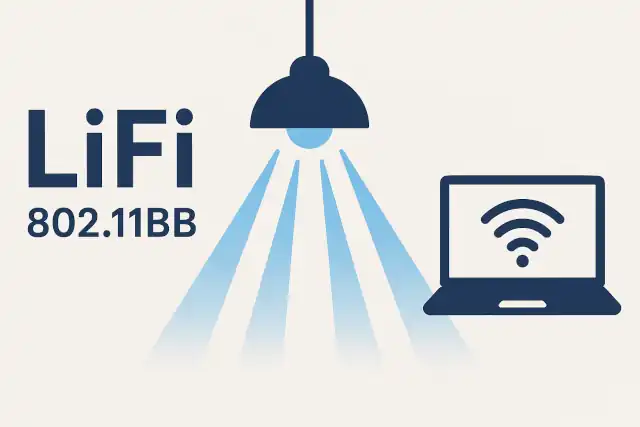
The history about LiFi wireless transmission:
From June 2023, the IEEE 802.11 wireless standard officially recognizes wireless optical communication as the physical layer of wireless LAN, which means that Li-Fi does not need to compete with Wi-Fi.
The light can be another access point and interface, providing the same network and/or the same internet to your device.
In fact, at least one IEEE member has been experimenting with networks that use both Wi-Fi and Li-Fi to overcome each other’s shortcomings, intelligently directing some office computers to use Li-Fi instead of Wi-Fi, improving the overall network.
Li-Fi products are actually not new: a lot of companies have been trying to sell Li-Fi products for years.
The International Telecommunication Union’s G.9991 even has a competing standard, used in data-transmitting light bulbs from companies like Philips Hue maker Signify.
The companies have been banking on light to provide fast, private, direct line-of-sight connections without radio interference — amid concerns that lighting conditions can change dramatically and line-of-sight connections can be easily cut accidentally.
In the experimental report, CableLabs does not deny that there is still room for improvement in optical communication (LC). “The range of LCs is very sensitive to irradiance and angle of incidence, making dynamic beam steering (and LoS availability) attractive for future LC development,” reads a line from the study. “Enterprise Wi-Fi is comparable to state-of-the-art LC performance, but LC reliability needs to be improved. One possible approach is to use multiple distributed optical front ends.”
PureLiFi just launched the Light Antenna One in February, a module so small that it could theoretically be integrated into a smartphone , it claims that its transfer rate can exceed 1Gbps depending on the use case. (It can only communicate with devices up to 10 feet away, and has a 24-degree field of view when beaming back). PureLiFi says it has become 802.11bb compliant, “the first large-scale integration of LiFi”.
If you want to learn more, the IEEE working group has a 59-page overview (PDF) of the 802 Optical Communications Standard, including links to some video technical demonstrations.
It also mentions parallel work on 802.15.13 for industrial and medical applications.
What is Li-Fi wireless transmission?
Li-Fi, short for “Light Fidelity,” is a wireless communication technology that uses light to transmit data instead of traditional radio waves used in technologies like Wi-Fi.
It utilizes visible light communication (VLC) and works by modulating the intensity of light emitted by LEDs (Light Emitting Diodes) to send data signals. Li-Fi can be used as an alternative or complementary technology to Wi-Fi for wireless networking.
Data Transmission:
Li-Fi uses rapid changes in the intensity of light emitted by LED bulbs to transmit data. These changes happen at a rate that is imperceptible to the human eye, allowing for high-speed data transfer.
Light Spectrum:
Li-Fi uses the visible light spectrum, which includes the range of colors that are visible to the human eye. This spectrum is much larger than the radio frequency spectrum used by Wi-Fi, offering the potential for higher data transfer rates.
Advantages:
Li-Fi has several advantages over traditional Wi-Fi. It can provide faster data transfer rates, as light waves have a higher frequency than radio waves. Li-Fi is also less prone to interference from other wireless devices and offers greater security since light does not pass through walls like radio waves do.
Limitations:
One of the main limitations of Li-Fi is that it requires a direct line of sight between the light source and the receiver. The signal cannot pass through obstacles like walls or other opaque objects. Additionally, Li-Fi technology is still in the early stages of development and has limited compatibility with existing devices.
Applications:
Li-Fi has the potential to be used in various applications. It can be deployed in environments where radio frequency interference is a concern, such as hospitals, aircraft, or industrial facilities.
Li-Fi can also be utilized in high-speed wireless internet access, especially in areas with a high concentration of devices and heavy data traffic.
Challenges:
While Li-Fi has promising potential, there are challenges that need to be addressed. The technology requires specialized infrastructure and compatible devices for implementation. Moreover, the adoption of Li-Fi would require significant investment and standardization efforts.
It’s important to note that as of my knowledge cutoff in September 2021, Li-Fi is still an emerging technology and has not yet achieved widespread commercial deployment.
Therefore, the information provided here may not reflect the latest advancements or developments in Li-Fi technology.