March 7, 2026

PBX Science

VoIP & PBX, Networking, DIY, Computers.

Privacy Concerns Lead to Removal of Nothing Chat App from Google Play Store

Privacy Concerns Lead to Removal of Nothing Chat App from Google Play Store


Privacy Concerns Lead to Removal of Nothing Chat App from Google Play Store

Due to privacy concerns, the Nothing Chat application has been removed from the Google Play Store.

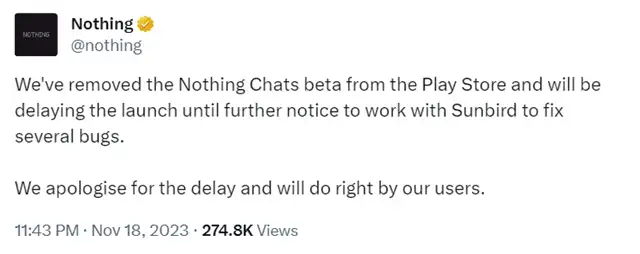
On November 19th, smartphone manufacturer Nothing announced that the beta version of Nothing Chats has been taken down from the Google Play Store.

They stated, “The release will be postponed until further notice to collaborate with Sunbird to address multiple issues.”
Privacy Concerns Lead to Removal of Nothing Chat App from Google Play Store

IT Home noticed a widely discussed article on the Texts.com blog. The blog revealed that messages sent using the Sunbird system were not actually end-to-end encrypted and were susceptible to easy decryption.

Sunbird responded by denying any security issues, demonstrating the reasonableness of their implementation, and emphasizing the security measures in place. They stated, “Although the protocol is HTTP, all data is encrypted.”

The keys used to encrypt this data are provided through HTTPS, ensuring that Apple credentials or messages sent via HTTP requests are secure and not exposed to the public.

HTTP is only used as part of the initial request for the one-time initiation of iMessage connections, which will be carried out through an independent communication channel after application notification to the backend.

Sunbird’s ISO27001 certification (certificate number: IA-2023-09-21-01) is an internationally recognized information security management system specification, reflecting their commitment to user privacy.

Many users expressed skepticism in response to Nothing’s tweet, claiming, “Are you categorizing lack of end-to-end encryption, public data exposure, and lack of HTTPS protocol as ‘issues’?” “Are we now classifying data privacy issues as ‘issues’?”




What is HTTP protocol?

HTTP, or Hypertext Transfer Protocol, is the foundation of data communication on the World Wide Web.
 
It is an application layer protocol that facilitates the transfer of information between a client (such as a web browser) and a server.
 
HTTP is part of the larger suite of protocols known as the Internet Protocol suite.

Key features and characteristics of HTTP include:

  1. Stateless Protocol:

    • HTTP is a stateless protocol, meaning that each request from a client to a server is independent, and the server does not retain information about the previous requests.
  2. Client-Server Model:

    • It follows a client-server model where a client, typically a web browser, sends requests to a server, and the server responds with the requested resources (such as web pages, images, or other content).
  3. Request-Response Cycle:

    • The communication between the client and server occurs in the form of a request-response cycle. The client sends an HTTP request to the server, and the server responds with the requested data or an error message.
  4. Uniform Resource Identifiers (URIs):

    • HTTP uses Uniform Resource Identifiers (URIs) to identify and locate resources on the web. URIs, often in the form of URLs (Uniform Resource Locators), specify the address of the resource.
  5. Methods:

    • HTTP defines various request methods, also known as HTTP verbs, which indicate the desired action to be performed on a resource. Common methods include GET (retrieve data), POST (submit data), PUT (update a resource), and DELETE (remove a resource).
  6. Status Codes:

    • HTTP uses status codes in its responses to indicate the success or failure of a request. Examples include 200 OK (successful), 404 Not Found (resource not found), and 500 Internal Server Error (server error).
  7. Headers:

    • HTTP headers provide additional information about the request or response. They can include details such as content type, content length, and information about the client and server.
  8. Connectionless:

    • Each request and response are independent of previous ones, making HTTP a connectionless protocol. This means that after a request is made and a response is received, the connection is closed.
  9. Text-Based:

    • HTTP messages are primarily text-based, making them human-readable and facilitating debugging and analysis using tools like web browser developer tools or proxy servers.
  10. Secure Version:

  • HTTPS (Hypertext Transfer Protocol Secure) is a secure version of HTTP that uses encryption (usually provided by TLS/SSL) to ensure the confidentiality and integrity of the data exchanged between the client and server.

HTTP has undergone several revisions over the years, with HTTP/1.1 being a widely used version, and HTTP/2 and HTTP/3 introducing improvements in terms of performance and efficiency.

Understanding HTTP is fundamental to web development and the functioning of the modern web.


Windows Software Alternatives in Linux


Disclaimer of pbxscience.com

PBXscience.com © All Copyrights Reserved. | Newsphere by AF themes.