Why IP Video Phones Don’t Support H.265 Video Encoding?
Why IP Video Phones Don’t Support H.265 Video Encoding? Technical and Economic Barriers
- 60% of MD5 Password Hashes Can Be Cracked in Under an Hour with a Single GPU
- Dirty Frag: Root Access on Every Major Linux Distribution — No Patch, No Warning
- Ubuntu 26.04 LTS (Resolute Raccoon): The Most Ambitious Ubuntu LTS in a Decade
- Proton Mail: Data Transferred to FBI Again!
- How Close Are Quantum Computers to Breaking RSA-2048?
- How to Prevent Ransomware Infection Risks?
- What is the best alternative to Microsoft Office?
Why IP Video Phones Don’t Support H.265 Video Encoding? Technical and Economic Barriers
In today’s interconnected workplace, IP phones have evolved far beyond simple voice communication devices.
Modern IP phones increasingly feature video capabilities, enabling users to participate in video calls and conferences directly from their desk phones.
However, despite the superior compression efficiency of H.265 (HEVC – High Efficiency Video Coding), virtually all IP video phones on the market today support only H.264 video encoding.
This limitation creates significant challenges for organizations seeking to integrate various video sources, as IP phones cannot decode H.265 surveillance feeds or other modern video resources, while simultaneously consuming more bandwidth than necessary.
Understanding why this technological gap persists requires examining three critical factors that have shaped the video communication industry.

The Computational Complexity Challenge
H.265 represents a substantial leap forward in video compression technology, delivering approximately 50% better compression efficiency than H.264 while maintaining equivalent video quality.
However, this improvement comes at a significant computational cost. Recent data shows that 78% of iPhone and 57% of Android smartphone requests come from devices that support hardware-accelerated HEVC decoding, highlighting the growing mobile support for the codec.
The encoding and decoding processes for H.265 require significantly more processing power than H.264. For IP phone manufacturers, this translates to a direct hardware cost increase.
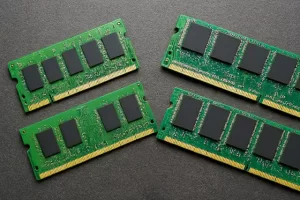
Implementing H.265 support necessitates more powerful processors, additional memory, and potentially dedicated video processing chips.
These hardware upgrades substantially increase manufacturing costs, which manufacturers must balance against market price expectations.
The economic reality is stark: if the majority of users don’t require H.265 functionality in their daily operations, manufacturers face a difficult choice between adding costly features that may go unused or maintaining competitive pricing with H.264-only implementations.
This cost consideration becomes particularly crucial in enterprise markets where purchase decisions often involve hundreds or thousands of devices.
The Patent Licensing Maze
Perhaps the most significant barrier to H.265 adoption in IP phones stems from the complex and expensive patent licensing landscape.
Unlike H.264, which has matured to the point where many fundamental patents have expired or carry minimal licensing fees, H.265 patents are distributed across multiple licensing pools with varying fee structures.
MPEG LA’s HEVC license covers essential patents from 23 companies, with the first 100,000 “devices” being royalty-free, followed by $0.20 per device up to an annual cap of $25 million. However, this represents only one of several patent pools that manufacturers must navigate.
Major patent pools including MPEG-LA and HEVC Advance have publicly disclosed rates ranging from $0.20 to over $1.50 per unit, with yearly caps reaching up to $40 million.
For large-scale video communication platforms like Zoom, Microsoft Teams, or Skype, which serve hundreds of millions of users, these licensing costs can reach astronomical levels.
The fragmented nature of H.265 patent licensing creates additional complexity. Manufacturers must potentially secure licenses from multiple patent pools – MPEG LA, HEVC Advance, and Velos Media – each with distinct terms and conditions.
This contrasts sharply with H.264’s more straightforward and economical licensing structure, making it a safer and more predictable choice for IP phone manufacturers.
The Compatibility Conundrum
The third major obstacle facing H.265 adoption in IP phones is the classic “chicken and egg” compatibility problem. Even if a manufacturer develops an IP phone with H.265 support, the device’s video capabilities remain limited by the broader ecosystem’s codec support.
When an H.265-capable IP phone attempts to communicate with H.264-only devices – which currently represent the vast majority of installed communication equipment – the video connection either fails or automatically falls back to H.264 encoding. This scenario negates the primary benefits of H.265 implementation while adding unnecessary cost and complexity.
The current communication infrastructure heavily favors H.264, from legacy PBX systems to modern unified communications platforms. Organizations considering H.265-capable devices would need to evaluate comprehensive system upgrades, dramatically increasing total cost of ownership beyond the individual device price.
Industry analysis confirms that “HEVC/H.265 format is not fully compatible with all devices, hardware, software, video streaming platforms, and cloud services,” often requiring conversion to H.264 to resolve compatibility issues.
Addressing Integration Challenges
Despite these limitations, organizations frequently encounter scenarios where H.265 video integration becomes necessary.
Modern security cameras, advanced conferencing systems, and other video sources increasingly utilize H.265 encoding for bandwidth efficiency and storage optimization.
The solution lies not in replacing existing infrastructure but in implementing video transcoding capabilities.
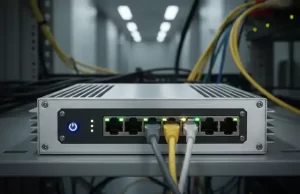
Video transcoding servers can bridge the codec gap by converting H.265 streams to H.264 in real-time, enabling seamless integration with existing IP phone deployments.
These transcoding solutions typically support SIP protocol compatibility, ensuring seamless integration with various IP PBX systems and unified communications platforms.
By deploying transcoding infrastructure, organizations can leverage H.265’s bandwidth efficiency for source content while maintaining compatibility with their existing H.264-based communication endpoints.
Looking Forward
While current market conditions favor H.264’s continued dominance in IP phone implementations, the landscape continues evolving. Recent patent landscape analysis indicates ongoing developments in the HEVC patent ecosystem, potentially leading to more favorable licensing terms in the future.
Additionally, newer codec standards like AV1 offer royalty-free alternatives that may eventually challenge both H.264 and H.265 in communication applications. However, the conservative nature of enterprise communication deployments suggests that any significant codec transition will occur gradually over several years.
For now, organizations requiring H.265 video integration with IP phone systems should focus on transcoding solutions rather than awaiting native H.265 support in IP phones. This approach provides immediate compatibility while avoiding the costs and risks associated with early adoption of emerging codec technologies.
Conclusion
The absence of H.265 support in current IP video phones results from a convergence of technical, economic, and compatibility factors rather than any fundamental technical limitation.
Computational complexity drives hardware costs higher, complex patent licensing creates financial uncertainty, and ecosystem compatibility issues limit practical deployment benefits.
While H.265 offers significant compression advantages, the mature H.264 ecosystem provides a stable, cost-effective solution for current video communication needs.
Organizations seeking to integrate H.265 content with IP phone systems should consider transcoding solutions as a pragmatic approach to bridging codec compatibility gaps without requiring comprehensive infrastructure replacement.
H.264 vs H.265: Complete Codec Comparison Guide