Should You Upgrade to PCIe 5.0 SSD?
Should You Upgrade to PCIe 5.0 SSD? Unveiling the Performance Pitfalls of PCIe 5.0 SSDs
- 60% of MD5 Password Hashes Can Be Cracked in Under an Hour with a Single GPU
- Dirty Frag: Root Access on Every Major Linux Distribution — No Patch, No Warning
- Ubuntu 26.04 LTS (Resolute Raccoon): The Most Ambitious Ubuntu LTS in a Decade
- Proton Mail: Data Transferred to FBI Again!
- How Close Are Quantum Computers to Breaking RSA-2048?
- How to Prevent Ransomware Infection Risks?
- What is the best alternative to Microsoft Office?
Should You Upgrade to PCIe 5.0 SSD? Unveiling the Performance Pitfalls of PCIe 5.0 SSDs
While PCIe 5.0 SSDs boast impressive sequential read speeds of 12,000-16,000 MB/s—double that of PCIe 4.0—their 4K random performance increases by only approximately 30%.
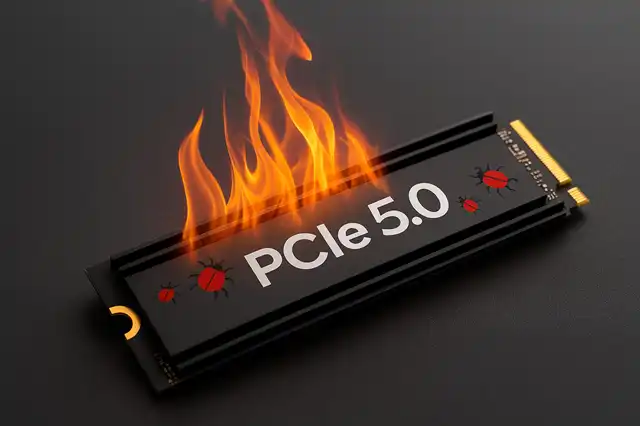
Additionally, controller heat output rises 20%-30%, necessitating enhanced cooling solutions.
Although energy efficiency improves, absolute power consumption remains high, potentially causing thermal throttling in laptops and compact systems.
PCIe 5.0 benefits scenarios with sequential read/write bottlenecks such as 4K/8K editing, 3D rendering, and AI training, but PCIe 4.0 suffices for everyday office work, web browsing, and online video streaming.
With PCIe 5.0 commanding a 30%-70% price premium for equivalent capacities, PCIe 4.0 represents superior value for mainstream users.
The Speed Revolution’s Hidden Compromises
As PCIe 5.0 technology gradually permeates the market, solid-state drive performance has once again shattered conventional boundaries.
However, beneath this “speed revolution” lurks a critical misalignment between technological capabilities and practical requirements—not all users need extreme speeds, nor can all scenarios accommodate the thermal and cost burdens PCIe 5.0 introduces.
Raw Performance: Impressive Numbers, Nuanced Reality
PCIe 5.0’s theoretical bandwidth reaches 32 GT/s, doubling PCIe 4.0’s capabilities. In x4 configurations, PCIe 5.0 SSDs achieve sequential read speeds of 12,000-16,000 MB/s, compared to PCIe 4.0’s typical 5,000-7,000 MB/s range.
This bandwidth increase delivers substantial gains in sequential read/write operations, yet 4K random read/write performance improves by merely 30%.
More critically, high-speed data transfer introduces significant power consumption and thermal challenges.
Despite employing advanced manufacturing processes (such as 6nm technology) that reduce per-unit power draw, PCIe 5.0 controllers still generate 20%-30% more heat than PCIe 4.0 counterparts, requiring motherboard heatsinks or active cooling systems to maintain stable operation.
The Energy Efficiency Paradox
From an energy efficiency perspective, PCIe 5.0 reduces power consumption per unit bandwidth by 15%-20%, yet absolute power consumption exceeds PCIe 4.0 levels.
This creates a critical limitation: users unable to provide adequate thermal management—such as laptop platforms or small form factor cases—may experience thermal throttling that prevents PCIe 5.0 drives from reaching rated specifications. In extreme cases, performance may fall below high-end PCIe 4.0 SSDs.
Who Actually Benefits from PCIe 5.0?
Content Creation Professionals
For 4K/8K video editing, 3D rendering, and large engineering file operations, PCIe 5.0’s high bandwidth significantly reduces asset import and export times. When paired with high-performance CPUs and GPUs, these drives unlock complete productivity potential.
Scientific and AI Workloads
AI training, scientific simulation, and high-performance computing scenarios involving massive parallel data operations benefit from PCIe 5.0’s 32 GT/s bandwidth, shortening model iteration cycles.
Demanding Gaming Scenarios
In select open-world games with high-resolution texture streaming requirements, PCIe 5.0 SSDs may reduce loading times by 1-2 seconds.
Who Should Skip PCIe 5.0?
Everyday Users
Daily document processing, web browsing, and online video streaming exhibit minimal sensitivity to storage speed. PCIe 4.0’s 5,000-7,000 MB/s sequential performance fully satisfies these requirements, with 128GB-1TB capacity SSDs offering superior cost-effectiveness.
Budget-Conscious Buyers
At equivalent capacities, PCIe 5.0 SSDs command 30%-70% price premiums over PCIe 4.0 models—an unjustifiable expense for users with limited budgets or mainstream computing needs.
The Bottom Line: Bridging the Gap Between Specs and Needs
The core “performance trap” of PCIe 5.0 SSDs lies in the disconnect between technical advancement and practical application. For mainstream users, PCIe 4.0 SSDs satisfy over 90% of use cases.
Professional users must evaluate the balance between performance gains and cost investment based on specific scenarios.
If workflows demonstrate clear sequential read/write bottlenecks (large file operations, video exports) and thermal/budget constraints permit, PCIe 5.0 SSDs become valuable efficiency tools.
However, for scenarios dominated by random operations (system boot, application loading) or cost-sensitive environments, PCIe 4.0 SSDs remain the optimal solution.
The question isn’t whether PCIe 5.0 represents technological progress—it undeniably does—but rather whether that progress aligns with your actual computing requirements and system capabilities.