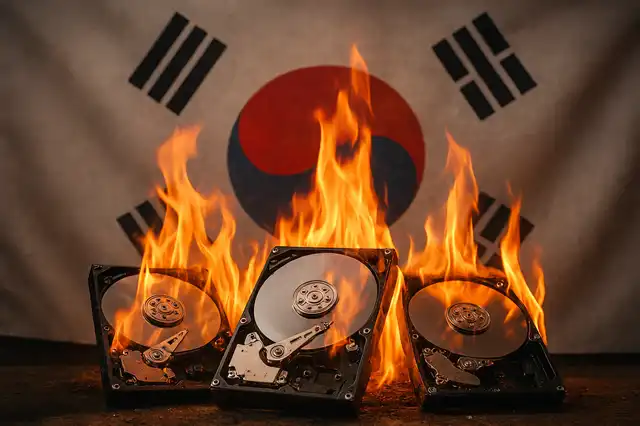
Major Fire at South Korean Government Data Center Destroys Seven Years of Critical Files
Major Fire at South Korean Government Data Center Destroys Seven Years of Critical Files
- 60% of MD5 Password Hashes Can Be Cracked in Under an Hour with a Single GPU
- Dirty Frag: Root Access on Every Major Linux Distribution — No Patch, No Warning
- Ubuntu 26.04 LTS (Resolute Raccoon): The Most Ambitious Ubuntu LTS in a Decade
- Proton Mail: Data Transferred to FBI Again!
- How Close Are Quantum Computers to Breaking RSA-2048?
- How to Prevent Ransomware Infection Risks?
- What is the best alternative to Microsoft Office?
Major Fire at South Korean Government Data Center Destroys Seven Years of Critical Files
DAEJEON, South Korea — A devastating fire at South Korea’s National Information Resources Service has resulted in the complete loss of nearly seven years of government work files, marking one of the country’s most severe public administration data security incidents in recent history.
Why Are Enterprises Adopting 3-2-1-1-0 for Data Safety?
The Incident
According to South Korea’s Ministry of the Interior and Safety, the fire broke out at approximately 8:15 PM local time on September 26 in the computer room on the fifth floor of the National Information Resources Service facility in Daejeon, located about 140 kilometers south of Seoul. The blaze erupted when a lithium battery unit exploded during maintenance procedures while power was disconnected.
The fire destroyed nearly 400 battery units and was not brought under control until 6:30 AM on September 27. Construction workers suffered burns to their faces and arms from the explosion.
Why Are Enterprises Adopting 3-2-1-1-0 for Data Safety?
Why You Should Choose CMR Over SMR Hard Drives Without Multiple Backups: A Technical Analysis
Catastrophic Data Loss
The fire has had devastating consequences for South Korea’s digital government infrastructure. Officials confirmed that 647 government business systems were shut down, with 96 systems completely destroyed. Among the destroyed systems was the government’s core file storage system, which contained work documents from approximately 750,000 civil servants dating back to 2018.
Because no external backup system had been established, all government files from 2018 to 2025—including administrative approvals, policy research, and public service records—have been permanently lost with no possibility of recovery.
Since 2018, the South Korean government had required all civil servants to store work files in this centralized system rather than on personal computers, making the lack of external backups particularly catastrophic.
Widespread Service Disruptions
The incident has crippled operations across multiple government agencies, affecting approximately one-third of the nation’s online government information services. Key systems impacted include:
- Emergency Services: The 119 emergency rescue service’s location tracking functionality was disabled
- Core Government Agencies: The Prime Minister’s Office, Ministry of the Interior and Safety, and Ministry of Economy and Finance experienced online service paralysis
- Public Services: Official document issuance services were suspended, customs clearance was obstructed, police case filing systems went offline, and fire department dispatch operations were hindered
Citizens have been unable to access numerous government department websites to conduct routine business.
Hard Drive Selection Guide: Surveillance vs Enterprise Storage for Small-Scale Deployments
Root Cause: Aging Equipment and Inadequate Procedures
Preliminary investigations have identified the cause as an uninterruptible power supply (UPS) battery failure. The lithium batteries involved had been in service for over 12 years—far exceeding the standard 8-10 year safe operational lifespan for UPS batteries. Investigators also noted irregularities in maintenance procedures during the incident.
Implications
This disaster raises serious questions about South Korea’s government IT infrastructure management, particularly regarding backup protocols, equipment maintenance standards, and disaster recovery planning. The complete absence of external backups for such critical data represents a fundamental failure in data security practices that will likely prompt a comprehensive review of government digital infrastructure policies.
The incident serves as a stark reminder of the vulnerabilities inherent in centralized digital systems and the critical importance of robust backup and disaster recovery mechanisms in modern government operations.