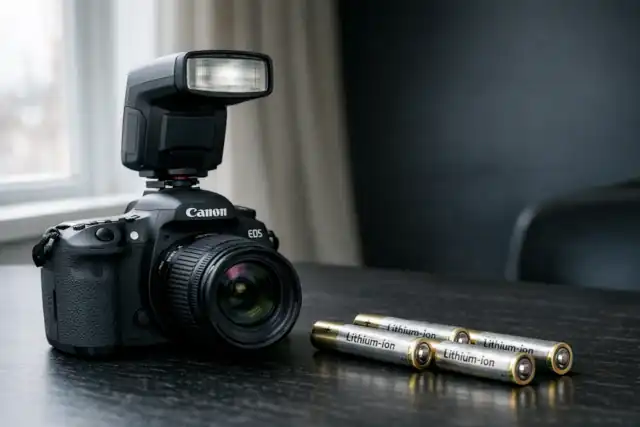
Canon Warns: Never Use Lithium Batteries in Flash Units
Canon Warns: Never Use Lithium Batteries in Flash Units
- Linux Kernel Removes strncpy After Six Years and 362 Patches
- Linux Kernel Drops 40-Year-Old AppleTalk Protocol — AI-Generated Patch Flood Was the Last Straw
- Apple’s Native Linux Container Tool Has Arrived — But Can It Really Replace Docker?
- 60% of MD5 Password Hashes Can Be Cracked in Under an Hour with a Single GPU
- Dirty Frag: Root Access on Every Major Linux Distribution — No Patch, No Warning
Canon Warns: Never Use Lithium Batteries in Flash Units
An updated service notice from Canon — confirmed April 28, 2026 — puts photographers on notice about a dangerous and widely overlooked battery incompatibility that spans nearly every major camera brand.
Canon has updated its official service notice cautioning photographers against the use of lithium and lithium-ion AA batteries in its lineup of Speedlite flash units, macro lights, and compact battery packs. The update — timestamped April 28, 2026 on the Canon USA support site — refreshes an advisory that has existed in some form since at least 2014, now expanding the list of affected products.
While the notice originates with Canon, the safety concern is far from brand-specific. Sony, Nikon, Panasonic, and OM System have each independently restricted or discouraged the use of AA lithium batteries in their respective flash products — though the precise language and reasoning differs between manufacturers.
“Please note that lithium batteries and lithium-ion batteries cannot be used with the Speedlites / Macro Ring Lites / Macro Twin Lights, and compact battery packs in general. Please be aware that using certain lithium and lithium-ion batteries will result in an extremely high temperature of the battery.”
Why Lithium Batteries Cause Problems in Flash Units
The root issue is thermodynamic rather than purely electrical. Flash units fire high-energy bursts in rapid succession, generating significant internal heat. Lithium AA cells — prized in cameras, torches, and remote controls for their longevity and stable voltage — deliver their power with a higher current capacity than alkaline or NiMH cells. In a flash unit, that translates directly to excess heat generation.
Testing documented as far back as 2010 showed that a Canon 580EX Speedlite fired at full power on a 20-second cycle using lithium batteries averaged just 52 flashes before failure — and the battery sets reached temperatures above 60 °C (140 °F) immediately after the test. Extended the cycle to three minutes and the flash count rose to 218, illustrating that the danger is primarily a function of sustained, rapid-fire use.
“Using lithium batteries in portable strobes and speedlights can lead to overheating, reduced performance, and, in extreme cases, damage to your gear or even a fire risk.”
— Digital Camera World, April 2026
It is worth noting the distinction between AA lithium primary (disposable) cells — brands like Energizer Ultimate Lithium — and the rechargeable lithium-ion battery packs found in laptops and phones. Canon’s warning covers both types in the context of flash units. Third-party flash makers such as Yongnuo and Pixel have produced speedlights with integrated lithium-ion packs, but those are purpose-built with appropriate internal management circuits; the danger arises from inserting standard AA lithium cells into units designed for alkaline or NiMH chemistry.
Affected Canon Products
The April 2026 update lists the following products as incompatible with lithium or lithium-ion AA batteries:
Canon Flash Units & Accessories Covered by Advisory
How Other Brands Handle the Issue
Canon is not alone. A survey of flash unit manuals across the industry reveals a consistent, if inconsistently worded, consensus against lithium AA cells:
-
SonyFlash manuals for the HVL-F28RM, HVL-F60RM, HVL-F60RM2, HVL-F46RM, and HVL-F46RMA explicitly state: “Do not use lithium-ion batteries in this flash unit as they may prevent the flash unit from delivering full performance.”
-
OM SystemThe FL-700WR manual states clearly: “Avoid using AA lithium batteries. Some AA lithium batteries may become extremely hot during use.” — among the most direct warnings in the industry.
-
PanasonicFor the DMW-FL360L flash, Panasonic specifies only alkaline or rechargeable NiMH cells. Lithium is not mentioned by name, but the omission from the approved list effectively excludes it. Manganese dry batteries are explicitly forbidden.
-
NikonNikon’s guidance is less specific, but its Speedlight manuals generally recommend alkaline or NiMH batteries without explicitly approving lithium AA cells.
Battery Types at a Glance
| Battery Type | Flash Use | Notes |
|---|---|---|
| AA Lithium (disposable) e.g. Energizer Ultimate |
Prohibited | Overheating risk; banned by Canon, Sony, OM System |
| AA Alkaline e.g. Duracell, Energizer |
Permitted | Widely compatible; shorter lifespan and slower recycle vs NiMH |
| AA NiMH rechargeable e.g. Panasonic Eneloop |
Recommended | Industry standard; fast recycle, low self-discharge, reusable |
| Integrated Li-ion pack e.g. Yongnuo YN686EX-RT |
Purpose-Built Only | Only safe when the flash is engineered specifically for Li-ion |
A Warning Hidden in Plain Sight
One remarkable aspect of this story is how long the restriction has existed without reaching mainstream photographer awareness. Canon’s original advisory dates to December 2014. Yet even photojournalists and experienced editorial photographers — people whose livelihoods depend on reliable flash performance — reported in 2026 that they had no idea lithium AA batteries were problematic in speedlights.
Ironically, the very qualities that make lithium AA cells attractive — long shelf life, consistent output in cold weather, lightweight construction — make them a tempting choice for event and wedding photographers who stock up on batteries and shoot in unpredictable conditions. The risk is compounded precisely in the high-throughput scenarios — rapid flash sequences at receptions, macro photography requiring precision exposure — where the heat buildup is most dangerous.
The advisory also underscores a gap between product manuals and actual practice. Several Canon Speedlite manuals from before 2014 explicitly listed lithium as a compatible battery type. The policy reversal was never loudly publicised, and many photographers continue to operate on outdated information.
Remove any AA lithium batteries currently loaded in your flash unit immediately. Replace them with NiMH rechargeable cells — Panasonic Eneloop (standard, not Pro) is the most widely recommended choice among professional photographers, offering up to 2,100 recharge cycles, low self-discharge, and consistent recycling performance across all major speedlight brands.
What to Do Now
If you shoot with any of the Canon units listed above — or with flash products from Sony, Nikon, Panasonic, or OM System — check the battery compartment before your next session. If there are lithium AA cells inside, replace them before use. Verify the specific battery guidance in your flash manual; if the manual predates 2015, cross-reference with the manufacturer’s current online service notices.
For photographers who regularly carry spare batteries in the field, switching entirely to NiMH rechargeables eliminates the risk. Low-self-discharge NiMH cells (the technology used in Eneloop and similar batteries) retain most of their charge for up to a year in storage, making them a practical replacement for lithium cells in flash use without sacrificing readiness.
Canon’s updated service notice is available directly from the Canon USA support portal. Photographers outside the US should contact the Canon Customer Support Centre in their region for localised guidance.