Will Unified Memory Kill the Computer DIY Market?
- Linux Kernel Removes strncpy After Six Years and 362 Patches
- Linux Kernel Drops 40-Year-Old AppleTalk Protocol — AI-Generated Patch Flood Was the Last Straw
- Apple’s Native Linux Container Tool Has Arrived — But Can It Really Replace Docker?
- 60% of MD5 Password Hashes Can Be Cracked in Under an Hour with a Single GPU
- Dirty Frag: Root Access on Every Major Linux Distribution — No Patch, No Warning
Will Unified Memory Kill the Computer DIY Market?
A seismic architectural shift is under way in personal computing. Unified memory — which merges CPU, GPU, and RAM into a single shared pool — is being championed by Apple, AMD, and now NVIDIA. But the benefits come with a cost that DIY builders may not be willing to pay.
What Is Unified Memory?
Traditional PC architecture separates computation into distinct domains: the CPU handles general processing, the GPU renders graphics and accelerates parallel workloads, and DRAM stores working data. To share information, these components shuttle data across the PCIe bus — a connection that, for all its engineering refinement, is a physical bottleneck. Data written by the CPU must be copied into the GPU’s dedicated VRAM before it can be used for rendering or AI inference, and vice versa.
Unified memory collapses that boundary. By placing CPU cores, GPU shaders, NPU engines, and the memory itself on the same silicon package — or at least connecting them via ultra-high-bandwidth on-package links — data written once is immediately visible to every compute unit. There’s no copy across the bus; all processors share the same physical memory pool.
Apple pioneered the consumer implementation of this idea with the M1 chip in 2020, and pushed it much further with the M1 Ultra’s 128 GB ceiling in 2021. The M4 Max now delivers up to 546 GB/s of memory bandwidth — roughly four to five times what a conventional DDR5 desktop system achieves. On-package interconnects like NVIDIA’s NVLink-C2C, used in the new RTX Spark platform, further cut the latency between compute and memory compared to a discrete PCIe-connected GPU.
Why Now? AI Is the Forcing Function
The conventional GPU-with-dedicated-VRAM model reached its practical ceiling once AI model sizes began to outpace consumer VRAM budgets. A 70-billion-parameter language model at standard quantization requires roughly 35–40 GB of contiguous, fast-access memory to run at usable speeds. The NVIDIA RTX 4090 — the most powerful consumer GPU available until recently — tops out at 24 GB of VRAM, which means a 70B model cannot fit at all at full precision, and must be split or quantized aggressively to run even partially.
Unified memory architectures break through that ceiling by pooling everything. A Mac Studio with an M4 Max chip and 64 GB of unified memory can run a 70B-parameter model locally at full quantization — something that would otherwise require two or three high-end discrete GPUs. Apple’s architecture also provides a genuine efficiency advantage for AI inference: because data is not duplicated between CPU RAM and GPU VRAM, each piece of data is processed where it already lives, saving energy and bandwidth. Independent benchmarks have confirmed that Apple Silicon machines achieve strong tokens-per-second performance for local large language model inference, particularly at the memory-per-dollar level.
A widely circulated claim attributes a direct quote to AMD’s Chief Technology Officer Mark Papermaster stating that “processors without a unified memory design will be obsolete in five years.” No verified source for this precise quote has been found. What Papermaster has said on record — in a 2026 interview and public remarks — is that unified memory architecture is moving from niche to mainstream as agentic AI demands grow, and that AMD’s Ryzen AI Max and future roadmap reflect that direction. The spirit of the observation is accurate; the specific wording and framing appear to be an embellishment.
AMD entered the unified memory space with its Ryzen AI Max series, which integrates a large Radeon GPU and substantial LPDDR5x memory onto the same package as the CPU. The Ryzen AI Halo dev box, launched in mid-2026 at $3,999 with 128 GB of unified memory, directly targets the same local-AI workstation market as NVIDIA’s DGX Spark. NVIDIA itself formalized its entry at Computex 2026 in late May, announcing the RTX Spark platform: a Blackwell GPU paired with a custom 20-core Arm-based CPU and up to 128 GB of unified memory via NVLink-C2C, delivering roughly one petaflop of AI compute. Systems from Microsoft Surface, Dell, HP, ASUS, Lenovo, and MSI are scheduled to ship in autumn 2026.
“Unified memory is no longer a niche design choice — it is becoming central to the next generation of AI-capable PCs.”
— InsightTechDaily, March 2026The Cost: What Unified Memory Takes Away
Every architectural gain trades against something. The question for the PC industry — and especially for the enthusiast builder community — is how steep that trade is.
Upgradeability disappears. Because unified memory is physically integrated with the processor package, it cannot be swapped out independently. When Apple ships a Mac mini with 16 GB or 24 GB of unified memory, that capacity is permanent. The same is true for AMD’s Ryzen AI Max designs in mini PCs from Minisforum, Beelink, and Geekom. Industry observers at XDA Developers and elsewhere have noted that SO-DIMM slots — the standard upgrade path for laptop and small-form-factor PC memory — are disappearing from products that adopt unified memory chips. Once the system is purchased, the memory tier is fixed for its lifetime. For users who historically bought a mid-range machine and upgraded RAM two or three years later, this is a meaningful change.
Memory commands a premium. Standardised DRAM — produced by multiple competing manufacturers at commodity prices — has historically kept memory affordable. Unified memory is a customised component specific to each silicon design. Apple’s M4 Max 128 GB configuration carries a substantial premium over the base model, far exceeding what the equivalent capacity of standard DDR5 would cost in a traditional system. That premium reflects not just the engineering cost of the memory itself but the absence of competition: only Apple can sell you that specific memory tied to that specific chip.
The broader memory market is under pressure. TrendForce projected the overall DRAM market to reach $551.6 billion in 2026 and to surge to a peak of $842.7 billion in 2027 — a 53% year-on-year increase — driven heavily by AI server procurement and supply tightness. That macro dynamic is pushing memory prices upward across the board, making upgradeable systems more attractive to cost-conscious buyers even as unified memory systems gain mindshare at the high end. A current DRAM shortage has, counterintuitively, nudged some system builders toward extending the life of existing upgradeable machines rather than replacing them with fixed-memory alternatives.
A circulating version of this story claims motherboard shipments will decline 27% year-on-year in 2026, and that Apple, NVIDIA, and AMD collectively hold 83% of relevant patents. Neither figure has been verified against a primary source. What is documented is a clear architectural trend: mini PC manufacturers are increasingly adopting unified memory designs, and traditional discrete-component desktop systems face competitive pressure from integrated platforms for AI-heavy workloads. The trend is real; the specific numbers require independent sourcing before they can be treated as reliable.
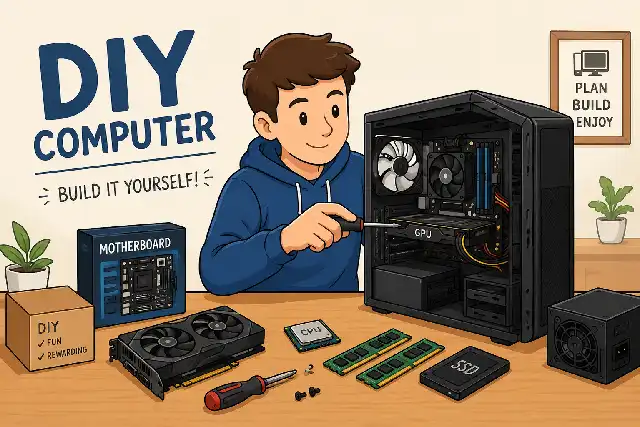
The DIY ecosystem faces structural pressure — but is not dead. Traditional desktop PC builders retain meaningful advantages for several workload categories. An RTX 4090 still outperforms any Apple Silicon chip for GPU-intensive gaming at high resolutions. Discrete GPU systems allow incremental upgrade paths — a user can replace a GPU without buying an entirely new machine. The Framework Desktop, which shipped with AMD Ryzen AI Max chips, explicitly addressed the tension by offering some modularity even within a unified memory design. NVIDIA’s RTX Spark devices will compete at the high end of the market, but they are positioned as AI workstations and thin laptops, not replacements for the tower PC that a gamer or content creator assembles from parts.
The honest picture is a bifurcating market. For AI inference and mixed CPU-GPU workloads where total memory capacity matters most, unified memory architectures offer a compelling cost-per-gigabyte-of-accessible-memory advantage. For gaming, GPU-intensive rendering, and any user who values the ability to upgrade individual components over time, the traditional discrete-component desktop remains the more practical and often more cost-effective choice. Whether unified memory eventually dominates that space too depends on whether the gains in AI-era workloads outweigh the loss of the flexibility that has defined PC building for four decades.
Sources: Apple (M4/M5 specifications), NVIDIA (RTX Spark announcement, Computex 2026, May 31 2026), AMD (Ryzen AI Halo launch, 2026), TrendForce (memory market forecast, January 2026), XDA Developers (unified memory / SO-DIMM analysis, May 2026), InsightTechDaily (Apple vs AMD unified memory analysis, March 2026), PBX Science (unified memory fact-check, June 2026).