CATL Sets Its Sights on Lithium-Air: A New Era of Battery Competition Begins
- Linux Kernel Removes strncpy After Six Years and 362 Patches
- Linux Kernel Drops 40-Year-Old AppleTalk Protocol — AI-Generated Patch Flood Was the Last Straw
- Apple’s Native Linux Container Tool Has Arrived — But Can It Really Replace Docker?
- 60% of MD5 Password Hashes Can Be Cracked in Under an Hour with a Single GPU
- Dirty Frag: Root Access on Every Major Linux Distribution — No Patch, No Warning
CATL Sets Its Sights on Lithium-Air: A New Era of Battery Competition Begins
At the 2026 Equipment Powerhouse Forum, CATL Chief Scientist Wu Kai confirmed mass production of sodium-ion batteries this year, small-batch solid-state by 2027, and revealed lithium-air technology as the company’s next-generation strategic focus — the first time CATL has made such a public declaration.
The world’s largest battery manufacturer, Contemporary Amperex Technology Co., Limited (CATL), has once again set the direction for the global battery industry. Speaking at the 2026 Equipment Powerhouse Forum on May 30, Wu Kai — Chief Scientist at CATL and Academician of the Chinese Academy of Engineering — dropped three significant announcements that are already reverberating through the electric vehicle and energy storage sectors.
Wu Kai’s Three Announcements
- Sodium-Ion Mass production launching in 2026, overcoming key manufacturing bottlenecks
- Solid-State Small-batch production expected to begin by 2027
- Lithium-Air Identified as CATL’s future strategic focus and the focal point of global next-generation battery competition
The lithium-air announcement is particularly notable because it marks the first time CATL has publicly stated its vision for next-generation battery technology beyond solid-state. The pattern is familiar: in 2020, CATL was the first major player to champion sodium-ion batteries — a move that accelerated industrialization of the entire sodium battery supply chain. Six years later, that bet has paid off, with CATL now delivering on its promise of mass-produced sodium-ion cells across passenger vehicles, commercial fleets, battery-swapping networks, and energy storage applications.
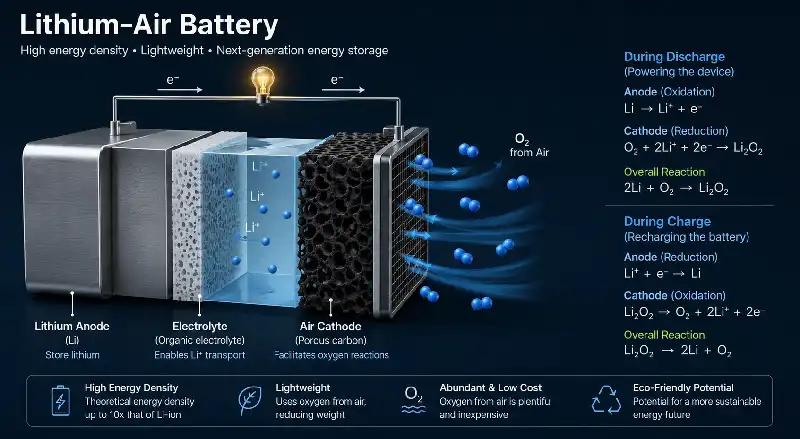
Lithium-air batteries may be unfamiliar to many outside the research community, but the underlying concept is elegantly simple. The battery uses lithium metal as the negative electrode (anode), while the positive electrode (cathode) draws oxygen directly from the surrounding air as its reactant — eliminating the need for heavy cathode compounds containing nickel, cobalt, manganese, or iron.
In today’s lithium-ion batteries, a single lithium ion carries one unit of charge, but must be “hosted” by cathode compounds built from far heavier elements, resulting in cathode materials with a relative molecular mass approaching 100 per unit of charge. Lithium-air batteries sidestep this entirely: the cathode reactant, oxygen, comes from the atmosphere at no weight penalty to the cell.
During discharge, oxygen oxidizes lithium to form lithium peroxide (Li₂O₂), generating current; during charging, the compound decomposes back into lithium and oxygen. The process has been described as “breathing” — absorbing oxygen on discharge, releasing it on charge.
The energy density advantage is dramatic. Current mainstream lithium-ion batteries achieve roughly 250–270 Wh/kg; solid-state batteries are projected to reach around 500 Wh/kg in the near term. Lithium-air batteries, by contrast, carry a theoretical energy density ceiling of approximately 12,000 Wh/kg — approaching the roughly 13,000 Wh/kg of gasoline. Even at practically achievable levels, this would represent a fundamental shift in what electric vehicles and energy storage systems can deliver.
The concept of lithium-air batteries is far from new — it dates back to the 1970s, and the first rechargeable lithium-oxygen cell was demonstrated in 1996. For decades, the technology remained confined to laboratories, burdened by fundamental engineering challenges: unwanted byproducts such as lithium superoxide limiting energy output; moisture and carbon dioxide in ambient air interfering with battery chemistry; catalyst degradation; interface instability; and packaging complexity.
IBM’s “Battery 500” project, launched in 2009 with the goal of producing a lithium-air cell capable of powering an electric vehicle for 500 miles, illustrated these difficulties vividly. Initially targeting a prototype by 2013 and commercial production by 2020, the project quietly went dark after 2012.
Recent years, however, have brought meaningful milestones. In February 2023, researchers at the Illinois Institute of Technology and Argonne National Laboratory published results in the journal Science describing a lithium-air cell using a solid ceramic-polymer electrolyte that achieved 1,000 charge-discharge cycles at room temperature — overcoming one of the most persistent barriers in the field. The team projected that with further development their design could reach an energy density of 1,200 Wh/kg, nearly four times that of today’s lithium-ion batteries, sufficient to give electric vehicles a range exceeding 1,000 miles (approximately 1,600 km) on a single charge.
A parallel line of research from the University of Illinois at Chicago and Argonne, published in Nature, demonstrated a lithium-air cell that maintained high performance across 700 cycles in an air-like atmosphere — clearing a long-standing hurdle that had previously restricted such batteries to pure-oxygen environments.
The timing of Wu Kai’s announcement reflects a broader logic. The industry’s consensus timeline for large-scale solid-state battery deployment now points to approximately 2030. Lithium-air research, bolstered by recent laboratory results, is pointing toward a post-2030 deployment window — meaning the two technologies are converging on similar commercial timelines. For CATL, which once used sodium-ion as both a supply-chain hedge and an industry rallying cry, flagging lithium-air now follows a recognizable playbook: name the technology, accelerate the ecosystem.
Wu Kai’s confirmation of sodium-ion mass production in 2026 shows that long bets can pay off. CATL’s sodium-ion flagship, the Naxtra cell, achieves an energy density of up to 175 Wh/kg — broadly on par with lithium iron phosphate — with near-term targets of 400 km range and longer-term targets of 600 km. A passenger vehicle co-developed with Changan featuring the Naxtra battery is expected on market by mid-2026, marking the first mass-produced sodium-ion passenger EV.
With solid-state moving toward small-batch production in 2027, and lithium-air now on the strategic map, CATL appears to be sequencing its technology roadmap deliberately: each generation named and activated while the previous one moves toward commercialization. The race for next-generation battery supremacy, Wu Kai suggested at the forum, is only just beginning.