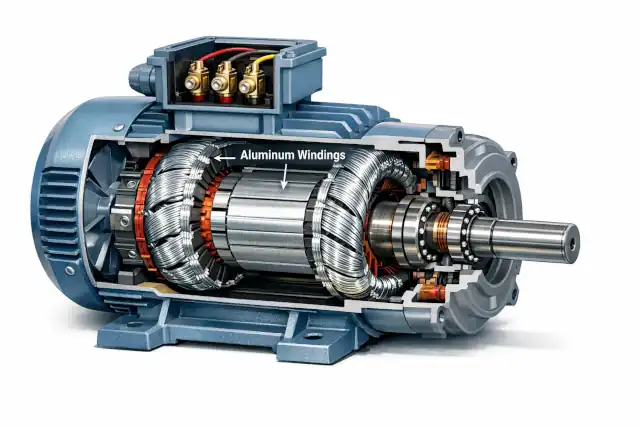
Aluminum vs. Copper Windings: The Real Trade-offs
Aluminum vs. Copper Windings: The Real Trade-offs
- Linux Kernel Removes strncpy After Six Years and 362 Patches
- Linux Kernel Drops 40-Year-Old AppleTalk Protocol — AI-Generated Patch Flood Was the Last Straw
- Apple’s Native Linux Container Tool Has Arrived — But Can It Really Replace Docker?
- 60% of MD5 Password Hashes Can Be Cracked in Under an Hour with a Single GPU
- Dirty Frag: Root Access on Every Major Linux Distribution — No Patch, No Warning
Aluminum vs. Copper Windings:
The Real Trade-offs
Rising copper prices are driving manufacturers toward aluminum-wound motors. But claims of 50%+ cost savings and catastrophic lifespan penalties deserve far more scrutiny than the industry conversation typically allows.
Copper prices have been on a multi-year upward trend. In the first quarter of 2025, copper wire prices in the United States reached approximately $22,945 per metric ton, driven by construction demand, renewable energy buildout, and global supply constraints. Against that backdrop, the case for aluminum windings in electric motors has never felt more urgent — or more contested.
Aluminum has been used in motor windings since the 1960s and 1970s. The debate over whether it is truly equivalent to copper has persisted for decades. What is new in 2025 and 2026 is the intensity of commercial pressure to make the switch, particularly in China and other cost-sensitive manufacturing markets, and the proliferation of marketing claims — some accurate, others significantly exaggerated — about what aluminum can and cannot deliver.
This report separates verified technical fact from overstatement, drawing on peer-reviewed engineering literature, current market pricing data, and independent analysis of the performance trade-offs that manufacturers and buyers must actually weigh.
Market Context: Why Aluminum Is Back in the Conversation
The global aluminum wire market was valued at approximately $46.5 billion in 2025 and is projected to grow at a compound annual rate of 3.87%, reaching an estimated $65.5 billion by 2034. Aluminum wire usage in industrial motors has climbed to account for more than 38% of applications worldwide — a figure that would have seemed implausible a decade ago.
This shift is overwhelmingly cost-driven. Copper prices have been volatile and persistently high, with elevated energy costs, reduced smelter output, and infrastructure demand from renewable energy projects all compressing supply. Aluminum, by contrast, benefits from abundant global production — annual output exceeds 68 million metric tons — and significantly lower per-kilogram pricing.
Per metric ton. Driven by supply constraints, infrastructure demand, and rising energy costs at smelters.
Global market value, projected to reach $65.5B by 2034 at 3.87% CAGR, led by Asia-Pacific (48% share).
Worldwide share of industrial motor winding applications now using aluminum wire, up significantly in recent years.
On the finished winding — not 50%+. Raw aluminum is 30–50% cheaper per kg, but larger wire cross-section is required.
A widely circulated industry claim holds that substituting aluminum for copper can reduce motor module costs by “50% or more.” This is substantially overstated. While aluminum is indeed 30–50% cheaper than copper by weight, aluminum’s lower conductivity requires larger wire cross-sections and more winding turns to achieve the same electrical performance. After accounting for this additional material, the net saving on the winding itself is typically 15–25%. Furthermore, the winding is only one component of the motor — so the system-level cost reduction is smaller still. Claims of 50%+ apply only to the raw material cost difference, not to the motor as a finished product.
The Technical Realities: What the Numbers Actually Say
The core electrical challenge with aluminum is well-established: aluminum’s conductivity is rated at 61% IACS (International Annealed Copper Standard), compared to 100% for copper. This means that to carry the same current, an aluminum conductor requires approximately 1.6 times the cross-sectional area of a copper conductor. Translated to wire diameter, that means roughly 1.26 times wider wire for equivalent conductance.
The practical implication is not simply that aluminum wire “has 1.65 times the resistance of copper wire” — as some industry materials state — because a well-engineered aluminum motor uses larger-gauge wire specifically to compensate for this gap. The statement is only true for like-for-like wire at the same dimensions. In a properly redesigned motor, the winding resistance — and therefore the heat generated — can be brought much closer to the copper baseline, though not fully equalized.
Efficiency: The Gap Is Real, but Modest
Under real operating conditions, an aluminum-wound motor is typically 1.5% to 2% less efficient than an equivalent copper-wound motor. For a 50 kW motor running 4,000 hours per year at $0.10/kWh, this translates to approximately $450 in additional annual energy costs. For most industrial applications, this efficiency penalty will erode the initial capital cost advantage within two to five years of operation — a calculation that demands careful total-cost-of-ownership analysis rather than a focus on purchase price alone.
“Motor efficiency is much more complicated than the great copper vs. aluminum debate. It is possible to match the power performance of a motor wound with aluminum to a motor wound with copper — but since aluminum requires more turns and/or a larger diameter wire, this may not always be economically feasible.”
ACHR News / Motor Engineering Consensus, 2025Lifespan: A Nuanced Picture
Under identical operating conditions, an aluminum-wound motor is estimated to have approximately 85–90% of the lifespan of a copper-wound equivalent. This is a real but manageable difference — not the catastrophic degradation sometimes implied by simulation studies that report motor bearing life dropping to 16.5% of the copper baseline. Such figures are derived from specific simulation conditions involving a 26.2 K temperature rise — a scenario that applies to motors where aluminum wire is used without redesigning the thermal management system. In a properly engineered aluminum motor with appropriate electromagnetic and cooling design, temperature rise can be substantially controlled.
The rule of thumb that bearing life halves for every 10°C increase in ambient temperature is a valid engineering principle. However, applying it to produce dramatic lifespan collapse figures requires assuming no compensating design changes — an assumption that does not reflect best current practice.
Copper vs. Aluminum at a Glance
| Property | Copper | Aluminum |
|---|---|---|
| Electrical Conductivity | 100% IACS (benchmark) | 61% IACS — requires ~1.6× larger cross-section for equivalent current |
| Resistivity | 1.68 × 10⁻⁸ Ω·m | 2.65 × 10⁻⁸ Ω·m (≈1.6× copper) |
| Thermal Conductivity | 401 W/(m·K) | 237 W/(m·K) — less efficient heat dissipation from winding |
| Density / Weight | 8,960 kg/m³ — heavy | 2,700 kg/m³ — ~67% lighter; advantageous in mobile or overhead applications |
| Raw Material Cost | High; volatile. ~$22,945/MT (USA, Q1 2025) | 30–50% cheaper per kg than copper on raw material basis |
| Net Winding Cost Saving | — | 15–25% after accounting for larger wire size required |
| Motor Efficiency Penalty | — | Typically 1.5–2% lower efficiency vs. copper-wound equivalent |
| Estimated Lifespan vs. Copper | Baseline | Approx. 85–90% of copper lifespan under comparable conditions |
| Oxidation at Connections | Copper oxide is conductive; less problematic | Aluminum oxide is hard and electrically insulating; requires specialized connectors and anti-oxidant compounds |
| Repairability | Easily soldered; high plasticity | Cannot be conventionally soldered; oxide layer makes welding complex |
| Tensile Strength | High; tolerates winding stress well | Lower; more prone to breakage during high-tension winding processes |
| Thermal Expansion | Moderate | Expands 18–25% more than copper under heat; connections can loosen over time (“creep”) |
| Motor Frame Size | Compact — smaller stator geometry possible | Larger stator core typically required; increases motor volume and weight of iron components |
| Sources: IEEE, ACHR News, Jingda Wire technical review (2025), Aarohi Embedded Systems, Fisher & Paykel Technologies engineering notes. | ||
Manufacturing Challenges: A Genuine Hurdle
The passage from the 1960s and 1970s — when aluminum windings were common — to their near-disappearance from the 1980s onward was not accidental. Connection failures were the primary culprit. Aluminum forms an aluminum oxide layer instantly on exposure to air. This oxide is electrically insulating and mechanically hard, creating high-resistance junctions that overheat, degrade insulation, and ultimately fail.
Modern motor manufacturers have developed solutions: high-pressure piercing crimp connectors that break through the oxide layer and seal the joint from further air exposure, combined with anti-oxidant compounds applied at terminations. These methods have substantially improved reliability. Industry engineers now broadly agree that, when properly manufactured, aluminum-wound motors can achieve reliability broadly comparable to copper-wound motors — though this requires strict process controls that add manufacturing complexity and cost.
Additional challenges include the lower tensile strength of aluminum wire, which increases the risk of wire breakage during the winding process, and the difficulty of repair: aluminum motor windings essentially cannot be field-repaired by conventional soldering. When they fail, they typically require complete rewinding or motor replacement.
Where Aluminum Windings Make Sense
The appropriate application range for aluminum-wound motors is real and substantial, but it is defined by engineering criteria, not simply cost pressure. Aluminum windings are well-suited to:
Intermittent-duty applications where the motor runs for short periods with cooling intervals — the efficiency penalty and additional heat generation have less cumulative impact when thermal cycling is limited.
Cost-and-weight-sensitive applications such as overhead power line equipment, garden machinery, portable tools, and certain categories of small household appliances, where upfront cost and mass are primary constraints and continuous high-performance operation is not required.
Power transmission infrastructure, where aluminum wire already dominates: approximately 54% of global overhead transmission line installations use aluminum conductors, valued precisely for their weight advantage and lower structural support costs.
Aluminum is less appropriate — and faces higher market resistance — in applications with stringent efficiency requirements (IE3 and IE4 class industrial motors), high continuous-duty cycles, applications requiring field serviceability, or environments with significant thermal stress where the creep behavior of aluminum connections becomes a reliability concern.
Aluminum resistivity is 1.6× copper. Aluminum oxide increases contact resistance. Thermal conductivity of aluminum (237 W/m·K) is lower than copper (401 W/m·K). Aluminum motors run slightly hotter and have modestly shorter lifespans under equivalent conditions. Aluminum wire has lower tensile strength. Welding/repair is significantly more difficult.
Claims of “50%+ cost reduction” are not supported — 15–25% is the realistic winding-level saving. The assertion that “bearing life falls to 16.5% of copper” applies only to specific uncompensated simulation scenarios. “Energy loss is 1.65× that of copper” oversimplifies: a properly designed aluminum motor compensates with larger wire gauge.
The claim that aluminum motors have “lower efficiency and shorter lifespan” is directionally correct, but the magnitude is more modest than often implied: 1.5–2% efficiency penalty and approximately 85–90% of copper lifespan in well-engineered designs. With proper electromagnetic and thermal design, much of the gap can be closed.
Market acceptance figures vary widely by geography and application. The claim that consumers “prefer copper” is true in premium and industrial segments, but aluminum already dominates in overhead transmission and holds strong positions in transformers and intermittent-duty motors. This is not a niche or emerging technology.
The Path Forward: Engineering Solutions and Market Reality
The most significant developments in aluminum motor technology over the past decade have been on the thermal management side. By adjusting electromagnetic design — in particular, by increasing slot fill factor and optimizing winding geometry — engineers can substantially reduce the copper loss increase inherent in aluminum windings. Liquid cooling technologies applied near or within the stator slot further reduce thermal load in high-performance applications.
Research published in the IEEE and related journals has demonstrated that an aluminum-wound induction motor designed with a slightly larger stator geometry can match the efficiency of its copper-wound counterpart in steady-state operation, at lower total manufacturing cost — particularly relevant as copper prices remain elevated. The trade-off is increased motor volume and the associated increase in iron lamination mass, which may or may not matter depending on the installation constraints.
The copper-clad aluminum (CCA) wire sector also deserves attention. CCA wire features an aluminum core with a bonded copper outer layer, offering conductivity intermediate between the two pure metals, substantially reduced weight compared to solid copper (approximately 40% lighter), and — critically — a copper surface that allows standard termination and soldering techniques. The global CCA wire market was valued at $2.01 billion in 2024 and is projected to reach $2.93 billion by 2030, growing at 5.1% annually. For applications that need the connectivity reliability of copper at the joints but can accept aluminum’s electrical properties in the conductor body, CCA represents a technically rational middle path.
Ultimately, the arrival of affordable aluminum winding solutions is a genuine and lasting shift in the motor industry’s cost landscape — but it is not a revolution that bypasses engineering physics. The decision between copper and aluminum windings remains, at its core, a question every application demands separately: is the reduction in initial capital cost worth the efficiency penalty, the maintenance considerations, and the total cost of ownership implications over the motor’s working life?
For a pump motor running three shifts a day in a production facility, the answer is almost certainly no. For a residential lawn mower motor, the answer is almost certainly yes. The motor industry’s maturation on this topic will come not from industry-wide proclamations about the “aluminum era,” but from the engineering discipline to ask — and honestly answer — that question product by product.