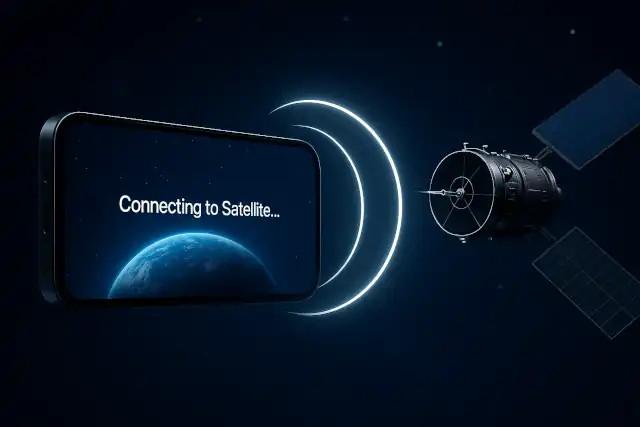
Apple Patent Reveals Satellite-Enabled iPhone Case That Could Bring Full Internet Anywhere
Apple Patent Reveals Satellite-Enabled iPhone Case That Could Bring Full Internet Anywhere
- Linux Kernel Removes strncpy After Six Years and 362 Patches
- Linux Kernel Drops 40-Year-Old AppleTalk Protocol — AI-Generated Patch Flood Was the Last Straw
- Apple’s Native Linux Container Tool Has Arrived — But Can It Really Replace Docker?
- 60% of MD5 Password Hashes Can Be Cracked in Under an Hour with a Single GPU
- Dirty Frag: Root Access on Every Major Linux Distribution — No Patch, No Warning
Apple Patent Reveals Satellite-Enabled iPhone Case That Could Bring Full Internet Anywhere
February 20, 2026
Apple has published a patent application for a satellite communication case that could dramatically expand connectivity for iPhone and iPad users — moving well beyond the emergency-only features the company introduced four years ago.
The patent, titled “Electronic Device and Case with Satellite Communication Capabilities,” was originally filed in 2024 and has just surfaced publicly.
It describes a detachable protective case housing a built-in phased array antenna designed to connect iPhones and iPads directly to low-Earth orbit (LEO) satellite constellations — potentially enabling full broadband internet access without any cellular network.
From Emergency Lifeline to Everyday Connectivity
When Apple launched Emergency SOS via Satellite with the iPhone 14 in 2022, it was a genuine breakthrough. The feature has since saved numerous lives by allowing users in remote areas — far from any cellular tower — to send distress signals and communicate in crisis situations. Apple has continued refining the feature in the years since, but the underlying technology has remained constrained by fundamental physical limitations.
Current iPhone satellite communication relies on the device’s built-in antenna, which has a small surface area and limited power output. Users must manually align their phone toward a passing satellite and hold that position as the satellite moves. A single LEO satellite travels from horizon to horizon in roughly seven minutes, and real-world connection time is often shorter than that, further reduced by obstructions such as buildings, trees, and terrain. These constraints mean only small amounts of data can be reliably transmitted per session, keeping the feature squarely in the realm of emergencies rather than everyday use.
A Smarter Antenna in a Familiar Form Factor
Apple’s newly published patent takes a different approach: rather than overhauling the iPhone’s internal hardware — which would add cost and complexity for every user — the company envisions an optional accessory that users can attach or remove like any standard case.
The key innovation is a hinged section on the back of the case that flips open, angling an internal phased array antenna toward the sky. Unlike a conventional single-point antenna, a phased array consists of multiple transmitting and receiving elements that work together. This allows the case to electronically steer its signal beam — a technique called beamforming — without any moving parts, similar in principle to the technology used in Starlink ground terminals, but miniaturized to fit a smartphone accessory.
Crucially, the phased array design enables the case to maintain connections with an entire group of satellites simultaneously and switch seamlessly between them as the constellation moves overhead. This directly addresses the short transit window problem and could eliminate the frustrating connection drops that currently limit satellite communication on iPhones.
The flip-open design also solves another persistent issue: hand obstruction. With the antenna housed in a section that extends away from the device, a user’s grip no longer interferes with the satellite signal — a problem Apple explicitly acknowledges in the patent filing.
Data Transfer: RF and NFC Options
For communication between the case and the iPhone itself, Apple’s patent describes several potential methods. The case could exchange data with the device via a dedicated radio-frequency (RF) connector or through Near Field Communication (NFC). Either approach would allow significantly greater data throughput than what the current built-in satellite antenna supports — potentially enough for web browsing, email, or even video streaming, rather than the limited text messages currently possible.
For iPad compatibility, the patent notes that the case could draw power through Apple’s Smart Connector, addressing battery life concerns for the larger accessory.
Ambition vs. Reality
The scope of what Apple is describing is notably ambitious. Where current iPhone satellite features are narrowband — designed for brief emergency texts — this patent envisions broadband data transfer that could, in principle, bypass cellular networks entirely for users in remote or underserved areas. For the hundreds of millions of people worldwide without reliable cellular coverage, such a product could represent a meaningful leap in connectivity.
That said, patent filings are not product announcements. Apple files thousands of patents each year, many of which explore concepts that never reach consumers. There is no confirmation that this satellite case is in active development or headed for a product launch, and significant engineering challenges remain — including miniaturization, cost, regulatory approvals for satellite communication hardware, and battery management.
Still, the filing signals clearly where Apple’s research ambitions lie: a future in which satellite connectivity is not a last-resort emergency tool, but a routine and accessible feature of everyday iPhone use.
Sources: AppleInsider, GSMArena, WebProNews, eTeknix