GIMP vs. Krita: Which is the Best Open-Source Alternative to Photoshop?
GIMP vs. Krita: Which is the Best Open-Source Alternative to Photoshop?
- Apple’s Native Linux Container Tool Has Arrived — But Can It Really Replace Docker?
- 60% of MD5 Password Hashes Can Be Cracked in Under an Hour with a Single GPU
- Dirty Frag: Root Access on Every Major Linux Distribution — No Patch, No Warning
- Proton Mail: Data Transferred to FBI Again!
- How Close Are Quantum Computers to Breaking RSA-2048?
- What is the best alternative to Microsoft Office?
GIMP vs. Krita: Which is the Best Open-Source Alternative to Photoshop?
For decades, Adobe Photoshop has been the industry standard for image manipulation. However, as subscription costs rise and software becomes increasingly heavy, many creatives are turning to the open-source world.
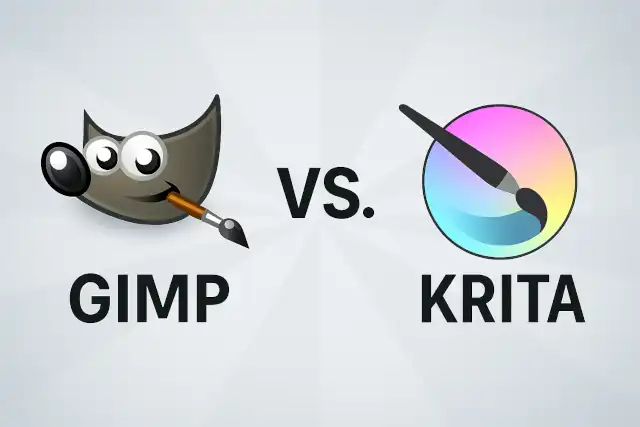
The two primary contenders are GIMP and Krita. While both are free, they serve very different purposes. Choosing the right one depends entirely on your specific workflow.
Windows Software Alternatives in Linux OS
Krita: The Artist’s Powerhouse
If your primary use for Photoshop is digital painting, illustration, or concept art, Krita is the clear winner. Originally designed as a generic image editor, Krita pivoted years ago to focus specifically on the needs of digital artists.
-
Superior Brush Engine: Krita’s brush customization is arguably more advanced than Photoshop’s. It features stabilizers for smooth lines and a unique “pop-up palette” that allows artists to switch colors and brushes instantly without breaking their flow.
-
Modern Workflow: Unlike many open-source projects, Krita feels modern. It supports non-destructive editing through filter layers and masks, and it even includes a functional 2D animation timeline.
-
Interface: The UI is intuitive and highly customizable, making the transition for Photoshop users relatively painless.
What is the best alternative to Microsoft Office?
GIMP: The Photo Manipulator
GIMP (GNU Image Manipulation Program) is the oldest and most famous Photoshop alternative. It is designed for photo retouching, image composition, and graphic design.
-
Photo Editing Tools: GIMP excels at technical tasks like background removal, color correction, and photo restoration. Its selection tools and massive library of filters (especially when combined with the G’MIC plugin) are powerful and precise.
-
Lightweight and Portable: GIMP is incredibly resource-efficient. It runs smoothly on older hardware where Photoshop or Krita might struggle.
-
The Learning Curve: GIMP’s greatest weakness is its user interface. It follows a unique logic that differs significantly from Adobe’s ecosystem. While the “Single-Window Mode” has improved things, users often face a steep learning curve to master its shortcuts and menu structures.
The Critical Comparison
| Feature | Krita | GIMP |
| Primary Goal | Digital Illustration & Animation | Photo Editing & Retouching |
| Best Input Device | Drawing Tablet (Stylus) | Mouse or Trackpad |
| Text Tools | Basic / Functional | Advanced / Precise |
| Non-Destructive | Yes (Filter Layers) | Limited |
| Industry Usage | Concept Art, Comics, VFX | Web Design, Photography |
Free Project Management Software Alternatives to MS Project for Linux
The Verdict: Which Should You Choose?
The choice is not about which software is “better,” but what you intend to create:
-
Choose Krita if you are an illustrator, comic artist, or animator. It is built to mimic the feel of traditional media and provides a much more “fluid” creative experience.
-
Choose GIMP if you are a photographer, web designer, or someone who needs to perform technical image edits. It is a robust tool for “fixing” images rather than “creating” them from a blank canvas.
In many cases, the best strategy is to use both. You can paint your characters in Krita and then move them into GIMP for final color grading and text layout. Since both are 100% free, the only cost of trying them is your time.