Huawei Offers $420000 in Prizes for Solutions to AI Storage Challenges
Huawei Offers $420000 in Prizes for Solutions to AI Storage Challenges
- Linux Kernel Drops 40-Year-Old AppleTalk Protocol — AI-Generated Patch Flood Was the Last Straw
- Apple’s Native Linux Container Tool Has Arrived — But Can It Really Replace Docker?
- 60% of MD5 Password Hashes Can Be Cracked in Under an Hour with a Single GPU
- Dirty Frag: Root Access on Every Major Linux Distribution — No Patch, No Warning
- How Close Are Quantum Computers to Breaking RSA-2048?
- What is the best alternative to Microsoft Office?
Huawei Offers $420000 in Prizes for Solutions to AI Storage Challenges
Huawei Launches Sixth Olympus Mons Awards with $420,000 Prize Pool to Tackle AI-Era Storage Challenges
On December 26, Huawei officially launched the sixth edition of its Olympus Mons Awards, maintaining a prize pool of 3 million yuan (approximately $420,000) as it continues to address critical storage challenges in the age of artificial intelligence.
Since its establishment in 2019, the Olympus Mons Awards have become one of the most influential professional awards in the data storage field. The initiative has attracted over 320 scholars from 12 countries worldwide, recognizing excellence through six Olympus Mons Awards and 18 Olympus Mons Pioneer Awards over the past five years.
The awards program aims to encourage global researchers to invest in fundamental theoretical research in data storage, breakthrough key technical challenges, accelerate the industrialization of research outcomes, and achieve win-win cooperation among industry, academia, and research institutions.
Can Huawei’s Kirin 9030 Pro Compete with Qualcomm’s Latest Flagship Processor?
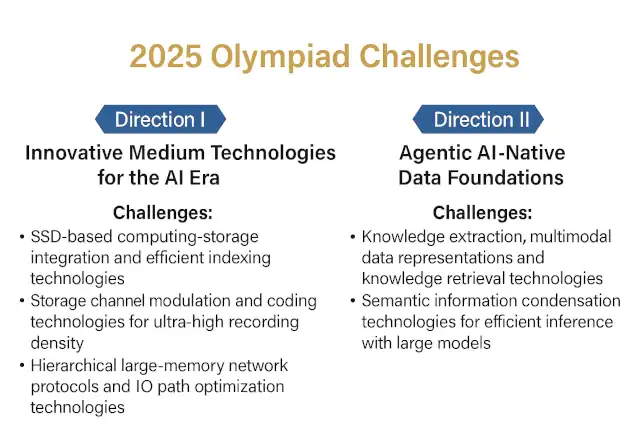
Two Major Research Directions for 2025
This year’s awards focus on two critical directions that reflect the evolving demands of AI technology on storage systems.
Direction One: Innovative Storage Media Technology for the AI Era
The widespread development and application of AI has fundamentally transformed data dynamics. Cold data is becoming warm, warm data is becoming hot, and the processing overhead for hot data continues to grow. This direction seeks to explore new paradigms of computation-storage integration and computation-storage trade-offs, along with ultra-high-density information recording and hierarchical large-memory innovative technologies to build storage systems that offer high performance, large capacity, and cost-effectiveness.
Three key challenges have been identified in this direction:
- The first involves SSD-based storage-computation fusion and efficient indexing technology.
- The second addresses storage channel modulation and coding technology for ultra-high recording density.
- The third focuses on hierarchical large-memory network protocols and I/O path optimization technology.
Direction Two: Agentic AI-Native Data Foundation
The development of Agentic AI requires storage systems to evolve from simple data repositories into comprehensive AI data platforms capable of data storage, management, and utilization. This direction emphasizes research into high-quality knowledge bases and semantic information condensation technologies to build a data foundation native to Agentic AI.
Two major challenges define this direction:
- The first encompasses knowledge extraction, multimodal data representation, and knowledge retrieval technology.
- The second targets semantic information condensation technology for efficient large model inference.
NVIDIA Declares War on Huawei for 6G Dominance
Geopolitical Considerations and International Participation
The awards initiative operates within a complex geopolitical landscape that may influence participation patterns, particularly among Western researchers. Since 2019, U.S. government restrictions and sanctions on Huawei have created potential complications for scholars considering collaboration with the Chinese tech giant.
Several factors may affect Western academic participation. American researchers and institutions receiving federal funding face constraints under U.S. export control regulations when collaborating with entities on sanctions lists. Many Western universities have implemented compliance frameworks requiring careful review of international collaborations, especially with Chinese technology firms. Some researchers may have concerns about future funding opportunities or security clearances, while the broader U.S.-China tech competition creates an atmosphere of uncertainty around academic exchanges.
However, the situation contains important nuances. Researchers from Europe, Canada, and other regions operate under different regulatory environments than their U.S.-based counterparts. Fundamental research, as opposed to direct technology transfer, sometimes receives different treatment under international frameworks. The awards’ focus on published academic research rather than proprietary development may provide some degree of separation from commercial concerns.
The fact that the awards have attracted participants from 12 countries suggests continued international engagement exists, though the geographic distribution and extent of Western participation remains unspecified in official announcements. Scholars from countries without specific restrictions on Huawei may find fewer barriers to participation, potentially explaining the sustained international interest despite geopolitical headwinds.
Why China May Refuse Nvidia’s H200: A Strategic Shift in the AI Chip Race
Bridging Research and Industry
The Olympus Mons Awards represent Huawei’s continued commitment to fostering innovation at the intersection of fundamental research and practical industrial applications. As AI systems become increasingly sophisticated and data-intensive, the storage infrastructure that supports them must evolve correspondingly.
By maintaining a substantial prize pool and clearly defining research challenges that address real-world problems, Huawei is positioning the awards as a catalyst for breakthrough innovations that could shape the future of data storage technology. The focus on both hardware-level innovations in storage media and software-level advances in AI-native data management reflects a comprehensive approach to solving the multifaceted challenges facing the industry.
Interested researchers and institutions can participate in the global call for submissions, which officially opened on December 26. The awards continue to serve as a bridge between academic research and industrial implementation, potentially accelerating the timeline from theoretical breakthrough to practical deployment in the rapidly evolving landscape of AI technology. However, prospective participants, particularly those from Western institutions, may need to navigate their own institutional policies and national regulations before engaging with the program.