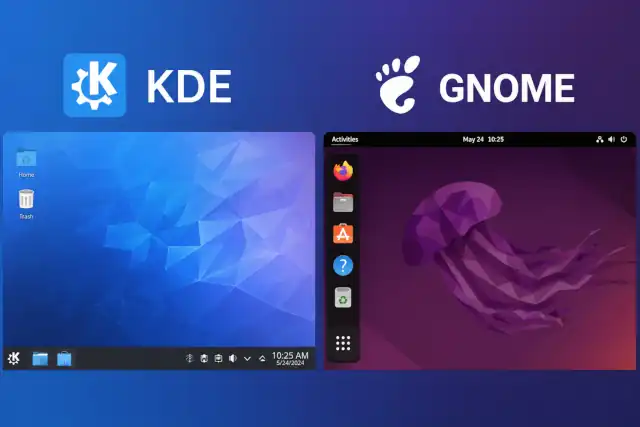
KDE and GNOME: Pillars of Progress or a Wall Around Innovation?
KDE and GNOME: Pillars of Progress or a Wall Around Innovation?
- Linux Kernel Removes strncpy After Six Years and 362 Patches
- Linux Kernel Drops 40-Year-Old AppleTalk Protocol — AI-Generated Patch Flood Was the Last Straw
- Apple’s Native Linux Container Tool Has Arrived — But Can It Really Replace Docker?
- 60% of MD5 Password Hashes Can Be Cracked in Under an Hour with a Single GPU
- Dirty Frag: Root Access on Every Major Linux Distribution — No Patch, No Warning
KDE and GNOME: Pillars of Progress or a Wall Around Innovation?
As KDE Plasma and GNOME together command roughly 65% of the Linux desktop market, a sharper question demands attention — is their dominance a natural outcome of merit, or is it quietly narrowing the ecosystem that made Linux great?
For more than two decades, KDE and GNOME have served as the two load-bearing columns of the Linux graphical desktop. They did not arrive at dominance through monopoly power or vendor lock-in. They earned their position through years of sustained engineering, large contributor communities, and the simple, compounding reality that more users attract more developers, which attracts more users still. Today, estimates place KDE Plasma at roughly 40% of the Linux desktop market and GNOME at around 25% — together accounting for nearly two-thirds of all Linux desktop usage worldwide.
That concentration raises a serious and increasingly urgent question: does the consolidation of developer resources, application compatibility, and distribution defaults around two environments come at the cost of the broader ecosystem? And critically — is there still meaningful room for new entrants to compete?
How the two giants rose
Neither KDE nor GNOME started from a position of advantage. KDE was founded in 1996 and GNOME in 1997, each born from real friction — KDE’s use of the then-proprietary Qt toolkit prompted the free-software community to build GNOME as a fully open alternative. Both projects survived schisms, rewrites, and years of criticism to arrive at where they stand today: mature, polished, and deeply integrated into the Linux distribution ecosystem.
Their dominance has a straightforward structural explanation. Ubuntu, the world’s most widely installed Linux desktop distribution, defaults to GNOME. Fedora — the upstream proving ground for Red Hat technologies — also ships GNOME by default. KDE, meanwhile, is the default environment for KDE Neon, openSUSE, and Manjaro KDE, and has seen a surge in developer adoption, particularly among technically sophisticated users who build and tinker. A 2025 Linuxiac survey found that Arch Linux users — those who actively decide every component of their system — skew noticeably toward Plasma, suggesting that when given a completely free choice, many informed users select KDE.
Where the other environments stand
Claims that desktop diversity is “dying” are overstated and not well supported by the data. Cinnamon, maintained by the Linux Mint project, holds approximately 15% of the market — a meaningful share, built on Linux Mint’s reported user base of 3.2 million in 2025. XFCE, LXQt, MATE, and Budgie all remain actively maintained and ship as official spins or community editions of major distributions. The current landscape looks like this:
The newcomer: COSMIC and what it reveals
The most significant development in desktop environment history in years arrived on December 11, 2025, when System76 released the first stable version of COSMIC alongside Pop!_OS 24.04 LTS. Written entirely in Rust using the Iced graphics toolkit, COSMIC is not a GNOME fork or a KDE reskin — it is a ground-up redesign of what a Linux desktop environment can be. It ships with native tiling and stacking window management, a custom theming engine, and core applications (Files, Terminal, Store, Text Editor, Media Player) built specifically for the environment.
Three years ago, it became clear we had reached the limit of our current potential and had to create something new. Today, we break through that limit.
— Carl Richell, CEO of System76, at the COSMIC launch, December 2025COSMIC is already available for installation on Arch Linux, openSUSE Tumbleweed, NixOS, Fedora, and several BSD platforms — not just Pop!_OS. System76 has since published a rolling roadmap (Epochs 2 and 3), detailing planned features including reactive rendering that is expected to cut CPU usage by 60–80%, IME support, and global shader customisation. As of February 2026, the project was on version 1.0.8 with continuous weekly updates.
COSMIC’s existence illustrates both sides of the argument about DE consolidation. On one hand, it proves the barrier to entry, while high, is not insurmountable — a well-funded, focused hardware company with a clear product vision can build and ship a competitive new desktop environment. On the other, it also shows how dependent such an effort is on corporate backing: COSMIC is sustained by System76’s hardware revenue in a way that a purely volunteer-driven project could not replicate against KDE and GNOME’s established ecosystems.
System76 did not build COSMIC out of admiration for GNOME’s design philosophy — they built it partly in response to it. The company cited limitations in GNOME’s extension system and disagreements with GNOME developers over the desktop experience as primary motivations. Previous versions of Pop!_OS ran a heavily customised GNOME; when the upstream project declined to accommodate those customisations, System76 concluded it was more efficient to build their own environment than to maintain an increasingly divergent fork indefinitely.
Is switching desktop environments actually hard?
One of the more misleading claims circulating in discussions of DE consolidation is that users are “locked in” to their default environment and face prohibitive switching costs. In practice, this is not accurate. Installing an alternative DE on most distributions takes a single terminal command or a package manager selection. The underlying system — the kernel, display server, application data, configuration files — is entirely unaffected. A user on Ubuntu can install KDE Plasma in minutes and switch between the two at the login screen.
What is true is that the experience of mixing DE ecosystems can be rough: GTK applications running inside a KDE session, or Qt applications in a GNOME session, may inherit inconsistent theming or behave unexpectedly. This is a genuine friction point, particularly for users who want a visually coherent environment. The XDG Desktop Portal specification and ongoing Wayland standardisation efforts are gradually reducing these incompatibilities, but the problem has not been fully solved.
The developer resource question
The more legitimate concern about consolidation is not user switching costs but developer time. There are only so many volunteer hours in the Linux community. KDE and GNOME each maintain enormous codebases — display servers, compositors, file managers, settings applications, application frameworks — that require ongoing work simply to keep pace with kernel changes, Wayland protocol updates, and hardware advances. KDE’s transition to a Qt 6 / Wayland-first architecture (separating X11 and Wayland code in KWin) consumed enormous engineering effort across multiple release cycles. GNOME spent years ahead of KDE in Wayland adoption, giving it reliability advantages on complex multi-display setups for much of the past decade.
A smaller environment like Budgie or COSMIC cannot match that depth of investment without proportional funding. This does not mean those projects are doomed — it means they must be strategic about which features they build and which they defer. COSMIC’s decision to write its compositor and application toolkit in Rust, for example, is partly a pragmatic bet that memory safety and performance can compensate for a smaller contributor pool.
The Linux desktop in a broader context
It is worth keeping the consolidation concern in proportion against a broader trend: the Linux desktop is growing. According to StatCounter data, Linux reached 5.03% of the U.S. desktop operating system market as of June 2025 — the first time it has crossed the 5% threshold in that market. Globally, usage stood at approximately 4.1%. That growth means more users encountering Linux desktop environments for the first time, making the quality and accessibility of default environments — primarily GNOME and KDE — more consequential than ever.
The “fragmentation” of Linux that commentators often cite as a barrier to adoption is, in many respects, a misdiagnosis. The real barriers have historically been hardware compatibility (particularly NVIDIA GPU drivers, which have improved substantially with NVIDIA’s addition of GBM support), application availability, and gaming support (now dramatically improved through Proton). The existence of multiple desktop environments is not a confusion for most users — they encounter whichever one their distribution chose, and they use it.
Where the ecosystem goes from here
KDE Plasma 6.6, released in 2026, has been described by multiple reviewers as the most complete and stable version of Plasma ever shipped. Its HDR support, resolved NVIDIA GBM compatibility, and fixed multi-display fractional scaling address three pain points that had pushed users toward GNOME for years. The release has prompted genuine debate about whether GNOME retains its traditional advantage in hardware reliability, or whether Plasma has now matched and in some respects surpassed it.
GNOME 48, meanwhile, continues its philosophy of deliberate restraint — a minimal interface designed to reduce cognitive load. It remains the default for Ubuntu and Fedora, giving it unmatched reach among newcomers, and its Wayland implementation remains mature and battle-tested.
COSMIC is receiving weekly updates and has a public roadmap extending through 2026 and beyond. It is too early to know whether it will grow into a third major player or remain a compelling but niche option tied to System76’s hardware business. What it demonstrates beyond doubt is that the appetite for innovation in the Linux desktop space has not died — it has simply required deeper investment to manifest.
KDE and GNOME are not villains in this story. They are the product of thousands of contributors working for decades to make the Linux desktop usable for ordinary people, and they have largely succeeded. Their dominance is a market outcome, not a conspiracy — and unlike proprietary operating systems, nothing prevents any well-resourced team from building a competitor.
The real concern is not monopoly but monoculture risk: if developer talent continues to concentrate around two ecosystems, the Linux desktop could lose the experimental agility that has historically been one of its defining strengths. The answer to that concern is not to diminish KDE or GNOME but to fund and support the alternatives — COSMIC, Budgie, XFCE — that keep the ecosystem honest.
The Linux community has always produced more innovation than the market predicted. There is no compelling reason to believe that will change now.