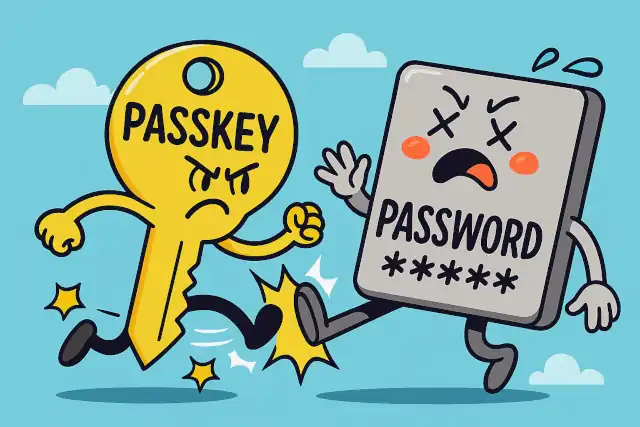
Microsoft Declares Passwords a Security Risk, Accelerates Global Push for Passkeys
Microsoft Declares Passwords a Security Risk, Accelerates Global Push for Passkeys
- Linux Kernel Removes strncpy After Six Years and 362 Patches
- Linux Kernel Drops 40-Year-Old AppleTalk Protocol — AI-Generated Patch Flood Was the Last Straw
- Apple’s Native Linux Container Tool Has Arrived — But Can It Really Replace Docker?
- 60% of MD5 Password Hashes Can Be Cracked in Under an Hour with a Single GPU
- Dirty Frag: Root Access on Every Major Linux Distribution — No Patch, No Warning
Microsoft Declares Passwords a Security Risk,
Accelerates Global Push for Passkeys
On World Password Day 2026, Microsoft published a landmark security blog calling for urgent adoption of passkey-based authentication — and backed its message with sweeping product changes across consumer and enterprise platforms.
Some versions of this story have incorrectly referred to the observance as “World Cryptography Day.” The correct name is World Password Day (or World Passkey Day). Microsoft’s announcement was made on May 7, 2026 — not May 9. This article reflects the accurate facts.
On World Password Day — observed annually on the first Thursday of May — Microsoft took the opportunity to issue one of its most direct calls yet for the technology industry and everyday users to abandon traditional passwords entirely. In a detailed post on the Microsoft Security Blog, published May 7, 2026, the company argued that passwords have become the weakest link in modern digital security, and that passkeys represent a ready, superior alternative.
The Case Against Passwords
Microsoft’s argument is stark: as artificial intelligence empowers attackers to automate and scale phishing campaigns to unprecedented levels, credential-based attacks have surged. The company noted that AI-powered phishing campaigns now drive click-through rates as high as 54%, making traditional passwords — however complex — increasingly indefensible.
Passkeys sidestep these vulnerabilities by design. Instead of a string of characters entered into a web form, passkeys rely on local verification methods — fingerprints, facial recognition, and device PINs — bound cryptographically to the specific site or application. Because no shared secret is transmitted to a server, there is nothing for a phishing page to steal, and nothing for a credential-stuffing attack to exploit.
Passwords remain a major source of risk; they’re difficult to manage and easy to steal. Along with weaker forms of multifactor authentication, they’re also highly vulnerable to phishing.
— Microsoft Security Blog, May 7, 2026What Microsoft Has Already Changed
The announcement was not merely aspirational. Microsoft has been steadily dismantling its own reliance on passwords and revealed the scale of that effort. Earlier this year, the company made newly registered Microsoft accounts passwordless by default, supporting login via passkeys, biometrics, and hardware security keys. Existing users can manually remove their account passwords to achieve the same fully passwordless experience.
(FIDO Alliance, 2026)
on passkeys (OneDrive, Xbox)
on phishing-resistant auth
Inside its own corporate environment, Microsoft has eliminated weaker authentication methods entirely. Phishing-resistant authentication now covers 99.6% of Microsoft’s own users and devices — a transformation the company says has simplified the daily sign-in experience: no one-time codes to enter, no extra prompts to dismiss.
Enterprise and Platform Moves
Microsoft also detailed a series of enterprise-level changes through its Microsoft Entra identity platform. Entra passkeys on Windows — which allow device-bound passkeys to be created directly on personal or unmanaged Windows devices via Windows Hello — are set to reach general availability in late May 2026. Passkeys for Microsoft Entra External ID, aimed at customer-facing applications, will also become generally available in late May 2026, enabling businesses to offer phishing-resistant authentication to their end customers without imposing enterprise-grade friction.
The Edge browser’s Microsoft Password Manager now supports syncing passkeys across iOS and Android, enabling users to use a passkey created on one device seamlessly on another.
Closing the Recovery Loophole
Perhaps the most consequential policy change concerns account recovery. Even the most secure primary login can be undermined if the recovery pathway is weak. To close this gap, Microsoft announced that starting in January 2027, Microsoft Entra ID will no longer allow passwords to be reset via security questions — a method long recognized as susceptible to social engineering and phishing. The company is pushing organizations to migrate to stronger recovery mechanisms before that deadline.
A Global Industry Consensus
Microsoft is not acting alone. The broader technology industry has coalesced around passkeys as the path forward. The FIDO Alliance — the standards body that underpins passkey technology — reports that 5 billion passkeys are now in active use globally, a roughly fourfold increase since 2024. Apple, Google, and Microsoft have all shipped comprehensive passkey support. Major platforms including Amazon, GitHub, and PayPal now support passwordless sign-in.
Analysts caution, however, that a full transition will take years. Many enterprise systems and legacy SaaS applications still depend on passwords paired with multifactor authentication. The realistic near-term picture is a hybrid model — passkeys for modern systems, passwords-plus-MFA as a stopgap for legacy infrastructure — while the industry completes the migration.
Key Dates & Milestones
- Early 2026 Microsoft begins creating new accounts passwordless by default; existing users can delete passwords manually.
- May 7, 2026 World Password Day: Microsoft publishes Security Blog announcing major passkey initiatives.
- Late May 2026 Entra passkeys on Windows and passkeys for Entra External ID reach general availability.
- January 2027 Microsoft Entra ID ends support for password reset via security questions.
The consensus from security researchers and industry observers is clear: this shift is real, it is accelerating, and organizations that delay passkey adoption are leaving an increasingly exploitable attack surface in place. World Password Day 2026 may well be remembered as the year the industry stopped treating passkeys as a future aspiration and started treating passwords as a legacy liability to be actively retired.