Microsoft’s Project Silica: Glass That Could Store Your Data for 10000 Years
Microsoft’s Project Silica: Glass That Could Store Your Data for 10000 Years
- Linux Kernel Removes strncpy After Six Years and 362 Patches
- Linux Kernel Drops 40-Year-Old AppleTalk Protocol — AI-Generated Patch Flood Was the Last Straw
- Apple’s Native Linux Container Tool Has Arrived — But Can It Really Replace Docker?
- 60% of MD5 Password Hashes Can Be Cracked in Under an Hour with a Single GPU
- Dirty Frag: Root Access on Every Major Linux Distribution — No Patch, No Warning
Microsoft’s Project Silica: Glass That Could Store Your Data for 10000 Years
February 19, 2026
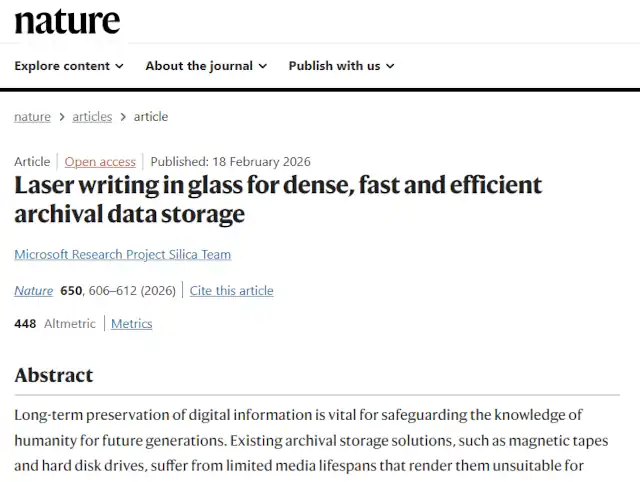
Microsoft Research has published a landmark paper in Nature describing major advances in its Project Silica program — a long-running effort to encode digital data permanently inside glass using ultrafast lasers.
The results mark a significant step toward making glass-based archival storage commercially viable, though the path to a finished product remains uncertain.
The Big Idea: Writing Data Into Glass
At the heart of Project Silica is a deceptively simple concept: use femtosecond laser pulses — each lasting just a few quadrillionths of a second — to create microscopic structural deformations inside a transparent glass plate. These deformations, called voxels (three-dimensional equivalents of pixels), change how light travels through the glass and can be read back with an optical microscope. Because the changes are embedded deep inside the material itself, not on a surface coating that can peel or oxidize, the data is extraordinarily durable.
Accelerated aging tests indicate that voxels written this way would survive for at least 10,000 years at typical storage conditions — and potentially far longer at room temperature. At extreme heat (290°C), the researchers found data would still outlast 10,000 years, though the longevity advantage is greatest at ambient temperatures. For context, magnetic tapes and hard drives can degrade within decades.
Two Types of Glass, Two Types of Voxels
A key distinction in the paper — one that has caused some confusion in early reporting — is that the researchers demonstrated two separate systems with different glass materials, each with its own performance profile.
System 1: Fused Silica with Birefringent Voxels (High Density)
The older, higher-performing system uses high-purity fused silica glass and encodes data as birefringent voxels, which alter the polarization of light passing through the glass. In the new paper, the team refined this technique to a “pseudo-single-pulse” regime, splitting each laser pulse in two — one pulse to begin forming a voxel and another to complete it — reducing the pulses required to just two per voxel. This improvement enabled tighter spacing and higher throughput.
This system achieved the headline-grabbing benchmark: 4.84 TB of data stored in a single 120mm × 120mm × 2mm glass plate, spread across 301 layers, at a density of 1.59 Gbit/mm³. Single-beam write speed is 25.6 Mbit/s. However, fused silica is expensive and difficult to manufacture, limiting its commercial appeal.
System 2: Borosilicate Glass with Phase Voxels (The Commercial Breakthrough)
The more commercially significant advance is the demonstration that data can be stored in ordinary borosilicate glass — the same material used in Pyrex cookware and oven doors — using a newly invented encoding method called phase voxels. Rather than altering polarization, phase voxels modify the local refractive index of the glass, requiring only a single laser pulse per voxel. This simpler physical mechanism works in cheaper, widely available glass, directly addressing the cost and supply-chain barriers that previously blocked commercialization.
The borosilicate demonstration achieved 2.02 TB per plate across 258 layers at a density of 0.678 Gbit/mm³ — roughly half the density of fused silica, but with significantly lower material cost and simpler hardware. With four laser beams writing in parallel, the system reached a combined write throughput of 65.9 Mbit/s. The team’s thermal models suggest scaling to 16 or more beams is feasible, which would push throughput to around 263 Mbit/s — still slower than modern LTO tape drives (400 MB/s uncompressed), but a meaningful step forward.
Simpler Reading, Smarter Decoding
Earlier Project Silica systems required three or four cameras to read data back from the glass. The new design uses a single-camera microscope that captures images layer by layer by detecting differences in refractive index — a significant reduction in size, cost, and complexity. The images are then processed by a convolutional neural network, and low-density parity-check (LDPC) error correction ensures complete data recovery even when the optical signal is noisy or the voxels are tightly packed. The researchers demonstrated full end-to-end data recovery — from writing to reading — for the first time in the system’s history.
The Write Speed Problem
Write speed remains the most significant practical obstacle. Filling a single fused silica plate with 4.84 TB at current throughputs would take over 150 hours. Even the faster borosilicate system, at 65.9 Mbit/s with four beams, would need roughly 70 hours for a 2 TB plate. This makes Project Silica unsuitable for workloads that require frequent writes. It is better suited to a write-once, read-rarely archive model — cold storage for data that must be preserved reliably for decades or centuries, such as government records, scientific datasets, cultural heritage archives, or long-term enterprise compliance data.
The research team acknowledges this limitation and notes that scaling to more parallel beams is the primary path to closing the gap with tape.
What It Means for the Storage Industry
Archivists and data center operators face a persistent challenge: no storage medium currently in use is rated to last more than a few decades without degradation or active migration. Magnetic tape, still the dominant cold storage technology, must typically be copied to fresh media every 5–15 years. Glass, by contrast, requires no power to maintain the data, no climate-controlled environment beyond basic protection from physical breakage, and no periodic migration. Once written, the data simply stays.
“You can write the data into the glass, and then once it’s done, then it’s done — there’s no ongoing cost,” Richard Black, the Microsoft Research computer scientist who led the project, told Gizmodo. “This will change the way we think about keeping data and archival preservation.”
Industry analysts caution, however, that glass storage faces a steep climb to commercial relevance. “It is more likely to emerge as a specialized ultra-long retention tier rather than a replacement for tape-based cold storage,” said Divya Gogia of Gartner. Any new medium must compete on economics, hardware, software, and operational model — not just media longevity.
Microsoft’s Uncertain Next Step
Perhaps the most significant detail buried in the announcement is what Microsoft said — and didn’t say — about commercialization. In a blog post accompanying the paper, the company stated that “the research phase is now complete,” and that it is “continuing to consider learnings from Project Silica as we explore the ongoing need for long-term preservation of digital information.” A Microsoft spokesperson added that the company “is exploring options for how to apply the research learnings.”
That language is notably noncommittal. There is no product roadmap, no announced partnerships with glass manufacturers, and no timeline for when — or whether — Project Silica technology would reach a data center. Microsoft holds the intellectual property and is assessing its options, but the jump from a laboratory demonstration to a commercially viable product involves engineering, economics, and market strategy that the research paper does not address.
Summary: What the Paper Actually Shows
| Parameter | Fused Silica (Birefringent) | Borosilicate (Phase Voxel) |
|---|---|---|
| Plate Size | 120 × 120 × 2 mm | 120 × 120 × 2 mm |
| Capacity | 4.84 TB | 2.02 TB |
| Layers | 301 | 258 |
| Density | 1.59 Gbit/mm³ | 0.678 Gbit/mm³ |
| Pulses per Voxel | 2 | 1 |
| Single-Beam Throughput | 25.6 Mbit/s | 18.4 Mbit/s |
| Multi-Beam Throughput (4 beams) | — | 65.9 Mbit/s |
| Longevity | 10,000+ years | 10,000+ years |
| Material Cost | High | Low |
| Commercial Viability | Limited | More promising |
The Bottom Line
Project Silica represents genuine and impressive science. The team has demonstrated — for the first time — a complete, end-to-end glass archival storage system capable of storing terabytes of data in commercially accessible materials with a credible 10,000-year lifespan. The move from expensive fused silica to ordinary borosilicate glass is the most commercially significant advance; the invention of phase voxels is the most technically elegant.
What it is not — at least not yet — is a product. Write speeds remain far below tape, the commercialization path is undefined, and Microsoft itself has not committed to bringing it to market. For now, Project Silica is what it has always been: a proof of concept pointing toward a future where the world’s most important data never has to be copied again.
Sources: Microsoft Research blog, Nature (Vol. 639, February 18, 2026), The Register, Computerworld, Gizmodo, Blocks & Files