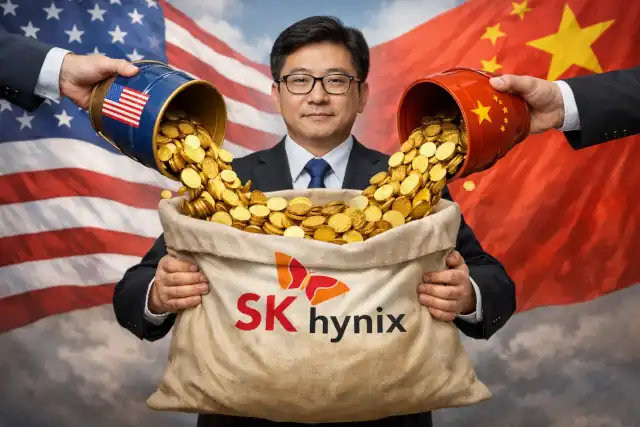
SK Hynix Shatters Every Record as AI Boom Drives 405% Profit Surge — and $477,000 Bonus Projections
SK Hynix Shatters Every Record as AI Boom Drives 405% Profit Surge — and $477,000 Bonus Projections
- 60% of MD5 Password Hashes Can Be Cracked in Under an Hour with a Single GPU
- Dirty Frag: Root Access on Every Major Linux Distribution — No Patch, No Warning
- Ubuntu 26.04 LTS (Resolute Raccoon): The Most Ambitious Ubuntu LTS in a Decade
- Proton Mail: Data Transferred to FBI Again!
- How Close Are Quantum Computers to Breaking RSA-2048?
- How to Prevent Ransomware Infection Risks?
- What is the best alternative to Microsoft Office?
SK Hynix Shatters Every Record as AI Boom Drives 405% Profit Surge — and $477,000 Bonus Projections
The South Korean chipmaker posted its strongest quarter in history, powered by insatiable AI memory demand. Employee bonuses averaging $477,000 are now projected for early 2027 — but the 2025 payout already reached a record $100,000 per worker.
Year-on-Year
Year-on-Year
Margin Q1 2026
(~$37.9B USD)
(~$27.1B USD)
Bonus per Employee
SK Hynix opened 2026 with quarterly results that rewrote its own record books across every metric. The South Korean memory giant reported Q1 2026 revenue of ₩52.58 trillion (approximately $37.9 billion), operating profit of ₩37.61 trillion ($27.1 billion), and net profit of ₩40.35 trillion — all-time highs for a single quarter. Revenue crossed the ₩50 trillion threshold for the first time in company history, during what is traditionally the weakest season for memory chip demand.
The force behind the numbers is unambiguous: artificial intelligence. As global hyperscalers race to build out AI infrastructure, the demand for advanced memory — particularly high-bandwidth memory (HBM) chips used inside AI accelerators — has overwhelmed available supply, handing SK Hynix extraordinary pricing leverage.
The first quarter is typically a slow season, but AI infrastructure investment created a need for more supply, and the pricing environment strengthened significantly.
— CFO Kim Woo-hyun, SK Hynix Q1 2026 Earnings CallA Quarter Like No Other
Operating profit surged 96% quarter-on-quarter and 405% year-on-year, reaching ₩37.6 trillion at a 72% operating margin. Net profit of ₩40.35 trillion carried a remarkable 77% net margin. The gross margin and EBITDA margin both came in at 79%, reflecting the company’s near-complete ability to convert revenue into profit at this stage of the AI supercycle.
By comparison, SK Hynix’s Q1 2026 operating profit alone nearly matched the company’s entire full-year 2025 operating profit of ₩47.2 trillion — and exceeded all of FY2024’s ₩23.5 trillion operating profit. Annualized, the Q1 run-rate implies 2026 revenues above ₩200 trillion, more than double 2025’s full-year figure.
Average selling prices told the story of just how dominant SK Hynix has become: DRAM ASP climbed by the mid-60% range quarter-on-quarter, while NAND flash ASP rose by the mid-70% range — even as NAND shipment volumes dipped 10%.
The HBM Advantage
At the center of SK Hynix’s outperformance is its leadership position in high-bandwidth memory. The company holds over 50% of the global HBM market — the specialist memory chips mounted directly alongside AI processors in products like Nvidia’s H100 and H200 GPU systems. HBM revenue more than doubled year-on-year in FY2025, and SK Hynix has stated that customer demand currently exceeds its own production capacity.
The company is now supplying samples of its next-generation HBM4E (seventh-generation) in preparation for a 2027 mass production ramp. SK Group Chairman Chey Tae-won has warned that the global chip wafer shortage is likely to persist until 2030, with demand for HBM continuing to outpace supply and a projected manufacturing capacity shortfall of over 20%.
The Bonus Story: Record Payouts Now, Historic Projections Ahead
The windfall has generated intense global attention for its implications for employee compensation — though it is important to distinguish between what has already been paid and what is projected for the future.
In February 2026, SK Hynix paid out its FY2025 profit-sharing bonus: a record 2,964% of employees’ monthly base salary — nearly double the prior year’s combined payout of 1,500%. For an employee earning ₩100 million ($68,000) annually, the payout amounted to approximately ₩148 million ($100,000). The total bonus pool for FY2025 was roughly ₩4.5 trillion. This followed a labor-management agreement reached in September 2025 that removed the previous bonus cap of 1,000% and locked in a framework of allocating 10% of annual operating profit directly to employees, with no ceiling, for the next ten years.
The projections for what comes next are far larger. With analyst consensus forecasting roughly ₩250 trillion in operating profit for SK Hynix in full-year 2026, the resulting bonus pool — 10% of that figure — would be approximately ₩25 trillion. Divided among approximately 35,000 employees, that translates to an average of around ₩700 million per person, or approximately $477,000. Some analysts at Macquarie project operating profit as high as ₩447 trillion in 2027, which would push per-employee bonuses toward $900,000.
These are projections based on forecast profits — not guaranteed payments. The actual FY2025 bonus already paid was approximately $100,000 per employee, a record in its own right.
— Editorial noteSouth Korea’s New Compensation Benchmark
The SK Hynix bonus structure has set off reverberations across South Korean corporate culture. Rival Samsung Electronics, whose semiconductor unit employs around 77,000 workers, found its labor union demanding 15% of operating profits as bonuses this year — compared to management’s proposed 10% offer matching SK Hynix’s framework. The union rejected management’s proposal and announced a general strike planned for May 21 to June 7, 2026. More than 30,000 Samsung union members staged rallies at its Pyeongtaek fab. The union noted that roughly 200 employees had left for SK Hynix in the preceding four months alone.
Even Hyundai Motor’s union has joined the trend, demanding 30% of last year’s net profit be allocated to employee bonuses, citing the new industry standard being set by chipmakers.
The scale of the payouts has also ignited a broader societal debate. Online forums in South Korea have seen arguments that SK Hynix’s profits were partly enabled by ₩20 trillion in state-backed low-interest loans, tax credits, and infrastructure support — including the “K-Chips Act” that offered up to 20% tax credits for R&D and facility investment — and that some of the windfall should be returned to the public. Critics of this view point out that the companies and their employees already contribute substantially through taxes, and that the bonus system is a legitimate contractual arrangement.
What to Watch
SK Hynix guided for Q2 2026 DRAM shipments up high single-digit percentages quarter-on-quarter and NAND up mid-teens quarter-on-quarter, with a favorable pricing environment expected to persist. The company plans to continue rolling out new products in DRAM and NAND flash to address expanding memory demand as AI evolves from large-model training into real-time agentic inference — a transition that the company says broadens demand across both memory types simultaneously.
With debt reduced to ₩19.3 trillion and cash reserves at ₩54.3 trillion, SK Hynix enters the next phase of the cycle from a position of exceptional financial strength. For the semiconductor industry, and for the engineers and technicians whose work made it possible, the AI memory supercycle is only deepening.
| Claim | Verdict | Notes |
|---|---|---|
| ~200% YoY revenue growth in Q1 2026 | ✓ Correct | +198% confirmed by official earnings release |
| 405% YoY operating profit surge | ✓ Correct | Confirmed ₩37.6T vs ₩7.4T in Q1 2025 |
| “Gross margin of 79%” | ⚠ Imprecise | 79% is the EBITDA/gross margin; operating margin was 72% |
| Memory prices up ~60%/70% QoQ | ✓ Correct | DRAM ASP mid-60%, NAND ASP mid-70% QoQ |
| 10% of operating profit allocated to bonuses | ✓ Correct | Per labor agreement, September 2025 |
| “Over 30,000 employees” benefit | ⚠ Understated | Actual workforce is ~35,000 employees |
| Bonuses “approach $500,000” as current fact | ⚠ Misleading | $477K is a 2026 profit projection; 2025 payout was ~$100K |
| 2025 FY bonus was ~$500,000 per employee | ✗ Incorrect | Actual 2025 payout was ~₩148M (~$100K) per employee |
| Report dated “May 8” cited within article dated May 7 | ✗ Impossible | Internal date inconsistency in original article |