Swedish Researchers Achieve 100% Aluminum and 98% Lithium Recycling in Batteries
Swedish Researchers Achieve 100% Aluminum and 98% Lithium Recycling in Batteries
- 60% of MD5 Password Hashes Can Be Cracked in Under an Hour with a Single GPU
- Dirty Frag: Root Access on Every Major Linux Distribution — No Patch, No Warning
- Ubuntu 26.04 LTS (Resolute Raccoon): The Most Ambitious Ubuntu LTS in a Decade
- Proton Mail: Data Transferred to FBI Again!
- How Close Are Quantum Computers to Breaking RSA-2048?
- How to Prevent Ransomware Infection Risks?
- What is the best alternative to Microsoft Office?
Swedish Researchers Achieve 100% Aluminum and 98% Lithium Recycling in Batteries
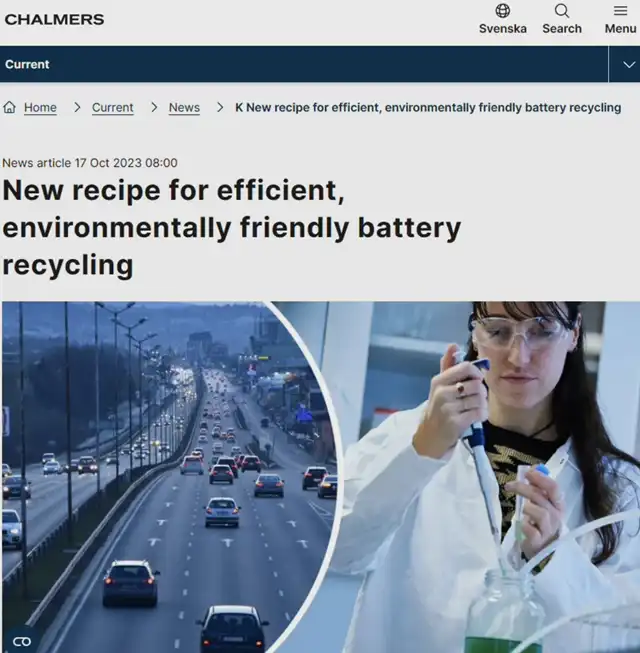
Chalmers University of Technology in Sweden has recently announced a breakthrough in recycling metals from old electric vehicle (EV) batteries.
Researchers at the university have introduced an innovative and efficient method for reclaiming metals, which can retrieve 100% of aluminum and 98% of lithium from EV batteries, while minimizing the loss of valuable materials like nickel, cobalt, and manganese.
Remarkably, this new recycling process does not require costly or harmful chemicals. Instead, the research team uses oxalic acid, an organic acid found in the plant kingdom.
Isamata Rouquette, a doctoral student in the Department of Chemistry and Chemical Engineering at Chalmers University, stated, “Until now, no one had found suitable conditions for using oxalic acid to separate this much lithium while removing all the aluminum. Since all batteries contain aluminum, we need to be able to remove it without losing other metals.”
This water-based recycling method is known as wet metallurgy. In traditional wet metallurgy, all metals from EV batteries are dissolved in inorganic acids, and impurities like aluminum and copper are then removed.
Finally, valuable metals like cobalt, nickel, manganese, and lithium are recovered individually. Although the residue of aluminum and copper is minimal, it requires several purification steps, and each step in this process could potentially lead to lithium loss.
In their recent research, the team reversed the order of operations, first recovering lithium and aluminum. This approach can significantly reduce the wastage of precious metals needed in manufacturing new batteries.
The researchers from this team remarked, “Given the vastly different properties of these metals, we believe that separating them is not as challenging as it may seem. Our method represents a promising new avenue for battery recycling, one that certainly merits further exploration.”
Martina Petranikova, an associate professor in the Department of Chemistry and Chemical Engineering at Chalmers University, stated that this method can be scaled up proportionally and is expected to be applied in industrial settings in the coming years.
It is worth noting that the research group led by Petranikova has been collaborating with local businesses to develop EV battery recycling technology and is also a partner with Volvo in this endeavor.