AMD Approaches 45% CPU Share on Steam — A Historic High for the Ryzen Era
- 60% of MD5 Password Hashes Can Be Cracked in Under an Hour with a Single GPU
- Dirty Frag: Root Access on Every Major Linux Distribution — No Patch, No Warning
- Ubuntu 26.04 LTS (Resolute Raccoon): The Most Ambitious Ubuntu LTS in a Decade
- Proton Mail: Data Transferred to FBI Again!
- How Close Are Quantum Computers to Breaking RSA-2048?
- How to Prevent Ransomware Infection Risks?
- What is the best alternative to Microsoft Office?
AMD Approaches 45% CPU Share on Steam — A Historic High for the Ryzen Era
Valve’s May 2026 Steam Hardware Survey places AMD at 44.97%, its best-ever result since the Ryzen launch in 2017, as the gap with Intel narrows to single digits for the first time on record.
Valve has published the results of its May 2026 Steam Hardware Survey, and AMD has reached a landmark moment: its CPU share among Steam users has climbed to 44.97%, the highest figure ever recorded on the platform since the Ryzen processor line debuted in 2017. The result represents a 0.79 percentage point gain over April’s figure of 44.18%, while Intel saw an equal and opposite decline, dropping to 55.02%.
The gap between the two companies has now narrowed to less than 10 percentage points — the smallest margin in the history of Steam’s CPU tracking data. As recently as January 2026, AMD held 43.34% against Intel’s 56.64%, meaning AMD has gained roughly 1.6 points in just five months.
“Steam Hardware Survey May: @AMD 45%”
— Saša Marinković, AMD Senior Director of Marketing, posted on X, June 6, 2026
AMD’s Senior Director of Marketing, Saša Marinković, wasted no time in celebrating the milestone, sharing the figure on the social platform X shortly after the survey was published. While the number is technically 44.97% — just shy of a clean 45% — it rounds up convincingly and marks a symbolic threshold that AMD and its community have been tracking closely.
The X3D Effect: Gaming Performance Driving Adoption
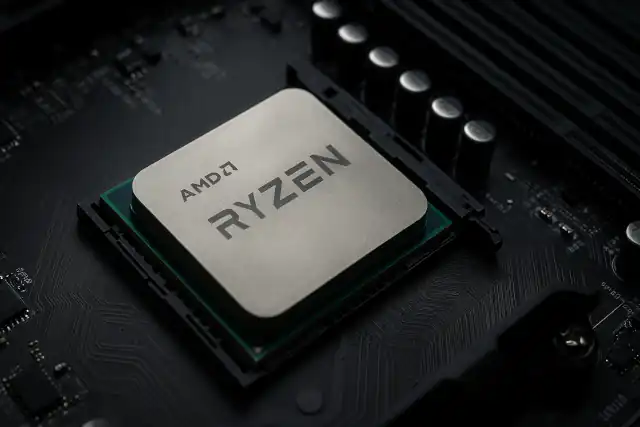
Much of AMD’s momentum can be traced to its Ryzen X3D lineup, which combines conventional Zen architecture with 3D V-Cache — a vertically stacked layer of additional L3 cache that dramatically improves gaming performance by reducing latency and keeping more game data closer to the processor cores. The strategy has resonated powerfully with PC builders who prioritize frame rates above all else.
Crucially, AMD has not limited the X3D approach to a single flagship product. The company currently sells the Ryzen 7 9800X3D on its latest Zen 5 platform, the Ryzen 7 7700X3D on the Zen 4 AM5 platform, and has even relaunched the Ryzen 7 5800X3D for the older AM4 platform — giving budget-conscious builders access to X3D gaming advantages without requiring a full platform upgrade.
According to retail data from major global e-commerce platforms, the top 10 best-selling CPUs are almost entirely AMD products. Not a single Intel processor currently breaks into the top tier of CPU sales charts — including Intel’s Core Ultra 200 Plus series, launched in March 2026, which has so far failed to meaningfully arrest AMD’s market share gains.
Intel’s Path Forward: Nova Lake on the Horizon
Intel continues to hold a substantial majority of the Steam CPU install base, with 55.02% — a lead that cannot be dismissed, even as the trend line moves steadily against it. The company is preparing to launch its Nova Lake architecture processors in the second half of 2026, and analysts widely agree that gaming performance will be the defining test for the new platform.
If Nova Lake can deliver meaningful gains in gaming workloads — the segment where AMD’s X3D chips have dominated — it could stabilize or reverse Intel’s decline on Steam. However, AMD’s compounding advantage means the bar is high: Intel must not only match AMD’s current performance, but deliver a compelling enough leap to shift purchasing patterns that have been moving decisively in one direction.
A Note on Methodology
It is worth noting that Steam’s hardware survey reflects the active user base of the platform, not global CPU shipment data or broader market share figures. The survey captures installed PCs that boot Steam, which skews toward gaming-focused machines and does not represent enterprise, laptop, or workstation markets. AMD’s position in those segments differs. Nevertheless, for the gaming PC market specifically, the Steam survey is among the most reliable and widely watched public datasets available.
Whether AMD can cross the 50% threshold before the end of 2026 remains an open question. The pace of growth — roughly 0.79 points per month — is consistent but not explosive, and Intel’s install base is large and sticky. What is clear is that the competitive landscape of the gaming CPU market has fundamentally shifted, and AMD’s X3D strategy has proven to be one of the most effective product plays in the semiconductor industry in recent years.