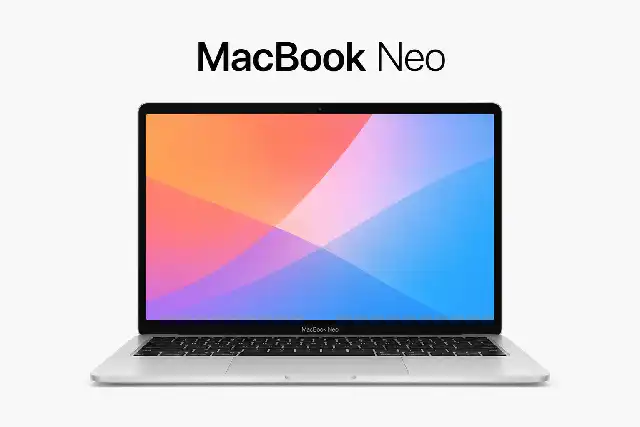
AMD Calls Out the MacBook Neo—Gaming Is the Battleground
- Linux Kernel Drops 40-Year-Old AppleTalk Protocol — AI-Generated Patch Flood Was the Last Straw
- Apple’s Native Linux Container Tool Has Arrived — But Can It Really Replace Docker?
- 60% of MD5 Password Hashes Can Be Cracked in Under an Hour with a Single GPU
- Dirty Frag: Root Access on Every Major Linux Distribution — No Patch, No Warning
- How Close Are Quantum Computers to Breaking RSA-2048?
- What is the best alternative to Microsoft Office?
AMD Calls Out the MacBook Neo—Gaming Is the Battleground
In a rare direct-attack marketing campaign, AMD is using Apple’s budget breakout laptop to argue that Windows still wins where it counts: gaming and software freedom.
Apple’s MacBook Neo has been one of the surprise hits of 2026. Priced at just $599 and powered by the same A18 Pro chip found in the iPhone 16 Pro, it sold over 1.1 million units within its first month on sale—outselling both the MacBook Air and Pro in its opening weeks. The success was striking enough to push Apple to reportedly double its production targets. Now AMD has decided it has seen enough.
In a campaign posted on AMD’s official website under the banner “Unleash Your Potential with AMD Ryzen AI Processors,” the chipmaker takes direct aim at the MacBook Neo. The opening line sets the tone clearly:
“Everything MacBook Neo leaves out, built in with AMD Ryzen AI processors.” — AMD official website, May 2026
The campaign is unusually blunt for the chip industry, and it has lit up discussion across tech media and social platforms. But beneath the bold marketing language lies a more complicated argument—one where AMD scores some real points while also leaving itself open to legitimate criticism.
The Gaming Argument
AMD’s sharpest claim centers on gaming compatibility. The company tested 20 of the most popular PC games currently charting on Steam and Epic and found that only five of those titles run natively on the MacBook Neo. The remaining 15 cannot be played without workarounds—compatibility layers, cloud streaming, or other indirect methods—none of which AMD considers equivalent to true native support.
By contrast, AMD says a Windows laptop powered by a Ryzen processor can run all 20 titles natively, with access to Steam, Epic Games Store, and PC Game Pass. The company emphasizes this advantage in bold: “No workarounds required.”
That is a factually grounded point. macOS has long been a secondary platform for game developers, and most major PC releases prioritize Windows first. Multiplayer titles, new AAA releases, and Game Pass exclusives remain largely inaccessible on Apple hardware without third-party tools.
The Spec Comparison
AMD paired its gaming argument with a direct hardware comparison, pitting the HP OmniBook X Flip—running a Ryzen 5 220 processor with integrated Radeon 740M graphics—against the MacBook Neo’s A18 Pro chip. The results, according to AMD’s internal testing, favor the Windows machine on several fronts.
HP OmniBook X Flip vs. Apple MacBook Neo — AMD’s Claims
| Category | HP OmniBook X Flip (Ryzen 5 220) | MacBook Neo (A18 Pro) |
|---|---|---|
| Starting Price | ~$609 | $599 |
| Storage | 512 GB SSD | 256 GB SSD |
| RAM | 8 GB | 8 GB |
| Ports | 2× USB-A, 2× USB-C, HDMI, 3.5mm | 2× USB-C, 3.5mm |
| Touchscreen | Yes (convertible) | No |
| Multitasking Performance | Up to 57% faster (AMD claim) | Baseline |
| Content Creation Performance | Up to 38% faster (AMD claim) | Baseline |
| Top 20 PC Games (native) | 20 / 20 | 5 / 20 |
On paper, AMD’s numbers look decisive. More storage, more ports, a touchscreen, and a convertible form factor—all for roughly the same price. The multitasking and content creation claims are based on AMD’s own benchmark suite, which tested the Ryzen 5 220 at 45W across tools including Blender, Handbrake, Cinebench, and a simulated multitasking scenario involving a 10-person Microsoft Teams call.
Where AMD’s Argument Gets Complicated
Critics have been quick to flag the weakest part of AMD’s campaign: the gaming performance of the Radeon 740M GPU that powers the Ryzen 5 220. The 740M is a modest integrated graphics solution—roughly a third the capability of the Ryzen Z1 Extreme chip used in the Asus ROG Ally X handheld. While it can technically launch all 20 games, third-party benchmarks from outlets including NotebookCheck paint a less flattering picture.
Titles such as Assassin’s Creed Shadows, Cyberpunk 2077, DOOM: The Dark Ages, and Battlefield 6 struggle to reach 30 frames per second at 1080p on minimum settings on the 740M—framerates that most PC gamers would consider unplayable. AMD’s claim of “high frame rates” and “advanced graphics” appears to apply mainly to older, lighter titles such as CS2, where the GPU can manage around 70 fps on low settings at 1080p.
The broader counterargument is also straightforward: nobody buys a $599 MacBook Neo to play PC games. Apple’s machine targets students, young professionals, and light productivity users who care about macOS, battery life, system reliability, and Apple’s cross-device ecosystem. Gaming compatibility simply was not a design priority, and using it as a benchmark is a category mismatch.
It is also worth noting that AMD’s comparison deliberately focuses on software access rather than raw chip performance—the Ryzen 5 220 is a Zen 4-based Hawk Point part, a product line now more than a year old, and it does not include AMD’s newer neural processing unit (NPU) for on-device AI acceleration. Comparing it to Apple’s A18 Pro, which has proven exceptionally efficient, on a chip-versus-chip basis would likely produce a different set of results.
What AMD Is Really Selling
Read carefully, AMD’s campaign is less a hardware argument than a platform argument. The core message is that Windows laptops offer more: more games, more software, more ports, more storage, and a wider range of form factors—all without asking buyers to commit to Apple’s ecosystem. The “Unleash Your Potential” branding reflects a broader AMD initiative aimed at positioning Ryzen AI laptops as the versatile choice for users who do not want to make trade-offs between work, creativity, and entertainment.
For buyers who already live in the Windows or PC gaming ecosystem, that message will resonate. For the audience that the MacBook Neo actually targets—people who want a no-fuss, affordable entry into macOS—AMD’s gaming metrics are unlikely to move the needle. The MacBook Neo’s sales figures suggest its buyers have already made their peace with the trade-offs.
The campaign has drawn attention nonetheless, partly because public direct comparisons of this kind remain uncommon in the PC industry, and partly because the MacBook Neo’s success has been pronounced enough to make a response feel overdue. Whether or not AMD’s numbers persuade anyone, the message is clear: the budget laptop war has a new front.