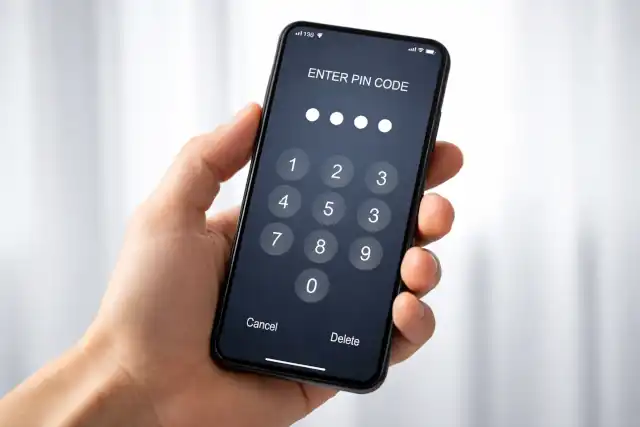
Is a PIN More Secure Than Biometrics for Unlocking Smartphones?
Is a PIN More Secure Than Biometrics for Unlocking Smartphones?
- Linux Kernel Removes strncpy After Six Years and 362 Patches
- Linux Kernel Drops 40-Year-Old AppleTalk Protocol — AI-Generated Patch Flood Was the Last Straw
- Apple’s Native Linux Container Tool Has Arrived — But Can It Really Replace Docker?
- 60% of MD5 Password Hashes Can Be Cracked in Under an Hour with a Single GPU
- Dirty Frag: Root Access on Every Major Linux Distribution — No Patch, No Warning
Cybersecurity & Digital Privacy
Is Unlocking a Smartphone with a PIN More Secure Than Biometric Authentication?
The question is not as simple as it sounds. The answer depends on who is trying to get into your phone — and why.
Every time you press your thumb to a sensor or glance at your front camera to unlock a phone, you are making a security trade-off. Biometric authentication is fast, frictionless, and, by most technical measures, difficult to spoof. A PIN is slower, forgettable, and vulnerable to basic human observation. Yet in certain scenarios — particularly those involving law enforcement access or physical coercion — the humble PIN may offer protections that no fingerprint or face scan can match.
The debate has intensified in recent months as U.S. federal courts began issuing conflicting rulings on whether police can force suspects to unlock their phones using biometrics. The question is no longer purely academic: it touches on constitutional rights, personal safety, and the daily choices millions of people make about how to secure their most personal device.
What the Technical Evidence Says
From a purely technical standpoint, modern biometric systems have a strong argument. Apple’s Face ID claims a false acceptance rate — the probability of the system unlocking for the wrong person — of roughly one in a million. Advanced fingerprint scanners, especially ultrasonic sensors, have achieved similarly low error rates. A standard four-digit PIN, by contrast, offers only 10,000 possible combinations, and as security researchers have long documented, most people do not choose those combinations randomly.
“Even though a random 4-digit PIN has 10,000 possible solutions, people don’t select random 4-digit PINs.” — Mark Rasch, cybersecurity attorney, Security Boulevard, March 2025
Common PIN choices — sequential numbers, birth dates, repeated digits — dramatically shrink the real-world entropy of PIN protection. The same pattern applies to longer passwords, which users frequently reuse across accounts or base on easily guessable personal details.
Biometrics sidestep these human tendencies entirely. Your face and fingerprints cannot be reused across accounts, cannot be guessed from public records, and cannot be stolen through phishing. The Identity Management Institute has stated that biometric authentication is generally more resistant to guessing and credential reuse than passwords or PINs.
Where PINs Have the Edge: Coercion and Legal Rights
The technical picture changes substantially when the threat model shifts from remote hackers to physical actors — whether that is a thief, an abusive partner, or law enforcement.
Physical Coercion
Biometrics require only that your body be present. Someone can unlock a phone with your fingerprint while you are asleep, under duress, or incapacitated. Facial recognition can be defeated by simply holding the phone toward your face. A PIN, by contrast, exists only in your memory — it cannot be extracted without your conscious cooperation.
PIN Advantages
- Cannot be extracted during sleep or incapacity
- Exists only in the holder’s memory
- Protected by Fifth Amendment (in many jurisdictions)
- Immune to spoofing via photos or 3D models
- Can be changed if compromised
PIN Disadvantages
- Vulnerable to shoulder surfing
- People choose weak, predictable codes
- Frequently reused across devices/accounts
- Can be forgotten
- Slower to enter than biometrics
The Legal Battlefield
Perhaps the most consequential difference between PINs and biometrics in 2025 is not technical — it is constitutional. U.S. courts have been wrestling with a fundamental question: can law enforcement compel a person to unlock their phone, and does the method of unlocking change the answer?
The Fifth Amendment to the U.S. Constitution protects individuals from being compelled to be witnesses against themselves. Courts have generally treated memorized information — passwords, PINs — as falling within this protection, because revealing them requires “disclosing the contents of one’s mind.” Biometrics, however, occupy much murkier legal territory.
April 2024
U.S. v. Payne — The Ninth Circuit ruled that compelling a suspect to provide a fingerprint to unlock a phone did not violate the Fifth Amendment, classifying the act as a physical rather than testimonial act.
January 2025
U.S. v. Brown — The D.C. Circuit reached the opposite conclusion, ruling that compelling a defendant to unlock his phone with a thumbprint violated his Fifth Amendment right against self-incrimination, finding the act disclosed ownership and control over the device.
January 2025
State v. Harris — The Kansas Supreme Court addressed whether law enforcement coerced a suspect into revealing a phone password, touching on the unsettled nature of compelled disclosure across jurisdictions.
2025–Present
The circuit split between the Ninth and D.C. Circuits has created significant legal uncertainty. Legal analysts and the Center for Democracy & Technology have flagged this split as likely grounds for eventual Supreme Court review — a decision that could set a national standard.
The practical upshot, for now, is that a strong PIN offers clearer legal protection than biometrics in most U.S. jurisdictions. Law enforcement can often use your face or fingerprint — physically or with a court order — in ways they cannot easily compel for a memorized code.
Biometrics Are Not Going Away — Nor Should They
It is important not to overstate the PIN’s advantages. For the vast majority of everyday threat scenarios — a phone stolen from a bag, a hacker attempting a remote attack, a stranger finding a lost device — biometrics represent a strong and practical defense. The low false acceptance rates of modern sensors, combined with the impossibility of guessing a biometric trait, make them genuinely difficult to defeat at scale.
Security experts increasingly recommend treating PIN and biometric authentication not as rivals but as complements. A robust PIN should serve as the foundation — the fallback, the legal backstop, the last line — while biometrics provide convenient day-to-day access on top of it.
📌 Best Practice: Use Both Together
Set a strong, unique PIN (six digits or more, avoiding obvious sequences or birth dates). Enable biometric unlock for daily convenience. For sensitive situations — protests, border crossings, encounters with law enforcement — use your platform’s “lockdown” mode to temporarily disable biometrics and require your PIN.
On Android (Pixel): Hold the Power button and select “Lockdown” from the Power menu. This disables fingerprint, face unlock, Smart Lock, and hides lock screen notifications until you re-enter your PIN.
On iPhone: Rapidly press and release the side button and a volume button, then drag the Emergency SOS slider — or simply press and hold the side button and a volume button until the power-off screen appears. This disables Face ID and requires your passcode.
The Biometric Data Problem
There is a dimension to this debate that goes beyond the moment of unlocking: what happens to the biometric data itself. Unlike a PIN, biometric traits cannot be changed. If your fingerprint data is exposed in a breach, you cannot issue yourself new fingerprints. This permanence creates a long-tail risk that does not apply to passwords or PINs, which can be rotated.
For this reason, security professionals advise that biometric data should be stored locally on the device and processed on-device — not transmitted to or held by cloud servers. Both Apple and Google enforce this for their flagship biometric features, but the same caution may not apply to third-party apps that request biometric access.
The Verdict: It Depends on Your Threat Model
The question posed in this article’s title does not have a single correct answer. In the context of protecting yourself from physical coercion or asserting your constitutional rights, a strong PIN is clearly the more powerful tool. In the context of resisting a brute-force guessing attack or credential theft, biometrics have the edge — provided the underlying sensor technology is robust.
What is clear is that weak PINs — the 1234s and birthday years of the world — offer worse protection than any biometric. The comparison only favors the PIN when that PIN is genuinely strong and private. Most users would be well-served by thinking of their PIN as a secret worth protecting, and biometrics as a convenience layer that sits on top of it — not a replacement for it.
As courts in the United States continue to grapple with the constitutional questions raised by biometric unlocking, and as the Supreme Court is expected to eventually weigh in, the legal calculus may shift. Until then, knowing how to quickly switch your phone into PIN-only mode may be one of the most underrated privacy skills available to ordinary users.