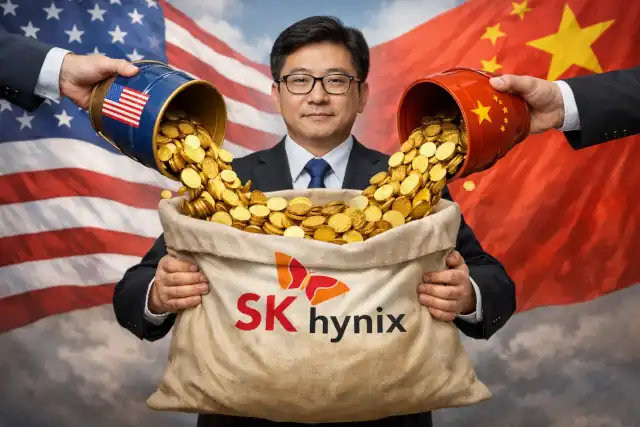
SK Hynix Posts Record-Breaking Results as AI Drives Global Memory Boom
SK Hynix Posts Record-Breaking Results as AI Drives Global Memory Boom
- 60% of MD5 Password Hashes Can Be Cracked in Under an Hour with a Single GPU
- Dirty Frag: Root Access on Every Major Linux Distribution — No Patch, No Warning
- Ubuntu 26.04 LTS (Resolute Raccoon): The Most Ambitious Ubuntu LTS in a Decade
- Proton Mail: Data Transferred to FBI Again!
- How Close Are Quantum Computers to Breaking RSA-2048?
- How to Prevent Ransomware Infection Risks?
- What is the best alternative to Microsoft Office?
SK Hynix Posts Record-Breaking Results as AI Drives Global Memory Boom
February 22, 2026
South Korea’s SK Hynix has capped one of the most remarkable financial turnarounds in semiconductor history, posting all-time high annual revenue and profit for 2025 — and the company’s leadership is already bracing for what could be an even bigger — or more perilous — year ahead.
Record 2025 Results Fueled by AI Demand
SK Hynix reported full-year 2025 revenue of 97.15 trillion won (approximately $67.9 billion USD), up 47% year-on-year, alongside operating profit of 47.21 trillion won (approximately $33 billion USD) — more than double the previous year’s figure, with an operating margin of 49%.
Net profit came in at 42.95 trillion won, up 117% from 2024 — a figure that itself exceeds the company’s entire revenue for the year 2023.
The company’s fourth quarter alone was historic: Q4 2025 revenue reached 32.83 trillion won, up 34% quarter-on-quarter and 66% year-on-year, while operating profit surged 68% quarter-on-quarter to 19.17 trillion won, with a staggering 58% operating margin.
The primary driver was High Bandwidth Memory (HBM) — the specialized chips used in AI accelerators such as NVIDIA’s GPUs. HBM revenue more than doubled year-on-year, with SK Hynix emerging as the dominant supplier in a market where demand has consistently outpaced supply. The company also achieved record annual revenue in its NAND flash business, boosted by enterprise SSD sales in the second half of the year.
The Memory Market Has Shifted to a Seller’s Market
Speaking at a Goldman Sachs investor conference earlier this month, SK Hynix delivered an unusually blunt market assessment: “The global memory industry has completely shifted to a seller’s market, with price increases expected throughout 2026.”
The company disclosed that current DRAM and NAND inventory across the industry stands at only around four weeks’ worth, with no single customer able to fully satisfy its demand. HBM capacity for 2026 has already been sold out ahead of schedule. The company stated plainly: “We cannot meet the needs of all customers this year, and continued price increases are a foregone conclusion.”
SK Hynix attributes this to two structural forces: explosive growth in AI infrastructure demand that has far exceeded industry expectations, and the slow pace of cleanroom expansion — the specialized manufacturing space memory production requires — which is physically limiting how quickly output can be increased.
This supply tightness is not limited to HBM. The concentration of production lines on high-margin AI memory products has created knock-on shortages in standard DRAM used in consumer electronics, raising the prospect of higher prices for smartphones, laptops, and other devices.
Chairman Warns: The Same Forces That Created $33 Billion in Profit Could Produce Equivalent Losses
Despite the record results, SK Group Chairman Chey Tae-won offered a sobering counterpoint at a recent public appearance, urging observers not to focus exclusively on the headline numbers.
While 2026 profit forecasts are widely expected to exceed last year’s — UBS, for instance, projected SK Hynix’s 2026 operating profit at 61 trillion won, 25% above consensus estimates at the time — Chey cautioned that the AI-driven demand surge carries enormous two-sided risk.
He pointed to the staggering scale of infrastructure investment required to sustain AI growth: building a single AI data center in the United States requires investment of up to $50 billion, and the computing power now being demanded — on the order of 100 gigawatts — implies total capital expenditure potentially reaching $5 trillion, before energy costs are even factored in.
Chey noted that energy, environmental, and financial constraints make it genuinely uncertain whether the industry can deliver on these targets. If AI infrastructure investment slows or demand disappoints, the same memory capacity that is generating record profits today could become a massive liability. “Failure to meet targets,” he warned, “could result in losses of equivalent scale.”
This helps explain why SK Hynix and its rivals — Samsung and Micron — have been disciplined about not aggressively expanding production capacity despite surging prices. The downside scenario is considered real enough to justify restraint.
What Comes Next: SK Hynix’s 2026 Outlook
Looking ahead, SK Hynix expects demand growth for DRAM and NAND in 2026 to remain above 20% and in the high-teens percentage range, respectively. The company plans to increase capital expenditure considerably from last year — targeting a CapEx-to-revenue ratio in the mid-30% range — while continuing its migration to more advanced 1c nanometer DRAM process technology and expanding its 321-layer NAND production.
On the product front, SK Hynix has already begun mass production of HBM4, the next generation of high-bandwidth memory, which it says is the first in the industry to reach this stage. Full-scale HBM4 sales are planned for 2026.
The company has also announced the formation of a U.S.-based AI solutions entity, tentatively called “AI Company,” with a committed capital budget of $10 billion, aimed at delivering optimized AI systems for data center customers in partnership with American AI companies.
Industry Context
SK Hynix’s results surpassed those of domestic rival Samsung Electronics, whose provisional 2025 operating profit stood at 43.53 trillion won — making SK Hynix the highest-earning listed company in South Korea for the year. Analyst firm TrendForce projects total global memory chip industry revenue could surge to an all-time high of over $840 billion in 2027, as AI continues to reshape the demand landscape.
The broader picture is one of extraordinary momentum — but also extraordinary risk. The memory industry’s fortunes are now more closely tied to the trajectory of AI infrastructure investment than at any point in history, and that trajectory remains, as Chairman Chey acknowledged, genuinely uncertain.
Sources: SK Hynix official earnings release (January 28, 2026); CNBC; Bloomberg/Taipei Times; UBS analyst note (September 2025); Goldman Sachs investor conference remarks (February 2026); TrendForce.