Winning in the Enemy’s Own Backyard: BYD’s Unlikely Triumph in South Korea
Winning in the Enemy’s Own Backyard: BYD’s Unlikely Triumph in South Korea
- Linux Kernel Removes strncpy After Six Years and 362 Patches
- Linux Kernel Drops 40-Year-Old AppleTalk Protocol — AI-Generated Patch Flood Was the Last Straw
- Apple’s Native Linux Container Tool Has Arrived — But Can It Really Replace Docker?
- 60% of MD5 Password Hashes Can Be Cracked in Under an Hour with a Single GPU
- Dirty Frag: Root Access on Every Major Linux Distribution — No Patch, No Warning
Winning in the Enemy’s Own Backyard:
BYD’s Unlikely Triumph in South Korea
How China’s electric vehicle giant cracked one of the world’s most competitive EV markets — and what it reveals about the shifting global auto landscape.
South Korea is not an easy market to crack. Home to Hyundai and Kia — two of the world’s most formidable electric vehicle manufacturers — the country long seemed immune to foreign disruption from the EV segment. Yet in early 2026, BYD Korea made a quiet but seismic announcement: since its first passenger vehicle delivery on April 14, 2025, the Chinese automaker had crossed the 10,000-unit sales threshold in just 11 months, setting a new record for the fastest time any import brand had achieved that milestone in South Korea’s history.
The achievement surprised many industry observers. After all, this is a nation where Hyundai and Kia together once commanded over 90% of the domestic car market — and where consumer loyalty to local brands runs deep. So what, exactly, went right for BYD?
The Price Weapon
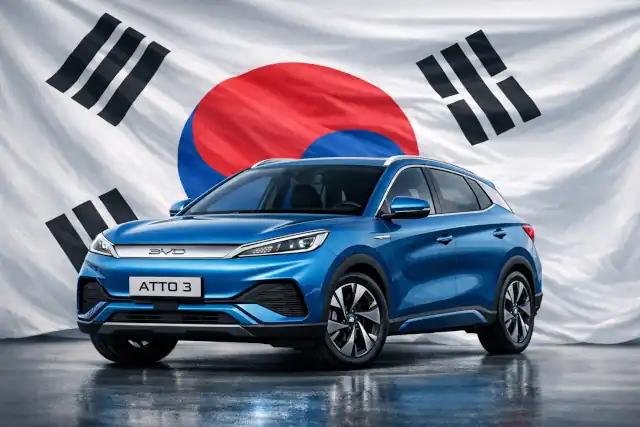
The most immediately legible explanation for BYD’s success is price. When the ATTO 3 (known in China as the Yuan Plus) debuted in South Korea in early 2025, its base price of 31.5 million Korean won — approximately USD $22,600 — undercut the comparable Hyundai Kona EV and Kia Niro EV by nearly one-third. After applying South Korea’s government EV subsidies, the final purchase price fell below 20 million won for many buyers: a figure that stunned local analysts and triggered a wave of worried commentary in the Korean media.
This wasn’t accidental discounting. BYD’s price advantage is structural. The company manufactures its own Blade Battery (a lithium iron phosphate cell), which dramatically reduces its cost base — battery packs typically account for roughly 40% of an EV’s total manufacturing cost. By controlling the entire supply chain from cell chemistry to pack assembly, BYD can offer vehicles that are, specification-for-specification, substantially cheaper than rivals who source batteries externally.
After applying South Korea’s government EV subsidies, BYD’s ATTO 3 landed at roughly 77–78% of the price of competing Korean models — for a vehicle that matched or exceeded them on most technical specifications.
| Model | Price (after subsidy, approx.) | Range (km) | Battery |
|---|---|---|---|
| BYD ATTO 3 | ~20M KRW | 321 | LFP (Blade) |
| Hyundai Kona EV | ~28M KRW | ~400 | NCM |
| Kia Niro EV | ~28–30M KRW | ~380 | NCM |
| Kia EV3 | ~30M KRW | ~400 | NCM |
Hyundai and Kia Were Looking Elsewhere
The price gap alone does not fully explain BYD’s inroads. Equally important is a strategic blind spot on the Korean incumbents’ side. Hyundai Motor Group’s ambitions in recent years have been squarely focused on export markets — particularly the United States and Canada, where the IONIQ 5 and IONIQ 6 have performed strongly, and where the company has invested billions in a new EV manufacturing plant in Georgia. The domestic market, particularly the entry-level electric segment, was not receiving the same urgency.
In short, Hyundai and Kia left a gap in their own home market: affordable EVs priced below 30 million won. BYD walked straight into it. This is a classic strategic vulnerability: companies optimising for their most profitable international markets can inadvertently neglect mid-range domestic demand, creating the exact opening that a price-aggressive competitor needs.
A Decade of Groundwork
BYD did not arrive in Korea as a stranger. The company first entered the market in 2016 — not with passenger cars, but with commercial electric vehicles: forklifts, buses, and light trucks. For nearly a decade, BYD built distribution relationships, trained service technicians, obtained regulatory certifications, and established brand awareness in the commercial sector. By the time the ATTO 3 rolled into showrooms in 2025, BYD Korea already had an operational infrastructure in place — 15 showrooms and 11 service centres across the country, from Seoul to Jeju Island.
This long runway mattered. Entering a developed automotive market without service depth is commercially suicidal; BYD avoided that trap by treating South Korea as a long-term commitment rather than an opportunistic export push.
Who Is Actually Buying?
The demographic profile of BYD’s Korean customers is telling. Fully 98% of BYD buyers in South Korea are Korean nationals — this is not a product purchased disproportionately by expatriates or Chinese residents. More strikingly, 65% of buyers are in the 40–50 age bracket: practical, value-oriented consumers who prioritise reliability and affordability over brand prestige. These are not early adopters chasing novelty; they are mainstream car buyers who ran the numbers and chose the Chinese brand on merit.
That demographic reality carries significant implications. BYD’s Korean success isn’t built on a niche of tech-curious enthusiasts — it is rooted in the mass market, which is precisely the harder and more consequential battleground.
98% of BYD’s Korean buyers are domestic consumers — and 65% are practical, value-driven buyers aged 40 to 50. This is not a niche story. It is a mass-market story.
Rapid Model Expansion Sustains Momentum
BYD did not rest on the ATTO 3’s early traction. By late 2025, it had launched the Seal (a mid-size electric sedan with a 530-hp AWD variant) and the Sealion 7 (a mid-size electric SUV), and in early 2026 added the compact Dolphin hatchback in two configurations. By March 2026, the Sealion 7 alone was selling over 800 units per month, ranking among the top ten imported vehicles in the country. BYD Korea has also announced plans to introduce plug-in hybrid DM-i models in the second half of 2026 — a segment where Korean consumer appetite has historically been strong.
This rapid cadence of new models kept BYD in the media spotlight and gave returning customers — and curious onlookers — new reasons to visit showrooms. It also systematically covered more price points and use cases, preventing consumers from dismissing the brand as a single-product curiosity.
The Bigger Picture
BYD’s South Korean success is simultaneously a local sales story and a global signal. South Korea is not merely a market; it is home to two of the world’s most technically sophisticated EV manufacturers, a world-class battery industry (LG Energy Solution, Samsung SDI, SK On), and consumers who understand electric powertrains better than almost any population on earth. Achieving record-breaking import sales in this environment carries a different weight than doing so in markets less saturated with EV knowledge.
For Hyundai and Kia, the lesson is uncomfortable but instructive: global success does not immunise a brand against domestic disruption, particularly when that disruption arrives at a price point below where incumbents choose to compete. The South Korean government has signalled awareness of the competitive threat — officials have noted the legal framework for anti-subsidy investigations exists — but no formal action has been taken.
BYD, for its part, has set an internal target of surpassing 10,000 units in South Korea in 2026 alone, representing roughly 64% growth over 2025’s full-year figure. Given the sales trajectory already visible in Q1 2026 — 3,968 cumulative units by end of March — that target looks achievable.
The backyard, it turns out, was not as well-guarded as anyone assumed.
Sources: Korea Automobile Importers & Distributors Association (KAIDA) · BYD Korea press releases · Korean Automotive Research Institute · Sina Finance · AJU Business Daily · April 2026