LibreOffice’s Parent Foundation Calls OnlyOffice “Fake Open Source” in Escalating Format War
LibreOffice’s Parent Foundation Calls OnlyOffice “Fake Open Source” in Escalating Format War
- 60% of MD5 Password Hashes Can Be Cracked in Under an Hour with a Single GPU
- Dirty Frag: Root Access on Every Major Linux Distribution — No Patch, No Warning
- Ubuntu 26.04 LTS (Resolute Raccoon): The Most Ambitious Ubuntu LTS in a Decade
- Proton Mail: Data Transferred to FBI Again!
- How Close Are Quantum Computers to Breaking RSA-2048?
- How to Prevent Ransomware Infection Risks?
- What is the best alternative to Microsoft Office?
LibreOffice’s Parent Foundation Calls OnlyOffice “Fake Open Source” in Escalating Format War
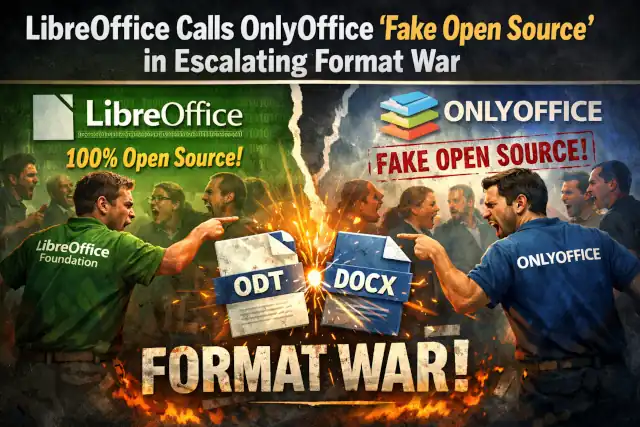
February 20, 2026 — The Document Foundation (TDF), the Berlin-based non-profit behind the LibreOffice office suite, has sharpened its criticism of rival productivity software OnlyOffice, publicly labeling it “fake open-source software” that helps entrench Microsoft’s grip on office document formats.
The charge appears in a blog post by TDF board member Italo Vignoli, published on February 16, 2026, as part of an ongoing series on the Open Document Format (ODF).
While earlier installments in the series focused squarely on Microsoft’s use of its Office Open XML (OOXML) format as a tool of vendor lock-in, this latest entry widens the target. According to Vignoli, OnlyOffice compounds the problem by defaulting to Microsoft’s proprietary DOCX, XLSX, and PPTX formats rather than championing open standards — functionally serving Microsoft’s interests even if not through any formal partnership.
The Browser Wars, Revisited
TDF draws a pointed analogy to the internet’s own format battles of the late 1990s. When Microsoft’s Internet Explorer 6 attempted to impose proprietary extensions on the HTML standard, the World Wide Web Consortium (W3C) refused to validate those changes, ultimately forcing Microsoft to build a standards-compliant browser. The open web survived.
The same principle, TDF argues, should govern office document formats — but it didn’t. The International Organization for Standardization (ISO) approved Microsoft’s OOXML as a standard in 2008, a decision TDF describes as a critical failure. Unlike the W3C’s stance on HTML, the ISO’s endorsement gave OOXML a veneer of legitimacy that, in TDF’s view, it never earned. The result, TDF says, is that users today must tolerate persistent formatting errors when opening DOCX, XLSX, or PPTX files in non-Microsoft environments.
The Risk of Handing Over Your “Keys”
Beyond compatibility frustrations, TDF raises a harder-edged concern: that relying on proprietary formats means entrusting control of your own content to a third party whose interests may not align with yours.
To illustrate the stakes, Vignoli cites a recent real-world case: Microsoft closed the email account of the Chief Prosecutor of the International Criminal Court following orders from the U.S. President. The case, which drew international attention, is used by TDF as a cautionary example of what can happen when critical communications infrastructure is owned and operated by a private company subject to political pressure.
“In the best case scenario, the content is shared,” Vignoli writes, “and in the worst case scenario, it is at risk.” TDF warns that proprietary formats are effectively “digital handcuffs” that protect what it estimates to be Microsoft’s roughly $30 billion commercial ecosystem.
OnlyOffice: Open Source by License, Not by Spirit?
OnlyOffice occupies an unusual position in this debate. The software is released under the GNU Affero General Public License v3 (AGPL-3.0) for its community edition — a recognized, legitimate open-source license — while also offering a proprietary enterprise edition. This hybrid model is not uncommon in the industry and is not itself what TDF objects to.
TDF’s criticism is more specific: that OnlyOffice markets its “high compatibility with Microsoft Office formats” as a core selling point, actively steering users toward OOXML-based workflows rather than promoting open standards. In TDF’s framing, this makes OnlyOffice a vehicle for lock-in rather than an escape from it, regardless of how its source code is licensed.
As of publication, OnlyOffice has not issued a public response to TDF’s characterization. The company is currently preparing for the release of ONLYOFFICE Docs 9.3, with a webinar scheduled for February 24.
Context: A Broader Advocacy Push
TDF’s offensive is part of a sustained campaign it has waged in recent months around document format sovereignty. The foundation has framed the issue as increasingly urgent given what it calls “the current geopolitical situation” and growing interest in digital independence from large U.S. technology companies. LibreOffice, TDF emphasizes, supports ODF natively and handles OOXML files — but defaults to ODF, which TDF says no government or corporation can weaponize against users.
The foundation’s position is clear: it wants all office software to adopt ODF as the reference format, enabling genuine competition based on features rather than format lock-in. Whether the broader ecosystem — including organizations that depend on Microsoft-compatible workflows — is ready to make that shift is another question entirely.
Sources: The Document Foundation blog (blog.documentfoundation.org); Neowin; OnlyOffice blog